
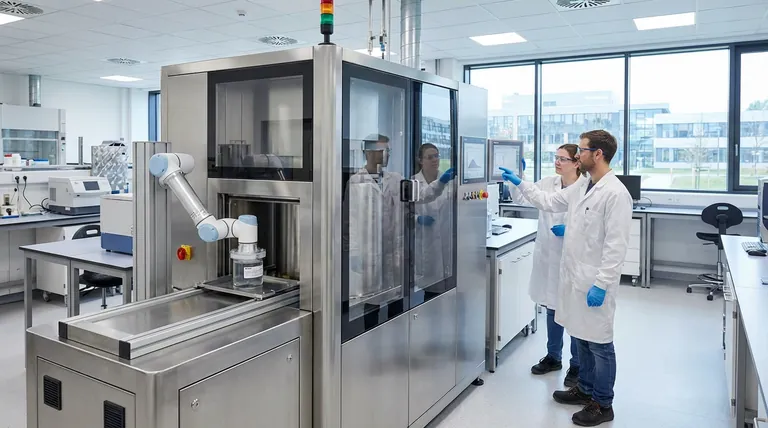
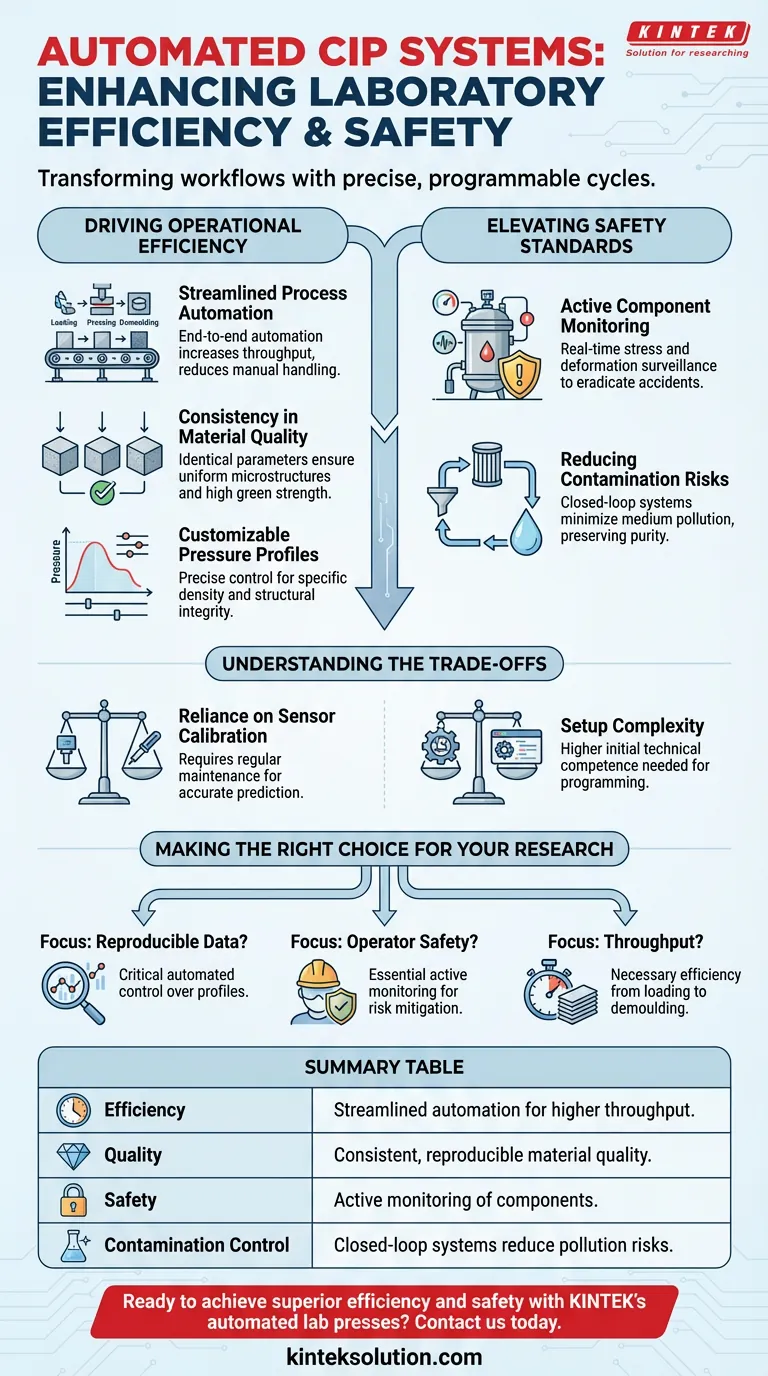
Automated Cold Isostatic Press (CIP) systems transform laboratory workflows by replacing variable manual interventions with precise, programmable cycles. They enhance efficiency through end-to-end automation—from loading to demoulding—while elevating safety standards by continuously monitoring component stress and minimizing contamination risks.
By removing human variability and automating critical high-pressure sequences, these systems deliver reproducible material quality while eliminating the physical hazards and medium pollution associated with manual operation.
Driving Operational Efficiency
Streamlined Process Automation
The primary driver of efficiency in automated CIP systems is the consolidation of the workflow. These systems handle the entire lifecycle of the pressing process, automating everything from loading to demoulding.
By removing the need for manual sample handling between stages, laboratories can significantly increase throughput. This ensures that valuable research time is spent on analysis rather than repetitive mechanical tasks.
Consistency in Material Quality
Automation does more than just speed up the process; it stabilizes the output. Automated systems ensure high efficiency and stable quality by applying identical parameters to every cycle.
This precision results in uniform microstructures and high green strength in processed materials. By eliminating human error in pressure application, researchers can trust that data variations are due to material properties, not process inconsistencies.
Customizable Pressure Profiles
Advanced CIP systems offer features such as high pressurization rates and customizable depressurization profiles.
These controls allow operators to fine-tune the environment for specific materials. This flexibility is essential for achieving the specific density and structural integrity required for high-performance laboratory testing.
Elevating Safety Standards
Active Component Monitoring
Working with high pressure introduces significant physical risks. Automated CIP systems enhance safety by actively monitoring the stress and deformation of high-pressure components during operation.
This real-time surveillance helps in eradicating potential accidents before they occur. The system can detect anomalies in the pressure vessel that a human operator might miss, triggering shutdowns before critical failure.
Reducing Contamination Risks
Manual CIP methods often involve direct handling of the pressing medium, increasing the risk of "medium pollution" (contamination of the hydraulic fluid or the sample).
Automated systems contain these fluids within closed loops. This significantly reduces the risk of medium pollution, ensuring a cleaner laboratory environment and preserving the purity of the pressing medium for longer periods.
Understanding the Trade-offs
Reliance on Sensor Calibration
While the monitoring of stress and deformation is a massive safety upgrade, it introduces a reliance on sensor accuracy.
To maintain this safety net, the laboratory must commit to regular calibration of the monitoring equipment. If sensors drift, the system's ability to predict high-pressure component failure is compromised.
Setup Complexity
The customizability of depressurization profiles and automation sequences offers great control, but it requires higher initial technical competence.
Operators must understand how to program these profiles correctly. Incorrect parameters in an automated high-rate pressurization cycle can lead to sample damage even if the machine itself remains safe.
Making the Right Choice for Your Research
To determine if an automated CIP system aligns with your laboratory's needs, assess your primary operational goals.
- If your primary focus is reproducible data: The automated control over pressurization and depressurization profiles is critical for achieving uniform microstructures.
- If your primary focus is operator safety: The active monitoring of stress and deformation in high-pressure components provides an essential layer of risk mitigation.
- If your primary focus is throughput: The end-to-end automation from loading to demoulding will provide the necessary efficiency gains.
Automated CIP systems are not just faster presses; they are stability tools that turn high-pressure processing into a predictable, safe science.
Summary Table:
| Key Aspect | How Automated CIP Systems Deliver |
|---|---|
| Efficiency | Streamlined automation from loading to demoulding for higher throughput. |
| Quality | Consistent, reproducible material quality with uniform microstructures. |
| Safety | Active monitoring of stress and deformation in high-pressure components. |
| Contamination Control | Closed-loop systems significantly reduce medium pollution risks. |
Ready to achieve superior efficiency and safety in your lab?
KINTEK's automated lab presses, including our advanced Cold Isostatic Press (CIP) systems, are designed to transform your high-pressure processing. We specialize in providing reliable, precise equipment that enhances reproducibility and protects your team.
Contact us today to discuss how our solutions can meet your specific laboratory needs and drive your research forward.
Visual Guide
Related Products
- Automatic Lab Cold Isostatic Pressing CIP Machine
- Manual Cold Isostatic Pressing CIP Machine Pellet Press
- Electric Lab Cold Isostatic Press CIP Machine
- Electric Split Lab Cold Isostatic Pressing CIP Machine
- Automatic Laboratory Hydraulic Press Lab Pellet Press Machine
People Also Ask
- What are the key features of automated laboratory Cold Isostatic Press (CIP) systems? Achieve Precise, High-Pressure Powder Consolidation
- Why is an Isostatic Press (CIP) Necessary After Uniaxial Pressing? Achieve Transparency in Nd:Y2O3 Ceramics
- How does a Cold Isostatic Press (CIP) facilitate the preparation of CaO-doped silicon carbide (SiC) green bodies?
- What is the primary function of a Cold Isostatic Press (CIP) in NASICON preparation? Achieve 96% Theoretical Density
- How does a Cold Isostatic Press (CIP) increase Bi-2223/Ag current density? Boost Superconductivity with Uniform Pressure








