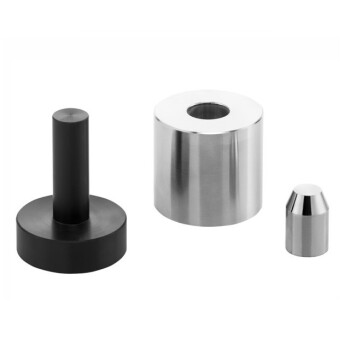
High-precision pressing equipment dictates the structural integrity and performance consistency of magnetic refrigeration wires produced via the Powder-in-Tube (PIT) technique. By strictly controlling diameter reduction and densification, this machinery ensures the magnetic powder core remains uniform within the metallic sheath, directly preventing critical failures like core breakage or uneven wall thickness.
Precision in the Powder-in-Tube (PIT) process is not merely about dimension control; it is the governing factor for thermodynamic efficiency. Without high-precision dies to ensure uniform density, the resulting wires will fail to provide the consistent heat exchange required for effective magnetic refrigeration.
The Role of Precision in Diameter Reduction
Controlling Powder Distribution
In the PIT process, magnetic refrigeration powder is packed into a metallic sheath, often made of stainless steel.
High-precision dies are required to manage the pressure applied to this composite structure. This ensures the powder distributes uniformly throughout the tube rather than clumping or shifting during compression.
Preventing Structural Defects
A major risk during diameter reduction is the physical failure of the wire components.
If the pressing equipment lacks precision, the force applied becomes uneven. This leads to core breakage inside the wire or uneven wall thickness, both of which render the wire unusable.
Impact on Thermal and Fluid Performance
Ensuring Consistent Fluid Dynamics
Magnetic refrigeration wires are frequently integrated into micro-channel heat exchangers.
The geometry of the wire must be exact to maintain predictable flow paths. High-precision manufacturing ensures the external dimensions are consistent, allowing for consistent fluid dynamics across the entire heat exchanger system.
Maximizing Heat Exchange
The ultimate goal of these wires is to transfer heat efficiently when exposed to magnetic fields.
Uniform powder density, achieved through precise multi-stage densification, results in uniform heat exchange performance. Variations in density would cause "hot spots" or inefficiencies that degrade the system's cooling power.
Understanding the Trade-offs
The Necessity of Multi-Stage Processing
High precision is rarely achieved in a single step. The process requires multi-stage diameter reduction, which increases production time and complexity compared to standard wire drawing.
Equipment Sensitivity
High-precision dies are sensitive to wear and contamination. Maintaining the tolerances required for uniform wall thickness demands rigorous maintenance schedules and higher operational costs than lower-precision alternatives.
Making the Right Choice for Your Production
To optimize the quality of your magnetic refrigeration wires, align your equipment choices with your specific performance metrics:
- If your primary focus is Thermodynamic Efficiency: Prioritize dies that guarantee internal density uniformity to ensure maximum heat exchange.
- If your primary focus is Mechanical Reliability: Focus on pressing equipment with advanced centering capabilities to prevent uneven wall thickness and core breakage.
investing in precision tooling is the only way to transform raw magnetic powder into a reliable, high-performance cooling element.
Summary Table:
| Feature | Impact on PIT Wire Quality | Performance Outcome |
|---|---|---|
| Diameter Reduction | Controls powder distribution & prevents clumping | Uniform magnetic core density |
| Precision Dies | Ensures uniform wall thickness & centering | Prevents core breakage & leaks |
| Multi-stage Pressing | Incremental densification of materials | High structural integrity |
| Geometric Accuracy | Maintains exact wire external dimensions | Consistent fluid dynamics in heat exchangers |
Elevate Your Material Research with KINTEK
Precision is the backbone of thermodynamic efficiency in magnetic refrigeration. KINTEK specializes in comprehensive laboratory pressing solutions, offering manual, automatic, heated, multifunctional, and glovebox-compatible models, alongside advanced cold and warm isostatic presses perfectly suited for battery and magnetic material research.
Don't let equipment limitations compromise your powder-in-tube (PIT) integrity. Our high-precision tooling ensures uniform density and structural perfection for your high-performance cooling elements. Contact us today to optimize your lab's pressing capabilities!
References
- Andrej Kitanovski. Energy Applications of Magnetocaloric Materials. DOI: 10.1002/aenm.201903741
This article is also based on technical information from Kintek Solution Knowledge Base .
Related Products
- XRF KBR Steel Ring Lab Powder Pellet Pressing Mold for FTIR
- XRF KBR Plastic Ring Lab Powder Pellet Pressing Mold for FTIR
- Lab XRF Boric Acid Powder Pellet Pressing Mold for Laboratory Use
- Lab Polygon Press Mold
- Lab Cylindrical Press Mold with Scale
People Also Ask
- What considerations are important regarding the die size of an XRF pellet press? Optimize for Your XRF Spectrometer and Sample
- Why are pellets used in XRF analysis, and what is their limitation? Boost Accuracy and Speed in Your Lab
- What is the general process for preparing a sample pellet for XRF? Master Consistency for Accurate Analysis
- What are the differences between manual and automatic XRF pellet presses? Choose the Right Press for Your Lab's Needs
- What are the different types of XRF pellet preparation methods available? Manual, Hydraulic, and Automated Presses Explained