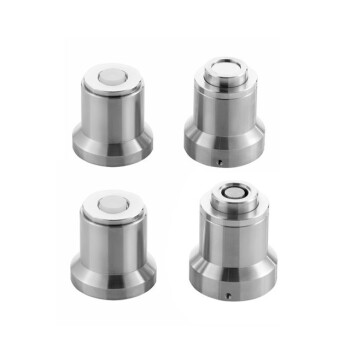
High-sensitivity load sensors ensure data quality by delivering exceptional range accuracy, typically around 0.15% Full Scale (F.S.). This precision enables the detection of minute stress fluctuations in real-time, a capability that is essential given the unique tendency of coral sand particles to break and crush during the shearing process.
Because coral sand particles are highly prone to breakage, standard sensors often miss the subtle signals associated with particle crushing. High-sensitivity sensors are required to accurately distinguish between these micro-events and the material's overall peak strength.
The Mechanics of Data Fidelity
Combating Particle Fragility
Coral sand behaves differently than standard silica sand due to the fragility of its particles. During triaxial testing, these particles frequently crush under pressure.
High-sensitivity sensors are designed to register the immediate impact of this breakage. They capture the specific mechanical response of the sand as its internal structure shifts.
Real-Time Fluctuation Monitoring
The shearing process introduces rapid, subtle changes in load. Standard sensors may smooth over these data points, presenting a deceptively linear progression.
High-sensitivity equipment captures these minute stress fluctuations in real-time. This ensures that the data log reflects the true, volatile nature of the material under stress.
Pinpointing Peak Strength
Determining the exact point of peak strength is the primary objective of triaxial testing.
With an accuracy of 0.15% F.S., these sensors identify the precise moment maximum resistance is reached. This prevents the "rounding off" of data peaks that can lead to underestimating the material's strength.
Recording Stress Drop Phenomena
When coral sand particles break, the material experiences sudden "stress drops."
These drops are often micro-events that low-sensitivity sensors treat as noise or fail to record entirely. High-sensitivity sensors validate these drops as genuine data points, providing a complete picture of the failure mechanism.
Common Pitfalls to Avoid
The Risk of Standard Sensitivity
Using standard load sensors for coral sand is a significant methodological error. Standard sensors often lack the resolution to detect the stress release caused by individual particle breakage.
Misinterpreting Data "Noise"
Without high range accuracy, genuine stress drops can be mistaken for signal noise.
This leads to over-smoothing the data curve. The result is a clean-looking graph that is factually incorrect because it ignores the granular mechanics of the coral sand.
Ensuring Accurate Triaxial Test Results
To maximize the reliability of your coral sand testing, match your sensor choice to your specific analytical goals.
- If your primary focus is determining maximum load capacity: Ensure your sensor allows for 0.15% F.S. accuracy to capture the true peak strength point without data lag.
- If your primary focus is analyzing particle crushing mechanics: Prioritize high real-time sensitivity to accurately map stress drop phenomena as particles fracture.
By utilizing high-sensitivity sensors, you transform subtle mechanical fluctuations from invisible noise into actionable, high-fidelity data.
Summary Table:
| Feature | Standard Load Sensor | High-Sensitivity Sensor (0.15% F.S.) |
|---|---|---|
| Range Accuracy | Low/Variable | High (0.15% Full Scale) |
| Micro-Event Detection | Often missed/Filtered as noise | Real-time particle crushing capture |
| Peak Strength | May 'round off' data peaks | Precise maximum resistance pinpointing |
| Stress Drop Mapping | Inaccurate/Over-smoothed | Validates genuine stress drop phenomena |
Elevate Your Research with KINTEK Laboratory Solutions
Precise data is the backbone of advanced material science. KINTEK specializes in comprehensive laboratory pressing solutions designed to meet the rigorous demands of battery research and geotechnical testing. Whether you require manual, automatic, heated, or multifunctional models, or specialized equipment like cold and warm isostatic presses, our technology ensures every micro-event is captured with absolute fidelity.
Why choose KINTEK?
- Unmatched Accuracy: Optimized for sensitive materials like coral sand and battery components.
- Versatile Range: From glovebox-compatible models to high-pressure isostatic systems.
- Expert Support: We help you match sensor sensitivity to your specific analytical goals.
Contact KINTEK today to discuss your pressing needs!
References
- Md Mahmudul Hasan, Md Nasrullah Sami. The Physical and Mechanical Properties of Coral Sand. DOI: 10.59324/ejtas.2024.2(1).27
This article is also based on technical information from Kintek Solution Knowledge Base .
Related Products
- Lab Cylindrical Press Mold for Laboratory Use
- Warm Isostatic Press for Solid State Battery Research Warm Isostatic Press
- Lab Double Plate Heating Mold for Laboratory Use
- Laboratory Hydraulic Split Electric Lab Pellet Press
- Manual Laboratory Hydraulic Press Lab Pellet Press
People Also Ask
- What is the purpose of incorporating cartridge heaters into a lab press mold for MLCC block compression? Optimize Results
- Why is precise cooling management of the lab press mold necessary? Protect Core Integrity in Thermoforming
- What is the function of a pressing tool in thermoplastic panels? Master Precision Shaping & Fusion Bonding
- Why is a high-performance laboratory molding press critical for in-situ electrolyte formation? Unlock Battery Success
- How does the geometry of laboratory molds influence mycelium-based composites? Optimize Density and Strength