
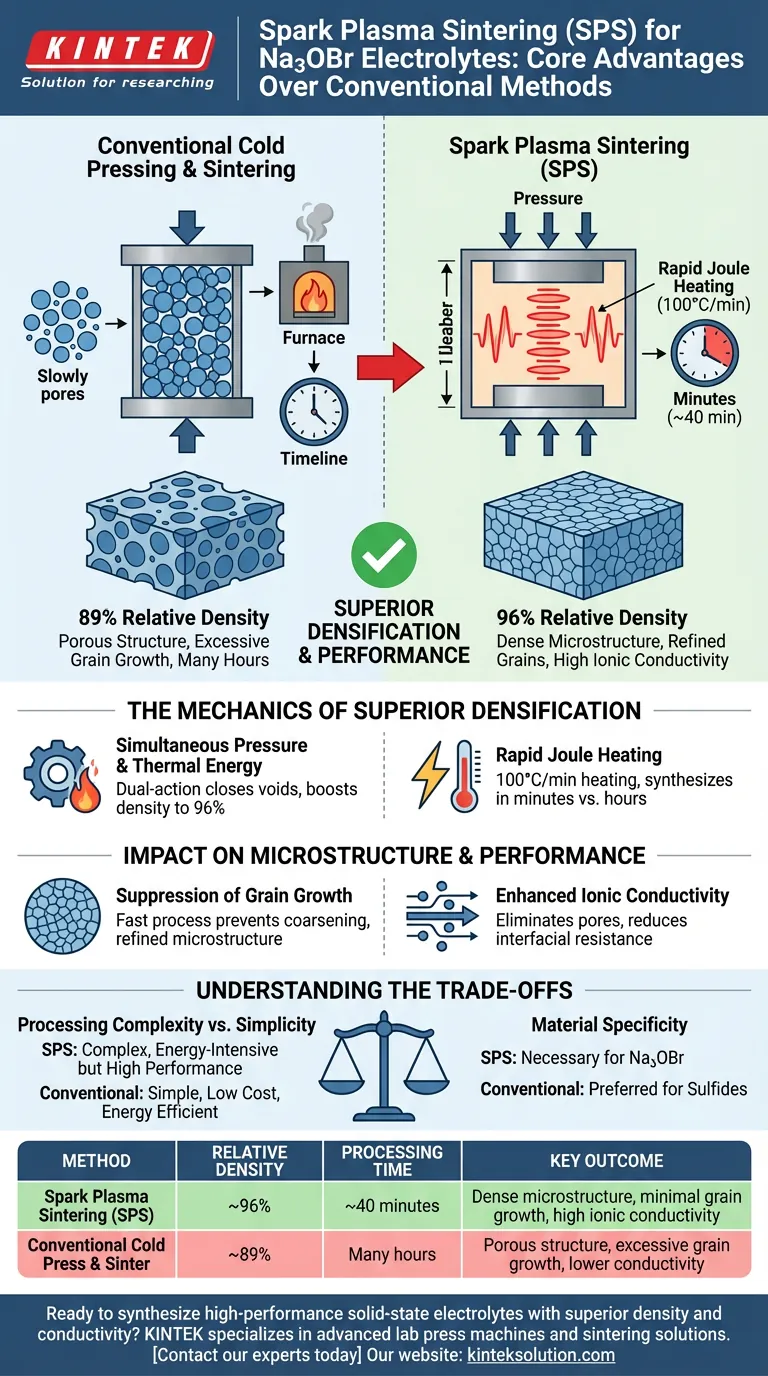
The primary advantage of Spark Plasma Sintering (SPS) for Na3OBr electrolytes is the ability to achieve superior relative density through rapid, simultaneous application of heat and pressure. While conventional cold pressing and sintering typically cap at approximately 89% density, SPS drives this figure up to 96%. This physical densification is the critical factor in minimizing interfacial resistance and maximizing the material's total ionic conductivity.
Core Takeaway: Conventional sintering methods often result in porous structures and excessive grain growth due to long processing times. SPS solves this by utilizing rapid heating rates (up to 100°C/min) and direct pressure to synthesize dense, mechanically robust electrolytes with optimized microstructures in minutes rather than hours.
The Mechanics of Superior Densification
Simultaneous Pressure and Thermal Energy
Unlike traditional methods that separate the pressing and heating stages, SPS applies mechanical pressure and heat at the same time. This dual-action approach forces particles together more effectively, closing the voids that cold pressing leaves behind. For Na3OBr specifically, this results in a jump in relative density from 89% to 96%.
Rapid Joule Heating
SPS utilizes pulsed direct current (Joule heating) to generate heat internally within the mold. This allows for extremely high heating rates, such as 100°C/min. Consequently, the synthesis process is completed in a matter of minutes—often around 40 minutes—rather than the many hours required by conventional solid-state furnace heating.
Impact on Microstructure and Performance
Suppression of Grain Growth
In materials science, prolonged exposure to high heat typically causes grains to coarsen and grow large, which can degrade performance. Because the SPS process is so fast, it significantly suppresses this grain growth. The result is a final product with a refined microstructure characterized by smaller, more uniformly distributed grains.
Enhanced Ionic Conductivity
The microstructure directly dictates the electrochemical performance of the electrolyte. By effectively eliminating pores and densifying the grain boundaries, SPS substantially reduces interfacial resistance. This structural integrity is the key to unlocking the full potential of the Na3OBr electrolyte’s ionic conductivity.
Understanding the Trade-offs
Processing Complexity vs. Simplicity
While SPS offers superior performance metrics for oxide-based and halide materials like Na3OBr, it is a complex, energy-intensive process. In contrast, cold pressing using a standard laboratory press is significantly simpler. It lowers processing costs and energy consumption, which simplifies cell assembly.
Material Specificity
The choice of method often depends on the material chemistry. For example, cold pressing is often preferred for sulfide electrolytes to circumvent high-temperature co-sintering challenges. However, for Na3OBr, the "simpler" method (cold pressing) fails to achieve the high density required for optimal function, making the complexity of SPS a necessary trade-off for performance.
Making the Right Choice for Your Goal
To select the correct processing method for your solid-state electrolyte, weigh the need for electrochemical performance against production complexity.
- If your primary focus is maximizing ionic conductivity: Choose Spark Plasma Sintering (SPS) to achieve >95% density and minimize interfacial resistance through refined microstructure.
- If your primary focus is reducing processing cost and complexity: Choose conventional cold pressing, provided your specific material (such as certain sulfides) does not require high-temperature densification to function.
For high-performance Na3OBr electrolytes, SPS is not just an alternative; it is the definitive method for overcoming the conductivity limitations caused by porosity.
Summary Table:
| Method | Relative Density | Processing Time | Key Outcome |
|---|---|---|---|
| Spark Plasma Sintering (SPS) | ~96% | ~40 minutes | Dense microstructure, minimal grain growth, high ionic conductivity |
| Conventional Cold Press & Sinter | ~89% | Many hours | Porous structure, excessive grain growth, lower conductivity |
Ready to synthesize high-performance solid-state electrolytes with superior density and conductivity?
KINTEK specializes in advanced lab press machines, including innovative sintering solutions. Our expertise can help you overcome the limitations of conventional methods and achieve the optimal microstructure for your materials research.
Contact our experts today to discuss how our equipment can accelerate your development of next-generation battery materials!
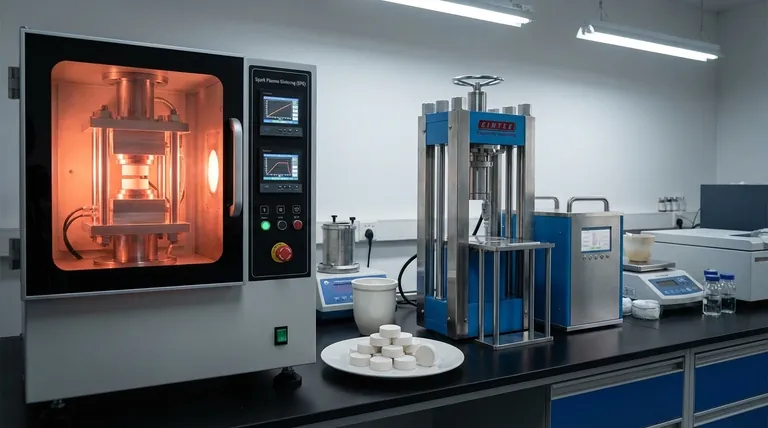
Visual Guide
Related Products
People Also Ask
- Function of a Laboratory Hydraulic Press with Heated Platens in SSE? Enhance Battery Density & Conductivity
- How does a laboratory heated hydraulic press facilitate PBN sample prep for WAXS? Achieve Precise X-Ray Scattering
- What are the requirements for electrode pressing with high-viscosity ionic liquids like EMIM TFSI? Optimize Performance
- What are the industrial applications of heated hydraulic presses? Master Heat & Force for Precision Manufacturing
- Why is a laboratory hydraulic press with heating plates required for PLA/TEC films? Achieve Precise Sample Integrity
