
Pressed pellets mitigate particle size effects by physically forcing loose, irregular powders into a solid, geometrically uniform disk with a consistent density. This process standardizes the sample surface, eliminating the scattering and shadowing caused by variable particle shapes and void spaces that otherwise lead to erroneous XRF signal intensities.
By compressing samples into a solid form, you standardize the interaction volume for the X-ray beam. This ensures that signal variations are attributable to chemical composition, not physical inconsistencies like particle segregation or air gaps.
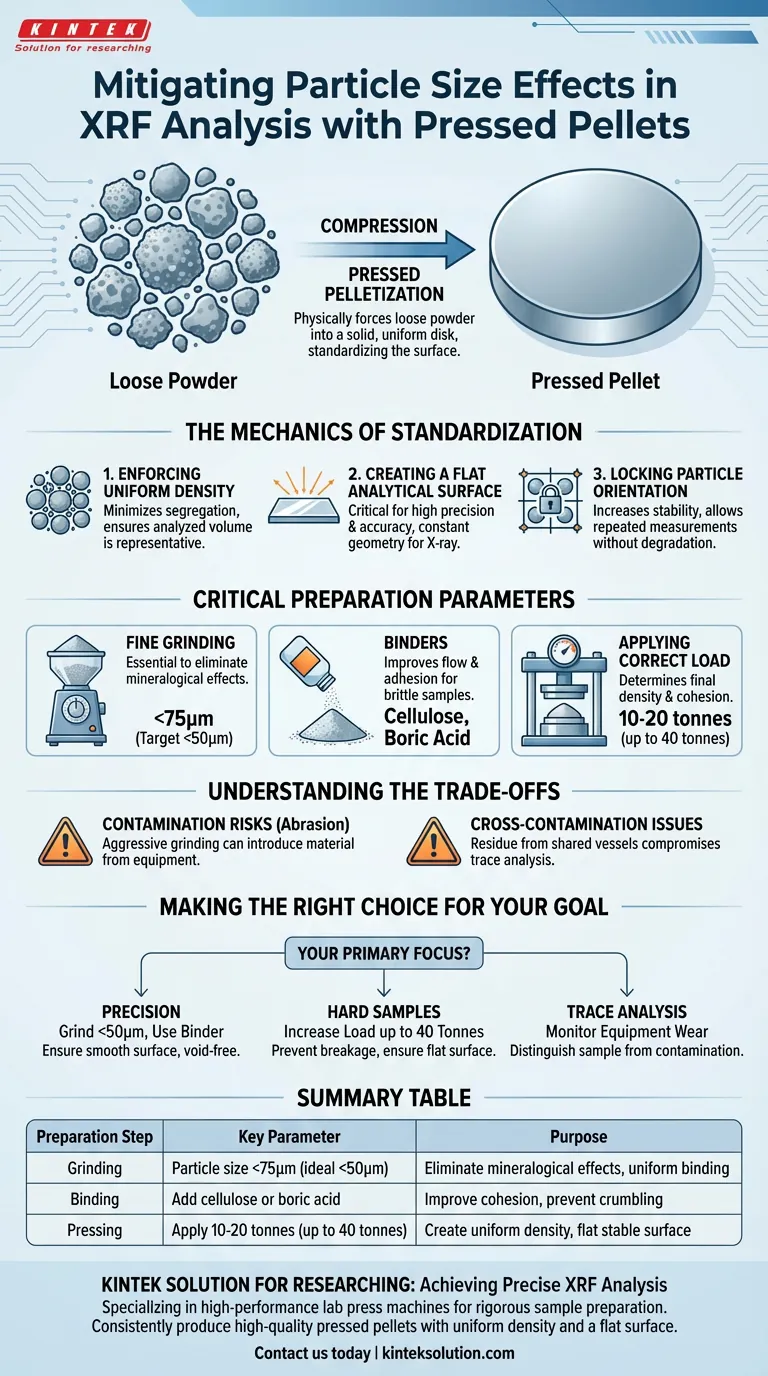
The Mechanics of Standardization
Enforcing Uniform Density
Loose powders contain significant void spaces (air) and irregular packing. This variability alters how X-rays penetrate and escape the sample.
Pressed pellets compress the material into a uniform density. This minimizes the risk of segregation, where lighter and heavier elements separate, ensuring the analyzed volume is truly representative of the whole.
creating a Flat Analytical Surface
In XRF, the geometry of the sample surface is critical. Irregular surfaces scatter X-rays unpredictably.
Pressing creates a perfectly flat, smooth surface. This allows the X-ray source and detector to maintain a constant geometry relative to the sample, which is essential for high precision and accuracy.
Locking Particle Orientation
Loose particles can shift or settle over time. Pressing locks particles into a fixed matrix.
This increases the stability and durability of the sample, allowing for repeated measurements without the physical degradation or shifting seen in loose powders.
Critical Preparation Parameters
The Necessity of Fine Grinding
Pressing alone is not enough; the input material must be sufficiently fine. Large particles create "mineralogical effects" where X-rays fail to penetrate the core of the particle.
For optimal results, samples must be ground to a particle size of less than 75 micrometers (<75µm), with less than 50 micrometers (<50µm) being the ideal target. This fine size ensures the sample binds effectively under pressure.
The Role of Binders
Hard or brittle materials, such as geological samples, often resist compaction or crumble after pressing.
To mitigate this, these samples are mixed with a binding agent like cellulose or boric acid. This improves particle flow during pressing and ensures adhesion, resulting in a robust pellet that can withstand the vacuum of the spectrometer.
Applying Correct Load
The force applied determines the final density of the pellet.
A load of 10-20 tonnes is typically sufficient for a standard 40 mm die. However, difficult samples may require loads of up to 40 tonnes to achieve the necessary cohesion and surface flatness.
Understanding the Trade-offs
Contamination Risks
The most significant downside to the pelletizing process occurs during the grinding phase.
Because aggressive grinding is required to reach <50µm, abrasion contamination is a real risk. Material from the grinding vessel (such as tungsten or steel) can introduce foreign elements into your sample.
Cross-Contamination Issues
The equipment used for pressing and grinding is shared across samples.
If the grinding vessels or pressing dies are not meticulously cleaned, residue from a previous sample can contaminate the current one. This cross-contamination compromises the accuracy of trace element analysis.
Making the Right Choice for Your Goal
While pressed pellets are superior to loose powder, the quality of your data depends on strict adherence to preparation protocols.
- If your primary focus is Precision: Grind samples to <50µm and use a binder to ensure the surface is perfectly smooth and free of voids.
- If your primary focus is Hard Geological Samples: Increase the compression load up to 40 tonnes to prevent pellet breakage and ensure a flat analytical surface.
- If your primary focus is Trace Analysis: Monitor grinding equipment wear closely to distinguish between sample elements and equipment contamination.
Consistency in sample preparation is the single most important factor in transforming raw XRF signals into reliable data.
Summary Table:
| Preparation Step | Key Parameter | Purpose |
|---|---|---|
| Grinding | Particle size <75µm (ideal <50µm) | Eliminate mineralogical effects, ensure uniform binding |
| Binding | Add cellulose or boric acid | Improve cohesion for brittle samples, prevent crumbling |
| Pressing | Apply 10-20 tonnes (up to 40 tonnes) | Create uniform density and a flat, stable analytical surface |
Ready to achieve precise and reliable XRF analysis in your lab?
KINTEK specializes in high-performance lab press machines, including automatic lab presses, isostatic presses, and heated lab presses, designed to meet the rigorous demands of sample preparation for XRF. Our equipment ensures you can consistently produce high-quality pressed pellets with uniform density and a flat surface, eliminating particle size effects and delivering accurate elemental data.
Contact us today to discuss how our solutions can enhance your laboratory's efficiency and data quality. Let our experts help you select the perfect press for your specific samples and analytical goals.
Get in touch with our team now!
Visual Guide
Related Products
- Laboratory Hydraulic Pellet Press for XRF KBR FTIR Lab Press
- Manual Laboratory Hydraulic Pellet Press Lab Hydraulic Press
- Laboratory Hydraulic Split Electric Lab Pellet Press
- Automatic Laboratory Hydraulic Press Lab Pellet Press Machine
- Automatic Laboratory Hydraulic Press for XRF and KBR Pellet Pressing
People Also Ask
- Why is a laboratory pellet press used to pre-press BaSnF4 samples? Ensure Precision in High-Pressure Studies
- What is the necessity of a laboratory pellet press for alcohol by-product fuels? Maximize Energy Density & Consistency
- Why Use a Laboratory Pellet Press for PXRD Anode Material Prep? Standardize Samples for Precise Analysis
- What are the different types of pellet-making tools available for labs? Choose the Right Press for Your Sample
- Why is a professional laboratory pellet press required for XRF of silica sand? Achieve +/- 0.10% Precision



















