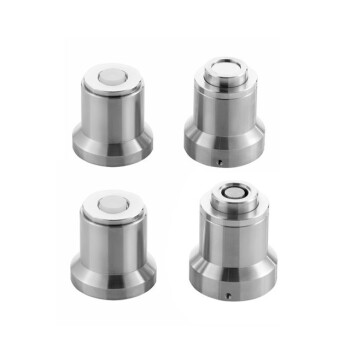
Standardized molds are fundamental to experimental precision. By enforcing exact specifications, these molds ensure that every test specimen maintains consistent geometric dimensions and cross-sectional areas. This uniformity eliminates variables related to size effects, allowing researchers to isolate specific variables—such as polymer type or impregnation method—without interference from physical inconsistencies.
Without uniform sample geometry, data variation becomes indistinguishable from actual experimental results. Standardized molds provide the necessary control baseline, ensuring that observed differences in performance are due to material properties and impregnation techniques, not irregular sample shapes.
The Role of Geometric Consistency
Eliminating Size Effects
In polymer impregnation, even minor variations in sample size can skew results. Standardized molds act as a control mechanism, ensuring that every specimen produced has identical dimensions.
This eliminates "size effects," where larger or smaller samples might behave differently under stress solely due to their volume or surface area, rather than their chemical composition.
Uniform Stress Application
Consistent cross-sectional area is critical when applying stress to a material. If the area varies between samples, the calculation of stress (force per unit area) becomes unreliable.
By strictly controlling the dimensions, molds ensure that any mechanical load applied during testing is distributed evenly and predictably across the sample.
Mechanics of Sample Fabrication
Restricting Lateral Displacement
During the fabrication process, particularly when hydraulic pressing is involved, materials tend to spread outwards. Rigid mold walls restrict this lateral displacement.
This containment forces the material to consolidate within a defined space, ensuring that pressure is applied vertically and efficiently.
Controlling Density and Swelling
The restriction provided by the mold impacts physical properties beyond simple dimensions. It ensures consistent density across the sample.
This consistency allows for fair comparisons of properties like thickness swelling, as every sample starts from the exact same physical baseline.
Enabling Valid Scientific Comparisons
Benchmarking Impregnation Methods
To scientifically compare different impregnation techniques—such as vacuum, ultrasonic, or simple immersion—the substrate must be identical.
Standardized molds provide this constant variable. If samples vary in shape, it becomes impossible to determine if a performance boost is due to the ultrasonic method or simply because one sample was slightly thinner and absorbed more polymer.
Comparing Polymer Types
Similarly, when testing different polymer formulations, the geometry must remain static.
Molds allow researchers to attribute performance differences—such as increased strength or durability—strictly to the chemical nature of the polymer, rather than an artifact of the sample preparation.
Understanding the Trade-offs
The Limit of Standardization
While standardized molds ensure precision, they may not always reflect real-world applications where shapes are irregular. Over-reliance on ideal geometries can sometimes lead to data that is theoretically perfect but practically limited.
Maintenance of Tolerance
Molds are subject to wear and tear. If a standardized mold loses its tolerance over time due to heat or pressure, it creates a false sense of security. Researchers must regularly verify that the "standard" mold is still actually standard.
Making the Right Choice for Your Goal
To maximize the reliability of your polymer impregnation data, consider your specific experimental focus:
- If your primary focus is Comparing Methods: Ensure your molds are rigid enough to prevent lateral displacement, isolating the efficiency of techniques like vacuum or ultrasonic impregnation.
- If your primary focus is Material Characterization: Prioritize geometric precision to eliminate size effects, ensuring that stress tests reflect true material properties rather than dimensional anomalies.
Ultimately, the mold is not just a container; it is a calibration tool that validates the scientific integrity of your entire study.
Summary Table:
| Feature | Impact on Accuracy | Benefit to Researcher |
|---|---|---|
| Geometric Consistency | Eliminates size effects and volume variables | Isolates material properties from physical shape |
| Rigid Mold Walls | Restricts lateral displacement during pressing | Ensures uniform density and vertical pressure |
| Cross-sectional Control | Standardizes stress (force/area) calculations | Provides reliable mechanical testing data |
| Dimensional Baseline | Controls initial thickness and swelling | Enables fair benchmarking of impregnation methods |
Elevate Your Polymer Research with KINTEK Precision
Achieve the ultimate experimental control with KINTEK’s comprehensive laboratory pressing solutions. Whether you are conducting battery research or advanced material characterization, our range of manual, automatic, heated, and multifunctional models—including specialized cold and warm isostatic presses—ensures your samples meet the strictest standards of uniformity.
Don't let geometric inconsistencies compromise your data. Contact KINTEK today to find the perfect glovebox-compatible or high-pressure solution tailored to your lab's specific needs!
References
- Shanaz Ahmed, Khalida Al-Azawi. Polymer-Impregnated Cement Mortar: Effects of PEG, PAM, and PVA on Mechanical Properties. DOI: 10.53293/jasn.2024.7089.1241
This article is also based on technical information from Kintek Solution Knowledge Base .
Related Products
- Infrared Heating Quantitative Flat Plate Mold for Precise Temperature Control
- Carbide Lab Press Mold for Laboratory Sample Preparation
- XRF KBR Plastic Ring Lab Powder Pellet Pressing Mold for FTIR
- Lab Round Bidirectional Press Mold
- Lab XRF Boric Acid Powder Pellet Pressing Mold for Laboratory Use
People Also Ask
- How do precision temperature-controlled heating plates function in electrolyte thermal stability storage experiments?
- What is the importance of a precision temperature-controlled heating module? Ensure Aluminum-Cadmium Thermal Stability
- How does heating platen precision affect rubber specimens? Achieve uniform density and reliable testing results.
- How are thin polymer films produced for spectroscopic analysis? Expert Guide to Heat and Low-Pressure Methods
- What accessories and field services can be used to optimize the capabilities of presses? Maximize Your Lab Performance