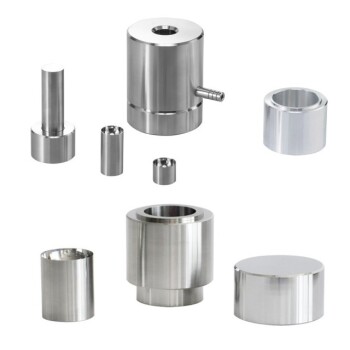
The design and geometric precision of pressing molds are the primary determinants of final dimensional accuracy in PTFE composite samples. High-precision tooling ensures that radial constraints and vertical loads are applied uniformly to the powder. This directly impacts the sample's ability to maintain its shape by effectively managing internal stresses during the pressing and unloading phases.
The quality of a PTFE composite sample is not solely defined by the material blend but by the rigid confinement provided by the mold; precise tooling controls plastic strain and prevents distortion caused by the release of elastic stress.
The Role of Rigid Constraints
Defining Dimensional Tolerances
The geometric precision of the mold and mandrel assembly sets the baseline for the sample's final dimensions. If the tooling lacks precision, it is physically impossible to achieve tight tolerances in the final part.
Providing Radial Constraint
The mold provides a rigid radial constraint around the PTFE powder. This confinement prevents the material from expanding outward uncontrollably during compression.
Ensuring Shape Consistency
By strictly defining the boundaries of the sample, such as in hollow cylinders, the mold ensures that every sample produced shares the exact same geometric profile.
Pressure Transmission and Load Application
Vertical Load Distribution
Punches are used to apply vertical loads to the powder within the mold. The design of these punches is critical to ensuring that pressure is transmitted effectively throughout the entire volume of the material.
The Function of Mandrels
In the creation of complex shapes like hollow cylinders, the mandrel acts as an internal core. It works in tandem with the outer mold to ensure pressure is applied evenly against both internal and external surfaces.
Managing Stress and Strain
Accumulating Plastic Strain
A correctly designed constrained environment allows for the controlled accumulation of plastic strain. This ensures that the powder particles deform and bond permanently rather than just temporarily compressing.
Mitigating Elastic Stress Release
When the vertical load is removed (unloading), materials naturally want to spring back. A precise mold design minimizes dimensional distortion that would otherwise occur due to this release of elastic stress.
Preventing Warpage
By controlling how the material relaxes during unloading, the tooling prevents the sample from warping or becoming misshapen.
Understanding the Trade-offs
The limit of Material Compensation
No amount of pressure adjustment can compensate for poor geometric precision in the mold. If the mold tolerances are loose, the dimensional tolerances of the sample will inevitably be loose as well.
Strain Management vs. Distortion
While the mold manages strain, it relies on the tooling remaining rigid. Any flexing or deformation in the mold itself due to high pressure will transfer directly to the part, undermining the effort to control elastic stress release.
Making the Right Choice for Your Goal
To ensure high-quality PTFE composite manufacturing, consider the following specific objectives:
- If your primary focus is dimensional accuracy: Prioritize the geometric precision of the mold and mandrel assembly above all else, as this dictates the final tolerances.
- If your primary focus is structural consistency: Ensure your punches are designed to apply vertical loads evenly to maximize effective pressure transmission throughout the powder.
Precision in tooling is not merely a manufacturing preference; it is the fundamental constraint that stabilizes the material.
Summary Table:
| Key Factor | Function in PTFE Pressing | Impact on Sample Quality |
|---|---|---|
| Geometric Precision | Sets baseline dimensions and tolerances | Ensures final part accuracy and consistency |
| Radial Constraint | Prevents outward powder expansion | Maintains shape and density during compression |
| Punches/Vertical Load | Transmits pressure through volume | Ensures uniform plastic strain and particle bonding |
| Mandrel Design | Acts as a rigid internal core | Essential for precise hollow/complex geometries |
| Stress Management | Controls elastic stress release | Prevents dimensional distortion and warpage |
Elevate Your PTFE Research with KINTEK Precision Tooling
Don't let poor mold precision compromise your material research. KINTEK specializes in comprehensive laboratory pressing solutions designed to meet the rigorous demands of battery research and advanced material science. Whether you require manual, automatic, heated, or glovebox-compatible models, our high-precision molds and isostatic presses ensure uniform load distribution and superior dimensional stability for every sample.
Our value to you:
- Unmatched Accuracy: Tooling engineered to minimize elastic stress and prevent distortion.
- Versatile Solutions: From standard pellet dies to custom cold/warm isostatic presses.
- Expert Support: Solutions tailored to the specific geometric requirements of your PTFE composites.
Ready to achieve superior structural consistency? Contact KINTEK today for a consultation and find the perfect press for your laboratory.
References
- Khrystyna Berladir, Аrtem Аrtyukhov. Computer Simulation of Composite Materials Behavior under Pressing. DOI: 10.3390/polym14235288
This article is also based on technical information from Kintek Solution Knowledge Base .
Related Products
- Lab Round Bidirectional Press Mold
- Special Shape Lab Press Mold for Laboratory Applications
- Lab Polygon Press Mold
- Lab Isostatic Pressing Molds for Isostatic Molding
- XRF KBR Plastic Ring Lab Powder Pellet Pressing Mold for FTIR
People Also Ask
- What is the purpose of incorporating cartridge heaters into a lab press mold for MLCC block compression? Optimize Results
- What is the function of a pressing tool in thermoplastic panels? Master Precision Shaping & Fusion Bonding
- Why is precise cooling management of the lab press mold necessary? Protect Core Integrity in Thermoforming
- Why is a high-performance laboratory molding press critical for in-situ electrolyte formation? Unlock Battery Success
- What challenges are associated with recycling textiles, and how do laboratory presses help? Overcome Recycling Hurdles with Precision Tools