
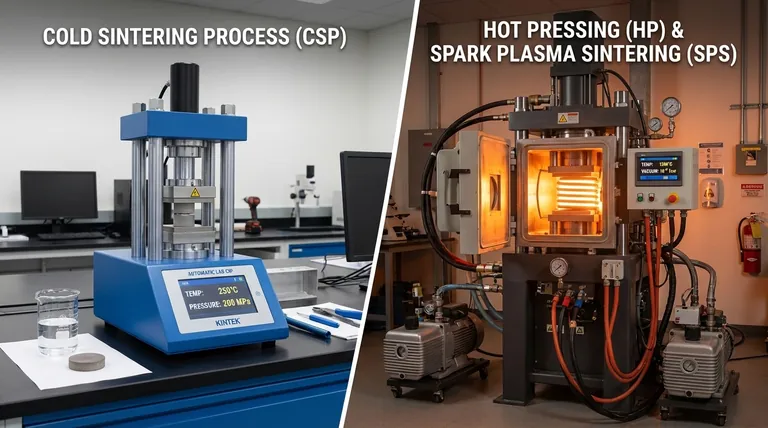
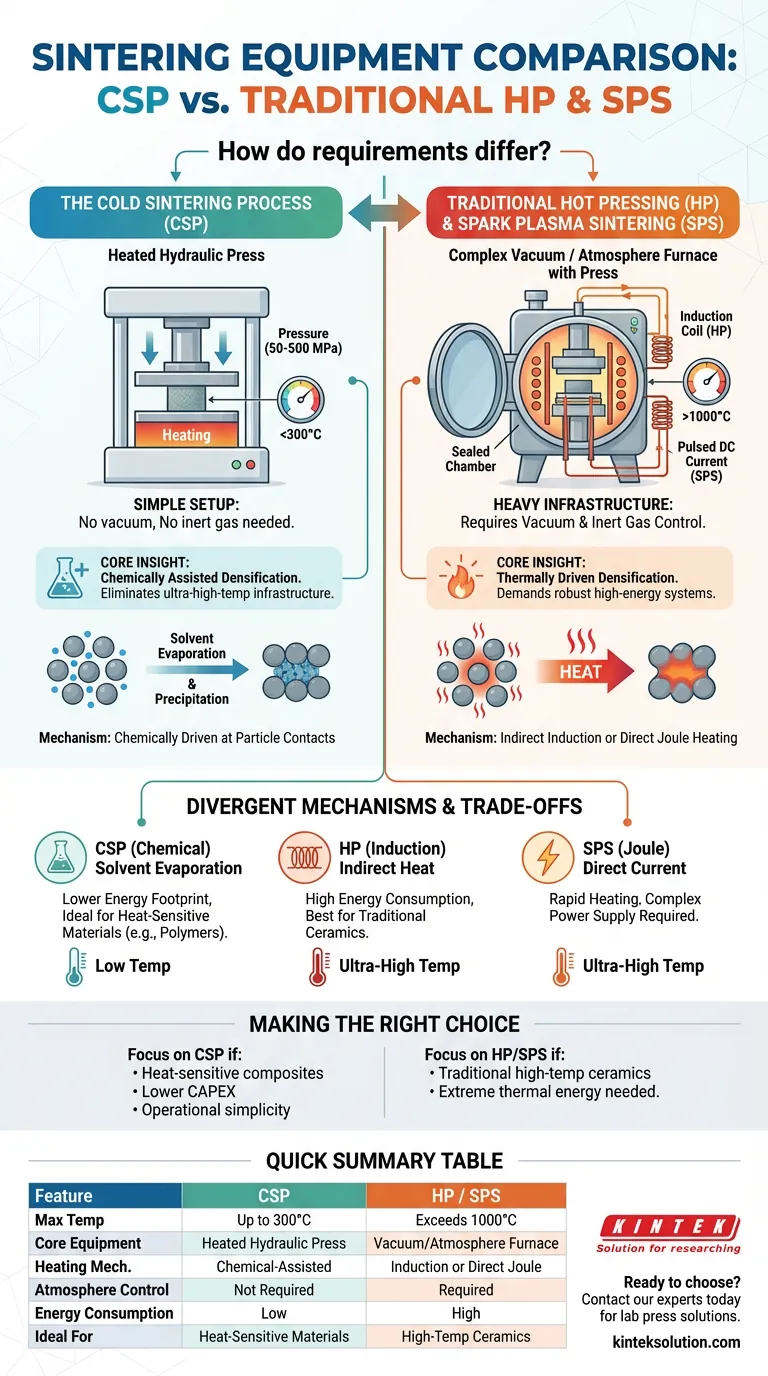
The primary difference lies in the complexity of the thermal infrastructure: The Cold Sintering Process (CSP) requires only a heated hydraulic press operating below 300°C, whereas Hot Pressing (HP) and Spark Plasma Sintering (SPS) demand complex systems integrating vacuum or atmosphere furnaces capable of withstanding temperatures exceeding 1000°C.
Core Insight: CSP transitions the sintering mechanism from a purely thermal event to a chemically assisted one. This shift eliminates the need for high-energy, ultra-high-temperature infrastructure, allowing densification to occur with standard industrial pressing equipment.
The Hardware Divide: Simplicity vs. Intensity
The equipment landscape for sintering is defined by how much thermal energy is required to bond particles.
The Streamlined CSP Setup
Equipment for Cold Sintering is remarkably straightforward. It centers on a heated hydraulic press capable of applying precise pressure (typically 50-500 MPa).
Because the process operates at low temperatures (up to 300°C), there is no need for specialized vacuum chambers or inert gas atmosphere controls. The equipment must simply manage pressure application while maintaining enough heat to facilitate solvent evaporation.
The Complex HP and SPS Infrastructure
In contrast, traditional methods like Hot Pressing and Spark Plasma Sintering require heavy industrial infrastructure. These systems must integrate a pressing mechanism inside a vacuum or atmosphere furnace.
Because these processes operate at ultra-high temperatures (above 1000°C), the equipment must be robust enough to safely contain and manage extreme thermal loads. This results in significant capital investment and higher operational complexity compared to CSP.
Divergent Heating Mechanisms
To understand why the equipment differs so radically, you must look at how energy is delivered to the material.
Chemical-Assisted Densification (CSP)
CSP utilizes a hydraulic press to apply heat and pressure simultaneously to a mixture containing a transient solvent.
The heating function here is not melting the material directly. Instead, it evaporates the solvent, creating a supersaturated solution at particle contact points. This drives precipitation and crystal growth, densifying the material chemically rather than just thermally.
Indirect Induction Heating (HP)
Induction Hot Pressing relies on an induction coil located outside the die assembly.
This is an indirect process. The coil heats a graphite die, which then conducts heat inward to the powder. This requires equipment capable of generating and sustaining massive magnetic fields and thermal gradients.
Direct Joule Heating (SPS)
Spark Plasma Sintering utilizes a pulsed DC current that passes directly through the punches and the graphite die.
The electrical resistance of the die assembly generates intense internal Joule heat. While this offers rapid heating, it requires sophisticated power supplies and electrical controls integrated into the pressing unit.
Understanding the Trade-offs
While CSP offers equipment simplicity, understanding the operational boundaries is essential for selecting the right process.
Energy Consumption and Efficiency
HP and SPS are inherently energy-intensive. Generating temperatures above 1000°C—whether through induction or direct current—requires significant power.
CSP dramatically lowers the energy footprint. By capping temperatures at 300°C, the power draw for the heating elements is a fraction of that required for traditional high-temperature furnaces.
Material Compatibility
The equipment choice dictates what materials you can process. The high-temperature environments of HP and SPS generally preclude the use of heat-sensitive materials.
The low-temperature nature of CSP equipment opens entirely new processing windows. It allows for the densification of heat-sensitive materials like polymers, enabling the creation of ceramic-polymer composites that are impossible to manufacture with traditional high-heat sintering gear.
Making the Right Choice for Your Goal
Selecting between these technologies depends on your material constraints and efficiency targets.
- If your primary focus is processing heat-sensitive composites: Choose CSP, as its <300°C operating range is the only viable option for integrating polymers without degradation.
- If your primary focus is operational simplicity and lower CAPEX: Choose CSP to avoid the complex vacuum and high-power electrical infrastructure required for HP and SPS.
- If your primary focus is traditional high-temperature ceramics: Acknowledge that while HP and SPS require complex, energy-intensive equipment, they provide the extreme thermal energy necessary for materials that do not utilize transient solvents.
Ultimately, CSP represents a shift toward simplified, chemically driven manufacturing, while HP and SPS remain the heavy-duty solutions for thermally driven densification.
Summary Table:
| Feature | Cold Sintering Process (CSP) | Hot Pressing (HP) / Spark Plasma Sintering (SPS) |
|---|---|---|
| Max Temperature | Up to 300°C | Exceeds 1000°C |
| Core Equipment | Heated Hydraulic Press | Vacuum/Atmosphere Furnace with Press |
| Heating Mechanism | Chemical-Assisted (Solvent Evaporation) | Induction (HP) or Direct Joule Heating (SPS) |
| Atmosphere Control | Not Required | Vacuum or Inert Gas Required |
| Energy Consumption | Low | High |
| Ideal For | Heat-Sensitive Materials (e.g., Polymers) | Traditional High-Temperature Ceramics |
Ready to choose the right press for your sintering needs? Whether you require the simplicity of a heated hydraulic press for CSP or a robust system for high-temperature applications, KINTEK has the solution. Our expertise in lab press machines, including automatic, isostatic, and heated lab presses, ensures you get the precise equipment to match your material and process goals. Contact our experts today to discuss how we can optimize your laboratory's efficiency and capabilities!
Visual Guide
Related Products
- Automatic High Temperature Heated Hydraulic Press Machine with Heated Plates for Lab
- 24T 30T 60T Heated Hydraulic Lab Press Machine with Hot Plates for Laboratory
- Laboratory Hydraulic Press 2T Lab Pellet Press for KBR FTIR
- Manual Heated Hydraulic Lab Press with Integrated Hot Plates Hydraulic Press Machine
- Automatic Heated Hydraulic Press Machine with Hot Plates for Laboratory
People Also Ask
- Function of a Laboratory Hydraulic Press with Heated Platens in SSE? Enhance Battery Density & Conductivity
- What are the requirements for electrode pressing with high-viscosity ionic liquids like EMIM TFSI? Optimize Performance
- How does a laboratory heated hydraulic press facilitate PBN sample prep for WAXS? Achieve Precise X-Ray Scattering
- What are the industrial applications of heated hydraulic presses? Master Heat & Force for Precision Manufacturing
- Why is a laboratory hydraulic press with heating plates required for PLA/TEC films? Achieve Precise Sample Integrity



















