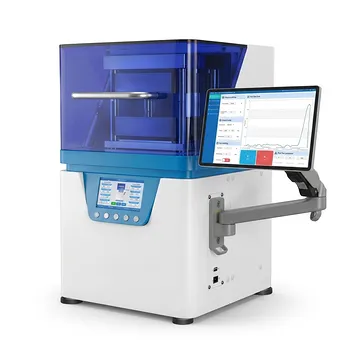
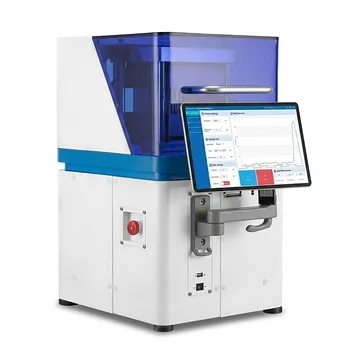
The thermal cycle of a laboratory hydraulic press is the critical determinant of a composite's internal architecture. Preheating ensures the material reaches a uniform molten state to minimize internal stress, while controlled cooling under pressure regulates crystalline growth and prevents structural deformation. Together, these phases dictate the mechanical strength, dimensional stability, and microscopic density of the final specimen.
The success of compression molding depends on balancing thermal energy and mechanical pressure. Preheating prepares the polymer matrix for optimal flow and bonding, while a stabilized cooling phase "locks in" the desired physical properties and prevents geometric failure.
The Preheating Phase: Establishing a Molten Foundation
Achieving a Uniform Molten State
Before full pressure is applied, a short preheating period (typically around 2 minutes) allows the material to reach a uniform molten state. This ensures that the heat penetrates the core of the sample, preventing a "cold core" that could lead to uneven density.
Mitigating Internal Stress
By allowing the polymer or powder to soften before high-pressure compaction, the preheating phase significantly reduces internal residual stress. This transition into a viscous flow state ensures that when pressure is eventually applied, the material deforms plastically rather than fracturing or storing elastic energy.
Facilitating Particle Rearrangement and Integration
For composites involving inorganic fillers or high-activity powders, preheating encourages particles to rearrange and bond tightly. This creates a uniform microstructure and allows the polymer matrix to wet the fillers effectively, eliminating internal micropores and enhancing final ionic or thermal conductivity.
The Cooling Phase: Solidification and Structural Integrity
Regulating Crystallization and Shrinkage
The pressure-holding cooling phase (often requiring 10 minutes) is vital for high-crystallinity materials like Polyamide (PA). Controlled cooling rates dictate the crystalline growth, which directly impacts the material's final hardness and chemical resistance.
Preventing Warping and Geometric Distortion
Maintaining pressure during cooling prevents the plates and the composite from warping or deforming as the material shrinks. Without this controlled environment, uneven thermal contraction would lead to internal voids or a loss of "flatness" in the final part.
Ensuring Mechanical Rigidity
A stabilized cooling process ensures the composite reaches sufficient structural rigidity before it is removed from the mold. This "setting" period is necessary to achieve a finished product with stable fiber volume content and precise thickness.
The Role of Simultaneous Pressure and Temperature
Driving Chemical Cross-Linking
In thermoset systems, such as urea-formaldehyde or epoxy resins, the combination of stable heat (150°C–180°C) and high pressure drives chemical cross-linking. This reaction is what transforms the raw components into a rigid, high-strength network with a high modulus of elasticity.
Eliminating Internal Voids
Constant pressure throughout the heating and cooling cycles forces powder particles into closer contact, minimizing internal porosity. This compaction is critical for achieving high green density and enhancing the Transverse Rupture Strength (TRS) of the material.
Enhancing Thermal and Electrical Pathways
In specialized composites like paraffin wax/expanded graphite, the press provides unidirectional pressure that aligns particles. This alignment constructs efficient heat conduction channels, significantly increasing the thermal conductivity of the finished composite.
Understanding the Trade-offs and Pitfalls
The Risk of Insufficient Preheating
If the preheating phase is too short, the material may not reach the necessary viscous flow state. This results in poor integration between fillers and the matrix, leading to high porosity and localized weak points in the structure.
Excessive Cooling Times vs. Productivity
While extended cooling under pressure ensures maximum stability, it can lead to unnecessary cycle times in a laboratory setting. However, rushing this phase often causes "spring-back" effects, where the material expands slightly upon release, compromising dimensional accuracy.
Temperature Overshoot and Material Degradation
Precise temperature control is mandatory; exceeding the polymer's degradation temperature during the preheating phase can break down molecular chains. This reduces the mechanical flexibility and longevity of the composite electrolyte or film.
How to Optimize Your Pressing Cycle
To achieve the best results with your laboratory hydraulic press, you must align your thermal phases with your specific material requirements.
- If your primary focus is Dimensional Stability: Prioritize a longer (10+ minute) pressure-holding cooling phase to ensure the material is fully rigid and "set" before the mold is opened.
- If your primary focus is Mechanical Strength: Ensure the preheating phase is long enough to reach a complete molten state, allowing for the total elimination of internal micropores and density gradients.
- If your primary focus is Maximizing Conductivity: Use constant, unidirectional pressure during both heating and cooling to induce the directional alignment of conductive fillers.
Mastering the transition between preheating and cooling transforms a simple compression process into a precise tool for engineering superior material properties.
Summary Table:
| Phase | Key Purpose | Impact on Final Performance |
|---|---|---|
| Preheating | Uniform melting & stress relief | Eliminates internal voids; ensures optimal matrix-filler bonding. |
| Cooling | Controlled solidification | Prevents warping & distortion; regulates crystallization & hardness. |
| Pressure Holding | Compaction & cross-linking | Ensures high density, precise thickness, and structural rigidity. |
Optimize Your Composite Research with KINTEK
Achieving superior material properties requires precision at every stage of the thermal cycle. KINTEK specializes in comprehensive laboratory pressing solutions tailored for advanced battery research and materials science. We offer a versatile range of equipment, including:
- Manual & Automatic Presses for consistent load application.
- Heated & Multifunctional Models for precise thermal control during preheating and cooling phases.
- Glovebox-Compatible Systems for air-sensitive research.
- Cold & Warm Isostatic Presses (CIP/WIP) for high-density specimen preparation.
Ready to elevate your lab's efficiency and specimen quality? Contact our technical experts today to find the perfect pressing solution for your specific application!
References
- Mihai Georgescu, Dana Gurău. New Polymeric Compounds with High Temperature and Impact Resistance. DOI: 10.24264/icams-2016.i.12
This article is also based on technical information from Kintek Solution Knowledge Base .
Related Products
- Laboratory Hydraulic Press Lab Pellet Press Machine for Glove Box
- Laboratory Hydraulic Press 2T Lab Pellet Press for KBR FTIR
- 24T 30T 60T Heated Hydraulic Lab Press Machine with Hot Plates for Laboratory
- Laboratory Hydraulic Press Lab Pellet Press Button Battery Press
- Laboratory Hydraulic Pellet Press for XRF KBR FTIR Lab Press
People Also Ask
- How does a laboratory hydraulic press contribute to the preparation of Li3-3xScxSb samples? Optimize Ionic Conductivity
- What is the function of a laboratory hydraulic press in FT-IR of curcumin-coated MWCNTs? Achieve Optical Clarity.
- Why is a laboratory hydraulic press required for compression molding boron-siloxane? Solve High-Loading Density Challenges
- What role does a laboratory hydraulic press play in the preparation of piezoelectric ceramic discs for DC-PG? | KINTEK
- What role does a laboratory hydraulic press play in reaction pellets? Optimizing Lunar Soil and Metal Fuel Density