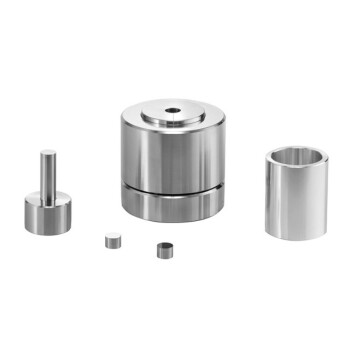
A laboratory precision press is essential for transforming viscous polymer precursors mixed with graphene into high-density "green bodies" suitable for pyrolysis. By applying rigorously controlled heat and pressure, the press eliminates internal pores and compacts the material, creating the structural foundation necessary for high-performance Polymer-Derived Ceramics (PDCs).
Core Takeaway The primary value of a precision press in this application is not just shaping the material, but establishing a uniform interconnected graphene network. This network is what enables the final ceramic product to function as a "smart" material with self-monitoring and damage-sensing capabilities.
The Critical Role of Precision in Molding
Compacting Viscous Precursors
In PDC technology, the initial mixture of polymer precursors and graphene (or carbon nanotubes) is often highly viscous.
A laboratory press applies significant force to compress this difficult-to-manage mixture. This compression is necessary to consolidate the loose material into a solid, cohesive shape known as a green body.
Eliminating Structural Defects
One of the main challenges in composite preparation is the presence of air pockets or voids.
Accurate pressure control forces these voids out of the matrix. Eliminating internal pores is critical, as any remaining air pockets will become structural weaknesses in the final ceramic product.
Impact on Material Performance
Forming the Conductive Network
The application of precise pressure does more than just shape the item; it dictates the internal arrangement of the graphene.
Compression brings the graphene fillers into close proximity. This facilitates the formation of a uniform interconnected graphene network during the subsequent pyrolysis (heating) process.
Enabling Smart Capabilities
The quality of this graphene network directly influences the functionality of the ceramic.
A well-formed network allows the ceramic to conduct electricity effectively. This conductivity is the mechanism that allows the final PDC to act as a smart ceramic, capable of self-monitoring and sensing internal damage.
Ensuring Consistency and Reproducibility
Reproducible Density and Sizing
Laboratory presses are engineered with components like threaded rods and nuts for precise platen adjustment.
This mechanical precision ensures that every pellet or sample produced has uniform size and density. For research and development, this uniformity is vital for generating accurate, reproducible data analysis.
Thermal Stability
Temperature fluctuations during molding can ruin the polymerization process.
Modern manual and automated presses integrate heated platens with digital controls to maintain exact temperatures. This guarantees that temperature variations do not compromise the quality of the green bodies.
Common Pitfalls to Avoid
Inconsistent Pressure Application
If pressure is applied unevenly or fluctuates, the density of the green body will vary across the sample.
This leads to "islands" of graphene rather than a continuous network. The resulting ceramic will lack the conductivity required for sensing applications, rendering the "smart" features useless.
Overlooking Temperature Control
Ignoring the precision of the heated platens can lead to incomplete curing or thermal gradients within the sample.
This results in internal stresses or warping. Even if the pressure was correct, thermal inconsistency can introduce cracks that destroy the mechanical integrity of the composite.
Making the Right Choice for Your Goal
To maximize the effectiveness of your PDC workflow, align your equipment usage with your specific end-goals:
- If your primary focus is Structural Integrity: Prioritize a press with high tonnage and rigid platen parallelism to ensure the absolute elimination of internal pores.
- If your primary focus is Smart Sensing Capabilities: Focus on thermal precision and pressure holding capability to ensure the graphene network forms continuously without interruption.
Precision at the pressing stage is the defining factor between a standard ceramic and a smart composite.
Summary Table:
| Feature | Impact on Graphene PDC Fabrication | Benefit for Research |
|---|---|---|
| Pressure Control | Compresses viscous precursors into dense green bodies | Eliminates structural defects and voids |
| Heated Platens | Maintains uniform thermal environment during molding | Ensures consistent curing and avoids warping |
| Network Formation | Compels graphene fillers into close proximity | Enables electrical conductivity for smart sensing |
| Mechanical Precision | Guarantees reproducible platen adjustment | Ensures consistent sample size and data accuracy |
Elevate Your Material Research with KINTEK Precision Solutions
Unlock the full potential of your Polymer-Derived Ceramics (PDCs) and graphene composites with KINTEK’s industry-leading laboratory pressing technology. Whether you are developing next-generation battery components or smart sensing materials, our comprehensive range of manual, automatic, heated, and isostatic presses provides the rigorous control necessary to eliminate defects and ensure structural integrity.
Why Choose KINTEK?
- Versatility: Solutions for every lab environment, including glovebox-compatible and multifunctional models.
- Precision: Advanced digital controls for temperature and pressure to ensure reproducible results.
- Expertise: Specialized equipment designed for the demanding requirements of battery and advanced ceramic research.
Ready to transform your precursors into high-performance green bodies? Contact KINTEK today to find your ideal pressing solution!
References
- Yujia Huang, Chunlei Wan. Controllable fabrication and multifunctional applications of graphene/ceramic composites. DOI: 10.1007/s40145-020-0376-7
This article is also based on technical information from Kintek Solution Knowledge Base .
Related Products
- Lab Polygon Press Mold
- Special Shape Lab Press Mold for Laboratory Applications
- Square Lab Press Mold for Laboratory Use
- Assemble Square Lab Press Mold for Laboratory Use
- Lab Infrared Press Mold for Laboratory Applications
People Also Ask
- What is the purpose of incorporating cartridge heaters into a lab press mold for MLCC block compression? Optimize Results
- How do the design and geometric precision of pressing molds and mandrels affect the quality of PTFE composite samples?
- What role do precision positioning and pressure molds play in single-lap joints? Ensure 100% Data Integrity
- What are the requirements for pressing molds when using SSCG? Key Materials for Complex Single Crystal Production
- How do industrial-grade pressure molds affect zinc metal pouch cells? Maximize Energy Density & Performance