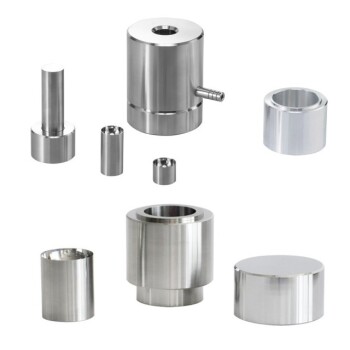
A laboratory pressure molding machine fundamentally enhances carbon block quality by applying high axial force to reorganize the internal structure of kneaded powder. This mechanical compression increases the packing density and reduces porosity, establishing the critical "green body" density required before the material undergoes the carbonization process.
By combining high-pressure compaction with precise pressure-holding capabilities, these machines optimize particle contact and facilitate the escape of trapped gases. This creates a homogeneous, high-density foundation that minimizes structural defects and maximizes the final product's strength.
The Mechanism of Density Improvement
Particle Rearrangement through Axial Pressure
The primary function of the machine is to apply substantial axial pressure, often reaching levels such as 130 MPa.
This force overcomes the friction between kneaded powder particles. The particles are forced to shift, slide, and rearrange themselves into a much tighter configuration.
Eliminating Voids and Porosity
As the pressure increases, the air naturally trapped between loose particles is expelled.
This drastic reduction in porosity significantly increases the bulk density of the green body. By minimizing void space, the machine ensures that the maximum amount of material is packed into the mold volume.
Creating a Foundation for Carbonization
The ultimate goal of this densification is to increase the physical contact area between particles.
This creates a solid, high-density foundation. A dense green body is essential for structural evolution during the subsequent carbonization phase, ensuring the final material possesses the desired mechanical properties.
Ensuring Integrity via Pressure Stability
Compensating for Plastic Deformation
Laboratory hydraulic presses utilize an automatic pressure-holding function to maintain a constant state of extrusion.
As powder particles rearrange or undergo plastic deformation, minor pressure losses naturally occur. The machine automatically compensates for these drops to ensure the compression force remains stable and effective throughout the cycle.
Preventing Structural Defects
Stable pressure holding allows time for the powder particles to fill every gap within the mold completely.
Crucially, this dwell time enables the slow, controlled release of internal gases. If gases are trapped or if pressure is released too rapidly, the internal stress can cause lamination (layer cracking), leading to sample failure.
Common Pitfalls and Trade-offs
The Risk of Rapid Decompression
While high pressure builds density, the release of that pressure is just as critical as the application.
Rapid pressure release can cause the material to rebound violently. This fluctuation often results in internal fractures or layer cracking, negating the benefits of the high-density packing.
Balancing Pressure and Time
Applying high pressure without a sufficient holding period is often ineffective.
Without the "holding" phase, the particles may not fully settle into their new positions. The pressure-holding function is the key mechanism that locks in the density gains and increases the overall sample yield.
Making the Right Choice for Your Goal
To optimize your green body preparation, align your machine settings with your specific physical requirements:
- If your primary focus is maximizing bulk density: Prioritize a machine capable of exerting high axial pressure (e.g., 130 MPa) to force maximum particle rearrangement and contact.
- If your primary focus is structural integrity and yield: Ensure your process utilizes the automatic pressure-holding function to prevent lamination and allow complete gas evacuation.
Achieving a superior carbon block requires viewing pressure not just as a force, but as a precise tool for microstructural engineering.
Summary Table:
| Feature | Mechanism | Impact on Carbon Block |
|---|---|---|
| High Axial Pressure | Forced particle rearrangement (up to 130 MPa) | Maximizes packing density & eliminates voids |
| Pressure Holding | Compensates for plastic deformation | Ensures uniform density & prevents internal stress |
| Controlled Decompression | Slow release of internal gases | Prevents lamination and layer cracking |
| Homogenization | Minimizes porosity & increases contact area | Provides superior foundation for carbonization |
Elevate Your Material Research with KINTEK Precision Solutions
Unlock the full potential of your carbon materials with KINTEK’s advanced laboratory pressing technology. Whether you are conducting cutting-edge battery research or developing high-strength composites, our comprehensive range of manual, automatic, heated, and multifunctional presses provides the exact control you need.
Our equipment—including specialized cold and warm isostatic presses—is engineered to deliver the high axial force and stable pressure holding essential for producing defect-free, high-density green bodies.
Ready to optimize your sample yield and structural integrity? Contact our experts today to find the perfect glovebox-compatible or standalone pressing solution for your lab's unique requirements!
References
- Sun-Ung Gwon, Jae‐Seung Roh. Effect of Pressure and Holding Time during Compression Molding on Mechanical Properties and Microstructure of Coke-Pitch Carbon Blocks. DOI: 10.3390/app14020772
This article is also based on technical information from Kintek Solution Knowledge Base .
Related Products
- Carbide Lab Press Mold for Laboratory Sample Preparation
- Square Lab Press Mold for Laboratory Use
- Lab Cylindrical Press Mold for Laboratory Use
- Lab Round Bidirectional Press Mold
- Assemble Lab Cylindrical Press Mold for Laboratory Use
People Also Ask
- What is the purpose of incorporating cartridge heaters into a lab press mold for MLCC block compression? Optimize Results
- What is the function of a pressing tool in thermoplastic panels? Master Precision Shaping & Fusion Bonding
- Why is precise cooling management of the lab press mold necessary? Protect Core Integrity in Thermoforming
- How does the geometry of laboratory molds influence mycelium-based composites? Optimize Density and Strength
- What is the significance of standardized molds in lab presses? Ensure Precise Seal Material Evaluation