The choice and operation of a coin cell crimper directly dictates the validity of your testing data by establishing the mechanical pressure required for a hermetic seal and uniform internal electrical contact. For high-voltage systems like Lithium Nickel Manganese Oxide (LNMO), this process controls two critical variables: the exclusion of moisture to prevent electrolyte degradation and the minimization of interfacial resistance to ensure accurate cycling metrics.
Core Takeaway The crimper is not merely a packaging tool; it is a critical variable in electrochemical testing. For LNMO batteries operating above 4.7 V, precise crimping pressure is the primary defense against moisture-induced electrolyte decomposition and the key to ensuring reproducible, low-resistance internal contact.
The Criticality of Sealing for High-Voltage LNMO
Moisture and Electrolyte Stability
The primary function of the crimper is to deform the coin cell case (typically CR2032) against the gasket to create an airtight seal. While important for all chemistries, this is vital for LNMO systems operating at high voltages (4.7 V).
Preventing Accelerated Degradation
At these high voltages, electrolytes are already near their stability limits. If the crimp is imperfect, trace amounts of external moisture can enter the cell. Moisture acts as a catalyst for electrolyte decomposition, leading to rapid degradation of cycle stability and skewed lifetime data that reflects assembly failure rather than material performance.
Preventing Electrolyte Evaporation
A proper seal also prevents the volatile components of the electrolyte from evaporating. Loss of electrolyte changes the concentration within the cell, altering ionic conductivity and leading to premature cell failure during long-term cycling tests.
Impact on Electrochemical Data Integrity
Optimizing Internal Contact
Beyond sealing, the crimper applies mechanical force to compress the internal stack—comprising the cathode, separator, anode, spacers, and spring. This compression ensures tight solid-to-solid physical contact between the active materials and the current collectors.
Minimizing Interfacial Resistance
Uniform pressure minimizes contact resistance (impedance). If the crimping pressure is insufficient, the internal components will have poor connectivity, resulting in artificially high impedance data. This prevents the battery from performing at its full electrochemical potential, particularly during high current density (rate performance) testing.
Manual vs. Automatic: The Consistency Factor
The Variable of Human Error
A manual crimper relies on the physical force applied by the operator. This introduces inconsistency, as the sealing pressure can vary between different cells or different operators. This variation creates "noise" in your data, making it difficult to distinguish between material variations and assembly inconsistencies.
Automated Repeatability
Automated laboratory presses provide precise, programmable, and repeatable encapsulation pressure. This ensures that every coin cell in a batch experiences the exact same mechanical conditions. By eliminating human error, automated crimpers yield significantly more reliable and reproducible data regarding cycle life and rate performance.
Common Pitfalls and Trade-offs
The Danger of Under-Crimping
Insufficient pressure is the most common failure mode. It results in leakage of the electrolyte and high internal resistance. If your data shows erratic voltage drops or unexpected impedance spikes, under-crimping is a likely culprit.
The Risk of Over-Crimping
While less common, applying excessive pressure can deform the internal components. This can crush the separator, leading to internal short circuits, or deform the can to the point where the gasket fails, compromising the seal. The goal is "constant and uniform" pressure, not maximum pressure.
Making the Right Choice for Your Goal
To ensure your LNMO research yields publication-quality data, evaluate your crimping process against your specific testing objectives:
- If your primary focus is long-term cycle life: Prioritize the sealing integrity of the crimper to prevent moisture ingress, which is the leading cause of electrolyte decomposition at 4.7 V.
- If your primary focus is rate performance and impedance: Ensure your crimper applies uniform, high compression to minimize contact resistance and allow the material to handle high current densities.
- If your primary focus is data reproducibility: Transition to an automated crimping system to eliminate operator variability and ensure that differences in data are due to materials, not assembly.
In high-voltage battery research, a consistent crimp is the baseline requirement for valid scientific conclusions.
Summary Table:
| Feature | Impact on LNMO Battery Testing | Importance |
|---|---|---|
| Sealing Integrity | Prevents moisture ingress & electrolyte decomposition at 4.7V | Critical |
| Pressure Uniformity | Minimizes contact resistance for accurate rate performance data | High |
| Manual Operation | Higher risk of human error and inconsistent data 'noise' | Variable |
| Automatic Operation | Provides programmable, repeatable pressure for scientific reproducibility | Superior |
Optimize Your Battery Research with KINTEK Precision
Don't let inconsistent assembly compromise your electrochemical data. KINTEK specializes in comprehensive laboratory pressing solutions tailored for advanced battery research. Whether you need manual, automatic, heated, or glovebox-compatible models, our equipment ensures the hermetic sealing and uniform pressure required for high-voltage systems like LNMO.
Our value to your lab:
- Precision Engineering: Eliminate interfacial resistance and moisture ingress.
- Versatile Solutions: From standard coin cells to cold and warm isostatic presses.
- Reproducible Results: Automated systems designed to remove operator variability.
Elevate your research standards today—Contact KINTEK for a Consultation!
References
- Jon Serrano Sevillano, Dany Carlier. Systematic Evaluation of Li <sub>3</sub> PO <sub>4</sub> Coatings on LNMO for Enhanced Cycling Stability using NMR‐Based Interfacial Probes. DOI: 10.1002/admi.202500814
This article is also based on technical information from Kintek Solution Knowledge Base .
Related Products
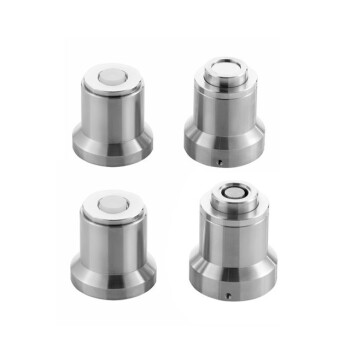
- Lab Button Battery Disassembly and Sealing Mold
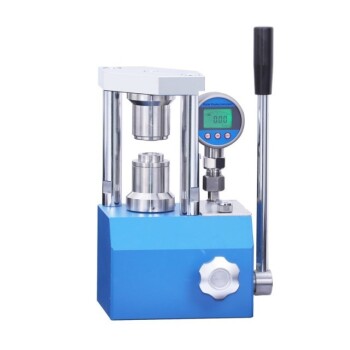
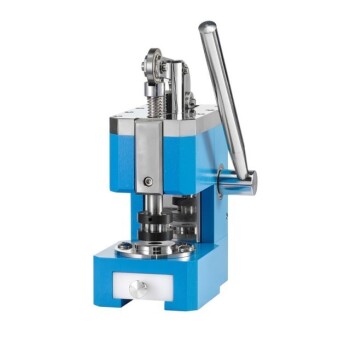
- Button Battery Sealing Machine for Button Batteries
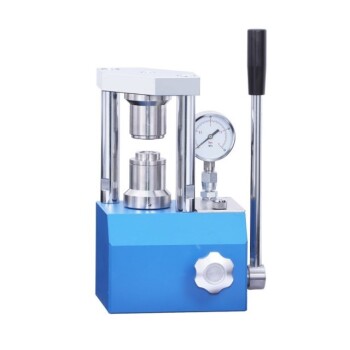
- Manual Button Battery Sealing Machine for Battery Sealing
- Lab Button Battery Tablet Press Sealing Mold
- Button Battery Sealing Press Machine for Lab
People Also Ask
- How does a sealed battery mold facilitate the assembly and testing of asymmetric supercapacitors using VO2?
- What is the function of specialized battery molds and sealing consumables? Optimize Your In-situ XRD Testing Today
- How does the geometry of laboratory molds influence mycelium-based composites? Optimize Density and Strength
- Why are specialized battery test molds used? Ensure Peak Performance for All-Solid-State Sodium Batteries (ASSIBs)
- What role do battery testing molds play in electrolyte performance? Exploring Pressure vs. Viscoelasticity