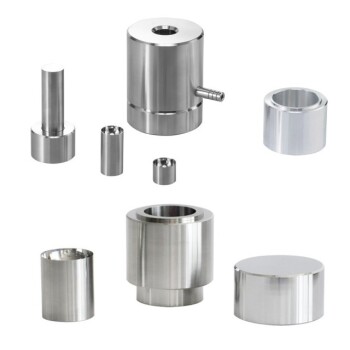
Applying a pressing pressure of 300 MPa is a critical process parameter that fundamentally transforms the physical properties of garnet-type solid electrolyte (LLZO) powder. By forcing precursor particles to overcome inter-particle friction and rearrange, this high-pressure environment significantly reduces porosity, resulting in a green compact with a density near the theoretical value and enhanced mechanical strength.
The application of 300 MPa creates a physically stable and dense matrix that is essential for reliable quantitative analysis. This specific pressure threshold ensures the sample achieves the mechanical integrity required to withstand rigorous post-processing, such as surface polishing and laser impact, without structural failure.
The Mechanics of Densification
Overcoming Particle Friction
At lower pressures, powder particles remain loosely packed due to friction between granule surfaces.
Applying 300 MPa provides the force necessary to overcome this friction. This forces the particles to slide past one another and reorganize into a much tighter configuration.
Drastic Reduction in Porosity
The primary result of this rearrangement is the elimination of voids within the material.
By compressing the powder to this extent, you minimize the empty spaces between particles. This creates a "green compact" (the pressed but unfired object) that is significantly denser than loose powder.
Achieving Theoretical Density
For accurate chemical analysis, the sample matrix must be consistent.
The 300 MPa pressure compresses the LLZO powder until its density approaches the theoretical maximum for the material. This provides a stable physical baseline, ensuring that subsequent quantitative measurements are accurate and repeatable.
Enhancing Physical Durability
Strengthening Mechanical Bonds
High pressure does more than just pack particles; it facilitates mechanical interlocking.
The strong bonding force generated at 300 MPa turns loose powder into a cohesive solid. This structural integrity is vital for handling the sample without it crumbling.
Withstanding Post-Processing
LLZO samples often require further preparation before analysis.
A sample pressed at 300 MPa is robust enough to endure surface polishing and laser impact. Lower pressures would likely result in samples that disintegrate under these physical stresses.
The Role of Stability and Time
Compensating for Deformation
During the pressing process, particles undergo plastic deformation and shifting, which can cause minor pressure drops.
Using a hydraulic press with automatic pressure-holding functionality maintains the 300 MPa force constant. This compensates for these shifts, ensuring the powder fills every mold gap completely.
Preventing Structural Defects
Rapid changes in pressure can be destructive to high-density compacts.
Stable pressure holding allows internal gases to escape gradually. This prevents common defects like lamination (layer separation) or layer cracking, which frequently occur if pressure fluctuates or is released too quickly.
Understanding the Trade-offs
The Risk of Rapid Release
While high pressure builds strength, the release of that pressure is a point of vulnerability.
If the 300 MPa load is removed instantly, the internal stress can cause the sample to fracture. High pressure must be paired with controlled depressurization to ensure high sample yield.
Equipment Precision Dependencies
The benefits of high pressure rely entirely on the consistency of the equipment.
If the hydraulic press cannot maintain stable pressure, it introduces "noise" into the process. In research settings, this makes it difficult to distinguish between actual material defects and artifacts caused by equipment fluctuations.
Making the Right Choice for Your Goal
To maximize the quality of your LLZO samples, align your pressing strategy with your specific objectives:
- If your primary focus is Physical Durability: Ensure you reach the full 300 MPa threshold to generate the mechanical bonding force needed for polishing and handling.
- If your primary focus is Analytical Precision: Prioritize achieving near-theoretical density to create a stable matrix that reduces errors in quantitative chemical analysis.
- If your primary focus is Sample Yield: Utilize automatic pressure-holding functions to allow gas release and prevent lamination cracks.
By mastering the application of 300 MPa pressure, you transition from simple powder compaction to creating high-fidelity ceramic matrices suitable for advanced characterization.
Summary Table:
| Impact Category | Effects at 300 MPa Pressure | Benefit to LLZO Samples |
|---|---|---|
| Densification | Eliminates voids & reduces porosity | Approaches theoretical density for accurate analysis |
| Structural Integrity | Enhances mechanical interlocking | Withstands surface polishing and laser impact |
| Sample Quality | Enables uniform particle rearrangement | Prevents crumbling and structural failure |
| Stability | Compensates for plastic deformation | Ensures repeatable results in quantitative measurements |
Elevate Your Battery Research with KINTEK Precision
Achieving the perfect 300 MPa density for LLZO electrolytes requires more than just force—it requires precision and stability. KINTEK specializes in comprehensive laboratory pressing solutions tailored for high-performance materials research.
Whether you need manual, automatic, heated, or glovebox-compatible models, our equipment—including advanced cold and warm isostatic presses—is designed to maintain constant pressure and controlled depressurization to prevent lamination and cracking.
Ready to optimize your sample yield and analytical accuracy?
Contact KINTEK Today for a Tailored Solution
References
- Stefan Smetaczek, Jürgen Fleig. Li<sup>+</sup>/H<sup>+</sup> exchange of Li<sub>7</sub>La<sub>3</sub>Zr<sub>2</sub>O<sub>12</sub> single and polycrystals investigated by quantitative LIBS depth profiling. DOI: 10.1039/d2ma00845a
This article is also based on technical information from Kintek Solution Knowledge Base .
Related Products
- Lab Round Bidirectional Press Mold
- Lab Polygon Press Mold
- Square Bidirectional Pressure Mold for Lab
- XRF KBR Plastic Ring Lab Powder Pellet Pressing Mold for FTIR
- Lab XRF Boric Acid Powder Pellet Pressing Mold for Laboratory Use
People Also Ask
- What is the purpose of incorporating cartridge heaters into a lab press mold for MLCC block compression? Optimize Results
- Why is precise cooling management of the lab press mold necessary? Protect Core Integrity in Thermoforming
- What is the function of a pressing tool in thermoplastic panels? Master Precision Shaping & Fusion Bonding
- Why is a high-performance laboratory molding press critical for in-situ electrolyte formation? Unlock Battery Success
- How do the design and geometric precision of pressing molds and mandrels affect the quality of PTFE composite samples?