
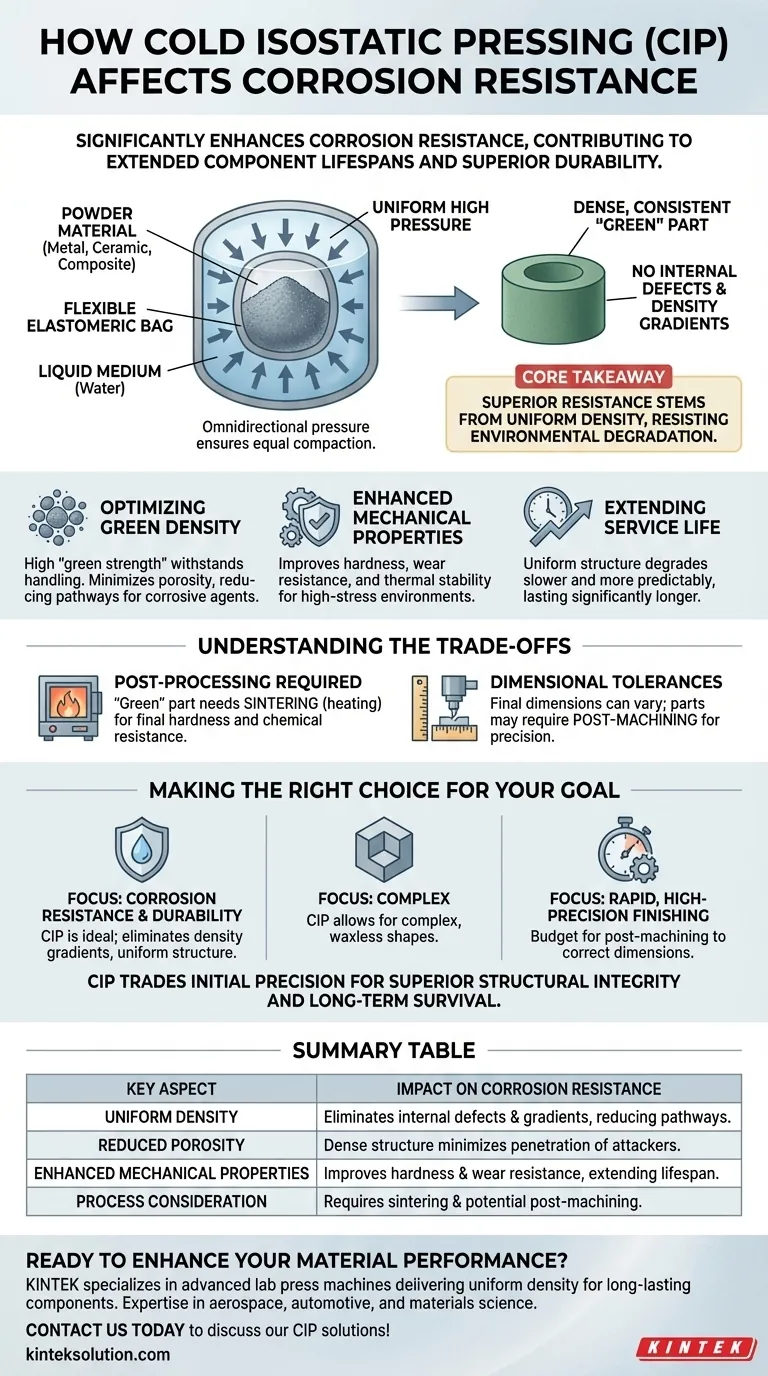
Cold Isostatic Pressing (CIP) significantly enhances the corrosion resistance of materials, directly contributing to extended component lifespans and superior overall durability. By subjecting powdered materials—whether metal, ceramic, or composite—to uniform pressure from all directions, CIP creates a dense, consistent structure that lacks the internal defects where corrosion typically begins.
Core Takeaway: The superior corrosion resistance of CIP-processed components stems from uniform density. Unlike unidirectional pressing, which leaves density gradients, CIP ensures equal compaction throughout the part. This homogeneity creates a robust material structure that naturally resists environmental degradation and chemical attack.
The Mechanics of Material Enhancement
Uniform Pressure Application
The CIP process involves placing powder into a sealed elastomeric container (bag), which is submerged in a liquid (typically water).
High pressure is applied to the fluid, transmitting force equally to every surface of the container.
This omnidirectional pressure ensures that the material is compacted evenly, resulting in uniform strength across the entire geometry of the part.
Optimizing Green Density
CIP operates at room temperature to consolidate powders into a solid mass with high "green strength."
Green strength refers to the ability of the molded material to withstand handling and manipulation before it is fully hardened (sintered).
By achieving a high and uniform green density, the material provides a superior foundation for subsequent processing. This structural integrity minimizes porosity, leaving fewer pathways for corrosive agents to penetrate the material.
Impact on Performance and Longevity
Extending Service Life
Because the material structure is uniform and dense, components produced via CIP exhibit a significantly longer lifespan compared to those made with conventional methods.
The reduction in structural inconsistencies means the material degrades at a slower, more predictable rate.
Enhanced Mechanical Properties
Beyond corrosion resistance, CIP improves general mechanical properties, including increased hardness, wear resistance, and thermal stability.
These enhancements make CIP-processed parts ideal for high-stress environments, such as critical applications in the aerospace and automotive industries.
Understanding the Trade-offs
The Requirement for Post-Processing
While CIP is excellent for consolidation and complex shapes, it is rarely the final step.
The process creates a "green" part that typically requires sintering (heating) to achieve final hardness and chemical resistance.
Dimensional Tolerances
Because the powder is contained in a flexible elastomeric bag rather than a rigid die, the final dimensions of the pressed part can vary.
References indicate that parts may require post-machining to achieve precise final tolerances, adding a step to the manufacturing workflow.
Making the Right Choice for Your Goal
If you are evaluating Cold Isostatic Pressing for your manufacturing process, consider your specific performance requirements:
- If your primary focus is corrosion resistance and durability: CIP is an ideal choice because it eliminates density gradients, creating a uniform structure that inherently resists environmental attack.
- If your primary focus is complex geometry: CIP allows for the creation of complex, waxless shapes that might be difficult to achieve with rigid die pressing.
- If your primary focus is rapid, high-precision finishing: Be aware that you will likely need to budget time and resources for post-machining to correct surface dimensions.
Ultimately, CIP is a foundational process that trades initial dimensional precision for superior internal structural integrity and long-term material survival.
Summary Table:
| Key Aspect | Impact on Corrosion Resistance |
|---|---|
| Uniform Density | Eliminates internal defects and density gradients, reducing pathways for corrosive agents. |
| Reduced Porosity | Creates a dense structure that minimizes penetration of environmental and chemical attackers. |
| Enhanced Mechanical Properties | Improves hardness and wear resistance, contributing to longer component lifespan. |
| Process Consideration | Requires sintering for final hardness and may need post-machining for precise dimensions. |
Ready to enhance your material performance with superior corrosion resistance?
KINTEK specializes in advanced lab press machines, including isostatic presses, that deliver the uniform density and structural integrity critical for long-lasting components. Our expertise helps laboratories in the aerospace, automotive, and materials science sectors achieve breakthrough durability.
Contact us today to discuss how our CIP solutions can benefit your specific application!
Visual Guide
Related Products
- Electric Lab Cold Isostatic Press CIP Machine
- Electric Split Lab Cold Isostatic Pressing CIP Machine
- Automatic Lab Cold Isostatic Pressing CIP Machine
- Manual Cold Isostatic Pressing CIP Machine Pellet Press
- Lab Isostatic Pressing Molds for Isostatic Molding
People Also Ask
- What are the applications of electric lab cold isostatic presses in research settings? Advance Material R&D with High-Pressure CIPs
- What role do electric lab cold isostatic presses play in industrial contexts? Bridge R&D and Manufacturing with Precision
- How does electrical Cold Isostatic Pressing (CIP) contribute to cost savings? Unlock Efficiency and Reduce Expenses
- What are some research applications of electric lab CIPs? Unlock Uniform Powder Densification for Advanced Materials
- What are the characteristics of standard off-the-shelf electric lab CIP solutions? Achieve Immediate, Cost-Effective Processing
















