
For strictly high-volume manufacturing where speed is the primary metric, Injection Molding is the superior choice. However, Cold Isostatic Pressing (CIP) challenges this dominance when the production run requires complex internal geometries, high-density material integrity, or shapes that rigid molds simply cannot produce.
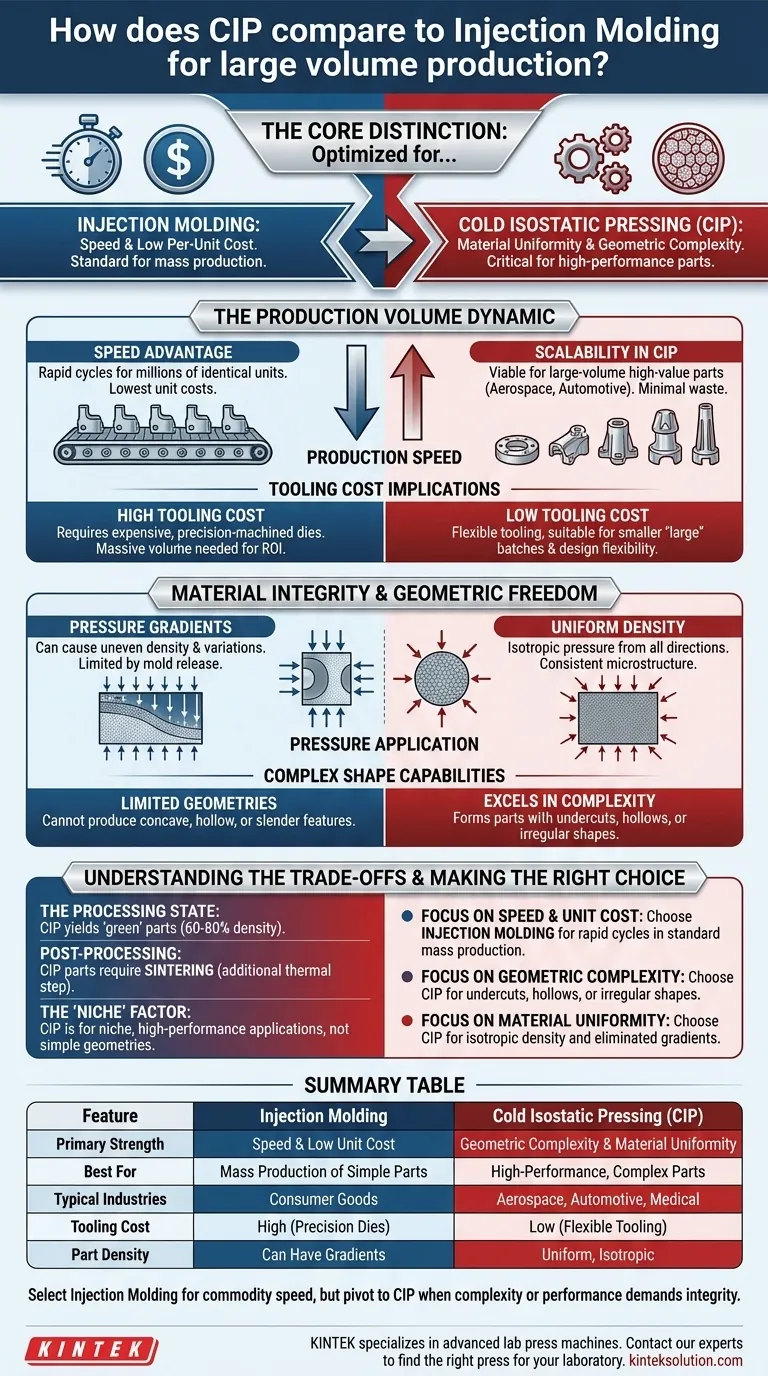
The Core Distinction: Injection molding is optimized for speed and low per-unit cost, making it the standard for mass production. CIP is optimized for material uniformity and geometric complexity, making it the critical choice for high-performance parts in aerospace and automotive sectors where structural integrity outweighs cycle speed.
The Production Volume Dynamic
The Speed Advantage
Injection molding is widely adopted industrially because it offers rapid production cycles. If your goal is to produce millions of identical units in the shortest timeframe possible, injection molding provides the necessary throughput to drive down unit costs.
Scalability in CIP
While slower than injection molding, CIP is scalable. It is capable of producing near-net-shape parts with minimal material waste. This makes it viable for large-volume production, but generally within specific high-value industries like automotive and aerospace, rather than general consumer goods.
Tooling Cost Implications
A major differentiator is the initial investment. CIP offers low tooling costs, which allows for greater flexibility during the design phase or for smaller "large" batches. Injection molding typically requires expensive, precision-machined dies, meaning the volume must be massive to amortize the startup cost.
Material Integrity and Geometric Freedom
Achieving Uniform Density
In injection molding (and uniaxial pressing), pressure gradients can cause uneven density. CIP applies hydraulic pressure uniformly from all directions. This results in a consistent microstructure and eliminates the density variations often seen in other pressing methods.
Complex Shape Capabilities
CIP excels where injection molding fails: complexity. It is the preferred method for parts with concave, hollow, or slender features. Because the pressure is applied via a fluid medium rather than a rigid die, CIP can form shapes that would be impossible to eject from a standard mold.
Strength and Reliability
For demanding applications, CIP produces parts with superior durability. The process creates high-integrity billets with predictable compression during sintering. This minimizes the risk of distortion or cracking, which is critical for components used in military, medical, and nuclear applications.
Understanding the Trade-offs
The Processing State
It is vital to understand that CIP is a powder-compacting process. It yields "green" parts with 60% to 80% of their theoretical density.
Post-Processing Requirements
Unlike many injection molding processes that yield a finished part, CIP parts are specifically prepared for sintering. You must account for this additional thermal processing step in your production timeline and cost analysis.
The "Niche" Factor
While CIP saves on raw material waste, references characterize it as suitable for niche applications. It is generally not a direct replacement for injection molding for simple geometries; it is a solution for parts where the geometry or material properties prevent the use of standard molding.
Making the Right Choice for Your Goal
To select the correct process for your volume production, evaluate your specific constraints:
- If your primary focus is Speed and Unit Cost: Choose Injection Molding for its rapid cycle times and economic efficiency in standard mass production.
- If your primary focus is Geometric Complexity: Choose Cold Isostatic Pressing (CIP) to manufacture parts with undercuts, hollows, or irregular shapes that rigid molds cannot accommodate.
- If your primary focus is Material Uniformity: Choose CIP to ensure isotropic density and eliminate the internal gradients or cracking risks associated with directional pressing.
Select Injection Molding for commodity speed, but pivot to CIP when the part's complexity or performance requirements demand a higher standard of integrity.
Summary Table:
| Feature | Injection Molding | Cold Isostatic Pressing (CIP) |
|---|---|---|
| Primary Strength | Speed & Low Unit Cost | Geometric Complexity & Material Uniformity |
| Best For | Mass Production of Simple Parts | High-Performance, Complex Parts |
| Typical Industries | Consumer Goods | Aerospace, Automotive, Medical |
| Tooling Cost | High (Precision Dies) | Low (Flexible Tooling) |
| Part Density | Can Have Gradients | Uniform, Isotropic |
Struggling to choose the right process for your high-volume production? KINTEK specializes in advanced lab press machines, including isostatic presses, to help you prototype and validate materials for complex parts. Whether your priority is achieving superior material integrity with CIP or exploring other pressing solutions, our expertise ensures you get the performance your application demands. Contact our experts today to discuss your project and discover the right press for your laboratory's needs.
Visual Guide
Related Products
- Electric Lab Cold Isostatic Press CIP Machine
- Electric Split Lab Cold Isostatic Pressing CIP Machine
- Automatic Lab Cold Isostatic Pressing CIP Machine
- Manual Cold Isostatic Pressing CIP Machine Pellet Press
- Lab Isostatic Pressing Molds for Isostatic Molding
People Also Ask
- What are the applications of electric lab cold isostatic presses in research settings? Advance Material R&D with High-Pressure CIPs
- What role do electric lab cold isostatic presses play in industrial contexts? Bridge R&D and Manufacturing with Precision
- How does electrical Cold Isostatic Pressing (CIP) contribute to cost savings? Unlock Efficiency and Reduce Expenses
- What are some research applications of electric lab CIPs? Unlock Uniform Powder Densification for Advanced Materials
- What are the characteristics of standard off-the-shelf electric lab CIP solutions? Achieve Immediate, Cost-Effective Processing
















