
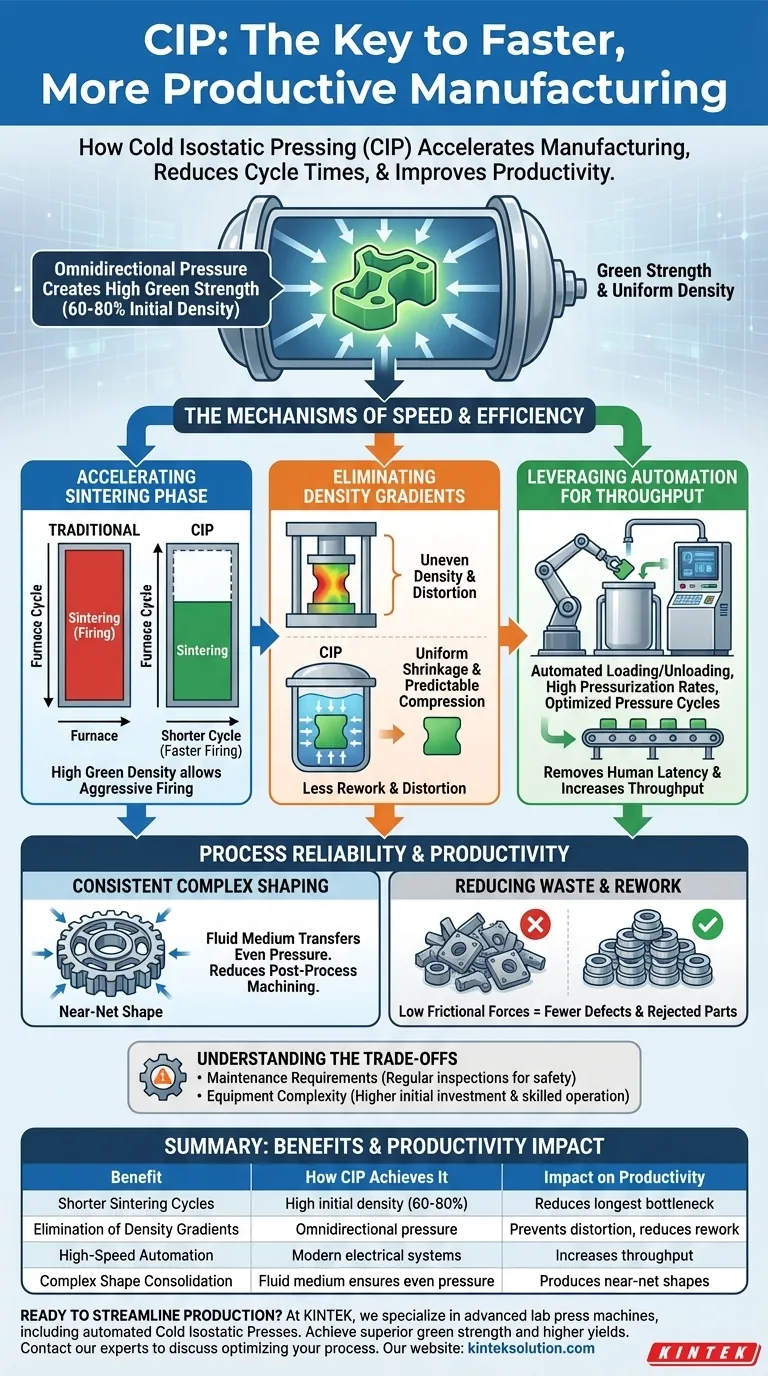
Cold Isostatic Pressing (CIP) accelerates manufacturing by utilizing omnidirectional hydraulic pressure to create parts with exceptional structural uniformity and "green strength." This high initial density allows manufacturers to significantly shorten downstream sintering cycles and utilize high-speed automation without risking component distortion.
The Core Efficiency CIP reduces total production time primarily by improving the material properties of the pre-sintered part. By achieving uniform density and high green strength early in the process, manufacturers can aggressively accelerate firing schedules and automate handling, eliminating bottlenecks common in traditional processing methods.
The Mechanisms of Speed and Efficiency
Accelerating the Sintering Phase
The most significant time savings in the CIP workflow occur during the sintering (firing) stage. Products created through CIP exhibit high "green strength" (strength before firing) and high initial density—often 60% to 80% of the theoretical maximum.
Because the material is already highly consolidated, it can be sintered much faster than materials processed by other methods. This allows the furnace cycle, often the longest bottleneck in production, to be shortened considerably.
Eliminating Density Gradients
Traditional uniaxial pressing often creates uneven density within a part due to friction against die walls. CIP eliminates this by immersing the sealed powder container in a liquid and applying pressure equally from all sides.
This isostatic application results in uniform shrinkage and predictable compression. Consequently, manufacturers spend less time correcting distortion or managing cracking risks during the firing process.
Leveraging Automation for Throughput
Modern electrical CIP systems have moved beyond manual operation to further reduce cycle times. Automated systems now handle the loading and unloading of pressure vessels, removing human latency from the equation.
These systems also offer high pressurization rates and customizable depressurization profiles. This allows operators to optimize the pressure cycle for speed while maintaining strict control over the material's microstructure.
Process Reliability and Productivity
Consistent Complex Shaping
CIP is particularly effective for consolidating complex shapes that would be difficult or slow to mold using other techniques. The fluid medium transfers pressure evenly regardless of the component's geometry.
This capability reduces the need for extensive post-process machining or shaping. By producing a "near-net shape" with high integrity, the total time from powder to finished part is reduced.
Reducing Waste and Rework
The low frictional forces involved in CIP minimize the internal stresses that typically lead to defects. Fewer defects mean fewer rejected parts and less time spent on rework.
This reliability directly translates to higher productivity. The process ensures that the time invested in pressing yields a usable, high-quality billet or preform essentially every time.
Understanding the Trade-offs
Maintenance Requirements
While CIP improves production speed, it introduces maintenance overhead that must be managed to prevent downtime. The hydraulic systems and pressure vessels require regular inspections to ensure safety and longevity. Ignoring these systems can lead to catastrophic equipment failure, negating any productivity gains.
Equipment Complexity
Achieving the high throughput discussed requires sophisticated equipment. Electrical CIP systems offer better control than manual methods, but they represent a higher initial capital investment and require skilled operation to program the automated cycles effectively.
Making the Right Choice for Your Goal
To maximize the benefits of Cold Isostatic Pressing, align your process parameters with your specific manufacturing targets:
- If your primary focus is rapid throughput: Invest in automated CIP systems with high pressurization rates to minimize the physical handling time of the powder containers.
- If your primary focus is reducing furnace time: Maximize the green density of your compacts during the pressing stage to allow for the most aggressive sintering schedules possible.
- If your primary focus is complex geometries: Prioritize the uniformity of the pressure application to eliminate gradient properties, ensuring the part shrinks evenly without distortion.
True productivity in CIP comes not just from pressing fast, but from creating a superior preform that streamlines every subsequent step of production.
Summary Table:
| Benefit | How CIP Achieves It | Impact on Productivity |
|---|---|---|
| Shorter Sintering Cycles | Achieves high initial density (60-80% theoretical) | Reduces the longest bottleneck in production |
| Elimination of Density Gradients | Applies omnidirectional pressure for uniform compaction | Prevents distortion, reduces rework and waste |
| High-Speed Automation | Modern electrical systems with automated loading/unloading | Increases throughput by removing human latency |
| Complex Shape Consolidation | Fluid medium ensures even pressure on all geometries | Produces near-net shapes, reducing post-processing time |
Ready to streamline your production and boost productivity with reliable, high-performance pressing?
At KINTEK, we specialize in advanced lab press machines, including automated Cold Isostatic Presses (CIP) designed for laboratories and R&D facilities. Our equipment helps you achieve superior green strength and uniform density, directly contributing to reduced cycle times and higher yields.
Contact our experts today to discuss how a KINTEK CIP system can be optimized for your specific materials and production goals.
Visual Guide
Related Products
- Electric Lab Cold Isostatic Press CIP Machine
- Electric Split Lab Cold Isostatic Pressing CIP Machine
- Automatic Lab Cold Isostatic Pressing CIP Machine
- Manual Cold Isostatic Pressing CIP Machine Pellet Press
- Lab Isostatic Pressing Molds for Isostatic Molding
People Also Ask
- What role do electric lab cold isostatic presses play in industrial contexts? Bridge R&D and Manufacturing with Precision
- What are the applications of electric lab cold isostatic presses in research settings? Advance Material R&D with High-Pressure CIPs
- How does electrical Cold Isostatic Pressing (CIP) contribute to cost savings? Unlock Efficiency and Reduce Expenses
- What are some research applications of electric lab CIPs? Unlock Uniform Powder Densification for Advanced Materials
- What are the characteristics of standard off-the-shelf electric lab CIP solutions? Achieve Immediate, Cost-Effective Processing
















