
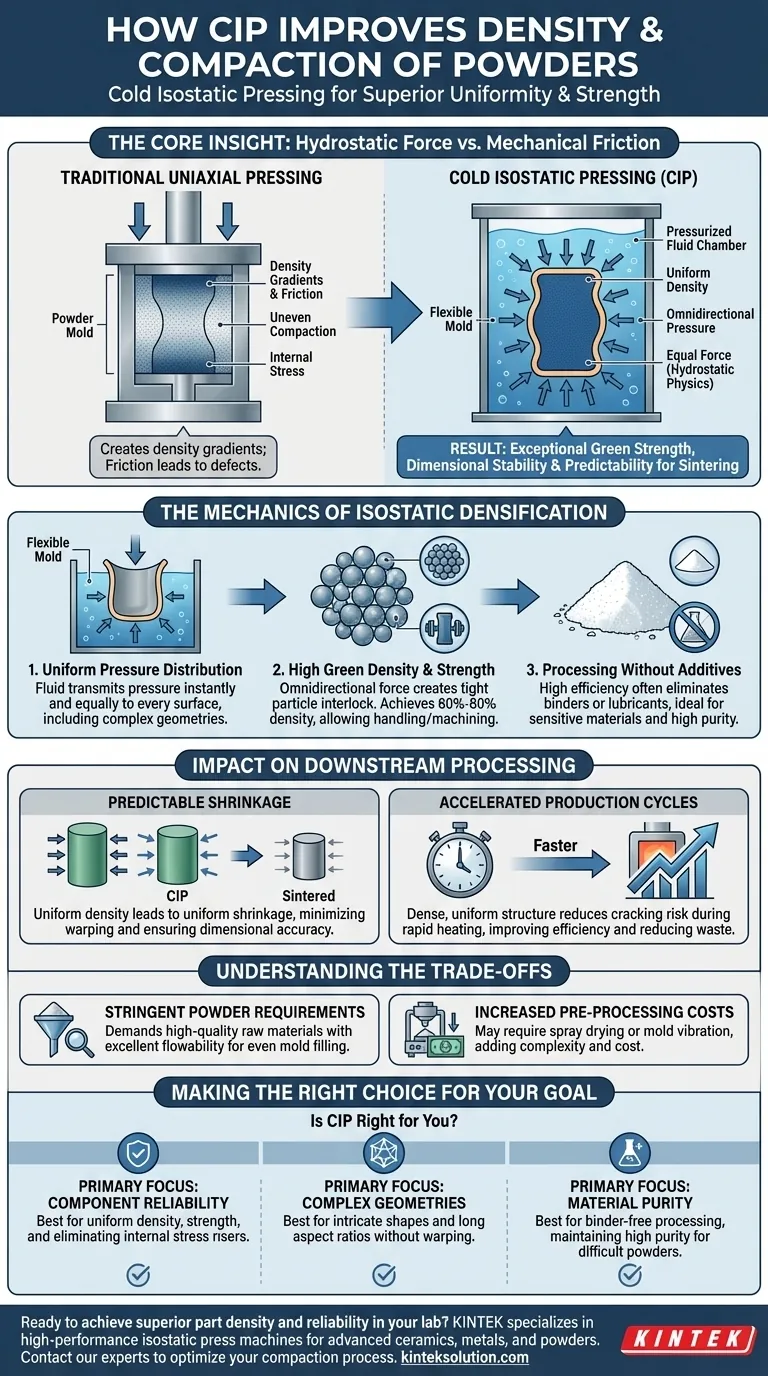
Cold Isostatic Pressing (CIP) achieves superior densification by applying hydraulic pressure uniformly from every direction, rather than mechanically compressing powder from a single axis. By immersing a powder-filled flexible mold into a high-pressure fluid medium, CIP forces the particles together with equal magnitude on all sides, creating a compact solid with high density and minimal internal voids.
The Core Insight While traditional pressing creates density gradients due to friction, CIP utilizes the physics of hydrostatics to ensure every millimeter of the component experiences the exact same force. This results in parts with 60% to 80% of their theoretical density and exceptional "green strength," ensuring they remain dimensionally stable and predictable during the subsequent sintering phase.
The Mechanics of Isostatic Densification
Uniform Pressure Distribution
Unlike uniaxial pressing, which compresses powder from top to bottom, CIP places the material inside a sealed rubber or elastomeric mold submerged in fluid.
When pressure is applied to the fluid, it is transmitted instantly and equally to every surface of the mold. This ensures that complex geometries receive the same compaction force as simple flat surfaces.
High Green Density and Strength
Because the pressure is omnidirectional, the powder particles interlock more tightly than they would under mechanical compression.
This process typically yields parts with 60% to 80% of their theoretical density. The resulting "green" (unsintered) parts possess high mechanical strength, allowing them to be handled or machined before the final heating process.
Processing Without Additives
The high efficiency of isostatic compaction often eliminates the need for chemical binders or lubricants.
This capability is particularly valuable for materials that are chemically sensitive or difficult to press, allowing for "dry pressing" that maintains higher material purity.
Impact on Downstream Processing
Predictable Shrinkage
The most critical advantage of uniform density is the behavior of the part during sintering (firing).
Because there are no dense spots or soft spots within the compacted powder, the material shrinks uniformly. This minimizes warping and ensures the final product maintains excellent dimensional accuracy.
Accelerated Production Cycles
The high green strength achieved by CIP allows manufacturers to sinter materials faster.
Since the internal structure is already dense and uniform, the risk of cracking during rapid heating is significantly reduced, improving overall production efficiency and reducing waste.
Understanding the Trade-offs
Stringent Powder Requirements
While CIP offers superior compaction, it demands high-quality raw materials. The powders used must have excellent flowability to ensure the mold is filled evenly before pressure is applied.
Increased Pre-processing Costs
To achieve the necessary flowability, raw powders often require additional preparation steps, such as spray drying or mold vibration during filling.
These pre-processing steps can add complexity and cost to the production line, meaning CIP is best utilized when component quality is more critical than rock-bottom operational costs.
Making the Right Choice for Your Goal
To determine if Cold Isostatic Pressing is the correct solution for your manufacturing needs, consider your specific constraints:
- If your primary focus is Component Reliability: CIP is the superior choice for ensuring uniform density and strength, eliminating the internal stress risers common in uniaxial pressing.
- If your primary focus is Complex Geometries: CIP allows you to consolidate intricate shapes and long aspect ratios that would otherwise crumble or warp under unidirectional pressure.
- If your primary focus is Material Purity: Use CIP to compact difficult powders without the contamination risk associated with binders and lubricants.
By replacing mechanical friction with hydrostatic force, CIP provides the structural foundation necessary for high-performance, defect-free materials.
Summary Table:
| Key Aspect | Benefit of CIP |
|---|---|
| Pressure Application | Uniform, omnidirectional (hydrostatic) pressure |
| Achievable Green Density | 60% to 80% of theoretical density |
| Part Geometry | Excellent for complex shapes and long aspect ratios |
| Material Purity | Enables binder-free processing, maintaining high purity |
| Downstream Impact | Predictable shrinkage and reduced warping during sintering |
Ready to achieve superior part density and reliability in your lab?
KINTEK specializes in high-performance isostatic press machines, including cold isostatic presses (CIP), designed to deliver the uniform compaction and high green strength detailed in this article. Whether you are processing advanced ceramics, metals, or other powders, our lab presses provide the foundation for defect-free, high-performance materials.
Contact our experts today to discuss how a KINTEK isostatic press can optimize your powder compaction process.
Visual Guide
Related Products
- Electric Lab Cold Isostatic Press CIP Machine
- Electric Split Lab Cold Isostatic Pressing CIP Machine
- Automatic Lab Cold Isostatic Pressing CIP Machine
- Manual Cold Isostatic Pressing CIP Machine Pellet Press
- Lab Isostatic Pressing Molds for Isostatic Molding
People Also Ask
- What are the applications of electric lab cold isostatic presses in research settings? Advance Material R&D with High-Pressure CIPs
- What role do electric lab cold isostatic presses play in industrial contexts? Bridge R&D and Manufacturing with Precision
- How does electrical Cold Isostatic Pressing (CIP) contribute to cost savings? Unlock Efficiency and Reduce Expenses
- What are some research applications of electric lab CIPs? Unlock Uniform Powder Densification for Advanced Materials
- What are the characteristics of standard off-the-shelf electric lab CIP solutions? Achieve Immediate, Cost-Effective Processing
















