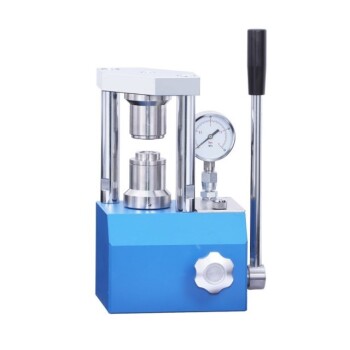
High-precision pressing equipment addresses the critical challenge of high interface impedance in garnet-type solid-state batteries by applying ultra-high, controlled pressure to the cell assembly. This mechanical force drives the tight fusion of the rigid oxide electrolyte with the electrode material, enabling nanometer-scale interface engineering that is otherwise impossible in solid-solid systems.
Core Takeaway In the absence of liquid electrolytes to naturally "wet" surfaces, high-precision pressing serves as the mechanical substitute. It eliminates microscopic voids to lower resistance and creates a dense, robust physical barrier that is essential for inhibiting lithium dendrite growth.
The Mechanics of Interface Engineering
Overcoming High Interface Impedance
Garnet-type oxide electrolytes are rigid ceramics. Unlike liquid electrolytes, they cannot flow into the microscopic irregularities of an electrode surface.
High-precision pressing applies massive force to bridge this gap. This process forces the electrolyte and electrode materials into atomic-level contact.
By eliminating physical gaps, the equipment significantly lowers the contact resistance. This ensures the smooth migration of ions throughout the energy storage system, which is a fundamental requirement for battery operation.
Densification and Porosity Reduction
The performance of a solid-state battery is directly linked to the density of its electrolyte layer.
Pressing equipment compresses solid electrolyte powders into high-density pellets or sheets. This reduction in internal porosity is critical because air gaps act as insulators.
By minimizing these voids, the equipment reduces grain boundary resistance. This directly enhances the overall ionic conductivity of the material, allowing ions to move efficiently through the solid structure.
Addressing Garnet-Specific Challenges
Suppressing Lithium Dendrites
A major failure mode in solid-state batteries is the growth of lithium dendrites—metallic filaments that can puncture the electrolyte and cause short circuits.
High-precision pressing enhances the mechanical stability of the electrolyte layer. A highly densified garnet structure acts as a physical barrier.
This dense barrier effectively inhibits the penetration and growth of lithium dendrites, thereby extending the cycle life and safety of the battery.
Preparation for Sintering and Deposition
Before final assembly, pressing is used to create a "green body" or powder compact.
For applications like pulsed laser deposition (PLD), raw powder is compacted into a dense preform. Achieving a uniform density at this stage is crucial for successful high-temperature sintering (e.g., at 1050°C).
Controlled pressure ensures the final target material has the correct stoichiometry and crystal phase structure, which dictates the fundamental electrochemical properties of the garnet electrolyte.
Understanding the Trade-offs
While high pressure is essential, relying on pressure alone has limitations that must be managed.
Pressure vs. Material Integrity
Garnet electrolytes are ceramic and inherently brittle. While ultra-high pressure (often 100–500 MPa) is needed for contact, excessive or uneven pressure can induce micro-cracks.
These cracks can become pathways for dendrite growth, counteracting the benefits of densification. Precision control is vital to find the "sweet spot" between contact and structural failure.
The Role of Temperature
Physical pressure creates contact, but it may not chemically bond the interfaces.
Supplementary techniques, such as hot pressing (applying heat and pressure simultaneously), are often required to maximize the effect. Heat helps the materials soften slightly, improving the physical "wetting" of the interface beyond what cold pressure can achieve alone.
Making the Right Choice for Your Goal
The specific application of pressing equipment depends on your stage of development.
- If your primary focus is Material Synthesis (Pre-Sintering): Prioritize equipment that delivers uniform isostatic pressure to create homogenous "green bodies" that will not warp or crack during high-temperature firing.
- If your primary focus is Cell Assembly (Interface Optimization): Focus on equipment capable of ultra-high, flat-plate pressure control to force atomic-level contact between the cured electrolyte and the anode/cathode without fracturing the ceramic layer.
High-precision pressing is not just a manufacturing step; it is the primary enabler of ion transport in the rigid architecture of garnet-based solid-state batteries.
Summary Table:
| Feature | Impact on Garnet Electrolytes | Benefit to SSB Performance |
|---|---|---|
| Ultra-High Pressure | Drives atomic-level contact between rigid layers | Drastically lowers interface impedance |
| Powder Densification | Minimizes internal porosity and air gaps | Enhances ionic conductivity across grain boundaries |
| Mechanical Barrier | Creates a robust, dense ceramic structure | Effectively inhibits lithium dendrite penetration |
| Precision Control | Prevents micro-cracks in brittle ceramic materials | Ensures structural integrity and long cycle life |
Elevate Your Solid-State Battery Research with KINTEK
Overcoming the rigid interface challenges of garnet-type electrolytes requires more than just force—it requires precision. KINTEK specializes in comprehensive laboratory pressing solutions designed specifically for the rigorous demands of battery material synthesis and cell assembly.
Whether you need manual, automatic, heated, or glovebox-compatible models, or advanced cold and warm isostatic presses, our equipment ensures uniform densification and optimal interface engineering.
Ready to eliminate interface impedance and enhance your battery's cycle life?
Contact KINTEK Today for a Solution Consultation
References
- Murali Krishna Pasupuleti. Next-Gen Energy Storage: Graphene and Nanomaterials Powering the Nanotechnology Revolution. DOI: 10.62311/nesx/rp05117
This article is also based on technical information from Kintek Solution Knowledge Base .
Related Products
- Warm Isostatic Press for Solid State Battery Research Warm Isostatic Press
- Lab Infrared Press Mold for Laboratory Applications
- Laboratory Hydraulic Press Lab Pellet Press Button Battery Press
- Button Battery Sealing Press Machine for Lab
- Lab Button Battery Tablet Press Sealing Mold
People Also Ask
- Why must composite cathodes be sealed in vacuum lamination bags for WIP? Ensure Battery Stability and Density
- How do sacrificial volume materials (SVM) maintain microchannels in isostatic pressing? Ensure Structural Integrity
- What is the function of elastic molds in warm isostatic pressing? Achieve Uniform Density in Composite Particles
- What is the mechanism of a Warm Isostatic Press (WIP) on cheese? Master Cold Pasteurization for Superior Safety
- What is the process involved in warm isostatic pressing? Mastering Uniform Density with WIP Technology