
Isostatic pressing is a manufacturing technique that significantly enhances the structural quality of pharmaceutical products by applying uniform pressure from all directions. This process ensures that drugs achieve consistent density throughout, resulting in superior mechanical strength that prevents physical degradation during manufacturing, shipping, and storage.
By eliminating the internal weak points common in standard compaction, isostatic pressing guarantees that pharmaceutical products maintain their physical integrity and precise tolerances throughout the entire supply chain.
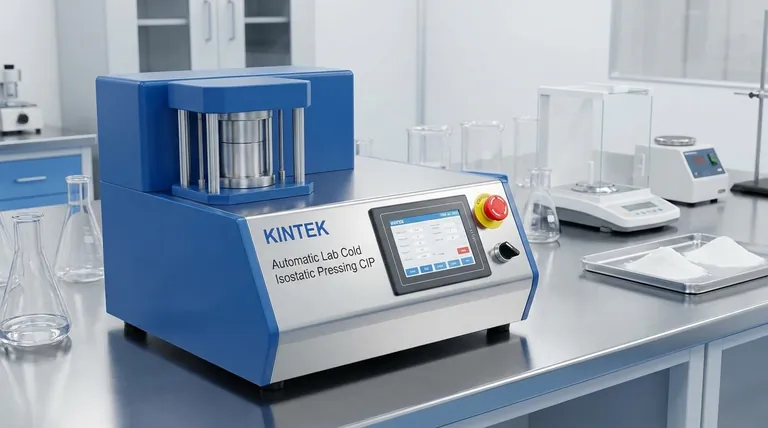
The Mechanics of Isostatic Pressing
Achieving True Uniformity
Unlike traditional uniaxial pressing, which compresses material from the top and bottom, isostatic pressing applies pressure equally from every angle.
This is typically achieved by submerging the material in a pressurized fluid or gas environment.
The result is a product with uniform density, devoid of the density gradients or "soft spots" often found in conventionally pressed tablets.
Enabling Complex Geometries
The nature of isostatic pressing allows for the creation of parts with complex shapes and precise tolerances.
Because the pressure is omnidirectional, manufacturers are not limited by the geometry of rigid dies used in standard mechanical pressing.
This flexibility is essential when producing specialized drug delivery forms or components that require exacting physical dimensions.
Impact on Product Quality and Stability
Enhanced Mechanical Properties
The primary benefit of uniform density is a dramatic improvement in the drug's mechanical properties.
A drug produced via isostatic pressing is structurally more robust and cohesive than one produced via uneven compaction.
This structural soundness ensures the medication remains physically intact, resisting crumbling or capping.
Stability Throughout the Lifecycle
High-quality drugs must survive rigorous conditions beyond the manufacturing floor.
Isostatic pressing ensures stability during transportation and storage, preventing the product from degrading due to vibration or handling.
This physical reliability guarantees that the dosage form reaches the patient exactly as intended.
Understanding the Operational Context
When to Utilize This Method
While isostatic pressing offers superior quality, it is a specialized technique often reserved for high-performance applications.
It is the method of choice when uniformity and density are critical performance metrics that cannot be compromised.
Comparisons to Other Industries
The effectiveness of this technique is proven in demanding fields such as aerospace and nuclear energy.
It is routinely used to produce high-performance alloys and nuclear fuel pellets, validating its ability to deliver uncompromising structural integrity.
Applying these same principles to pharmaceuticals brings an industrial level of precision to drug manufacturing.
Making the Right Choice for Your Manufacturing Goals
To determine if isostatic pressing aligns with your production requirements, consider your primary objectives:
- If your primary focus is Physical Stability: Use this method to ensure drugs withstand the rigors of global shipping and long-term storage without physical degradation.
- If your primary focus is Precision and Homogeneity: Rely on isostatic pressing to eliminate density gradients and achieve tight tolerances in complex dosage forms.
Isostatic pressing transforms pharmaceutical powders into highly durable, uniform products that define the standard for physical quality.
Summary Table:
| Benefit | Key Outcome |
|---|---|
| Uniform Density | Eliminates weak spots and density gradients for consistent product quality. |
| Enhanced Mechanical Strength | Prevents crumbling, capping, and physical degradation. |
| Complex Geometries | Enables precise, intricate shapes for specialized drug delivery forms. |
| Supply Chain Stability | Ensures drugs survive transportation and storage without damage. |
Ready to enhance the structural integrity and stability of your pharmaceutical products? KINTEK specializes in advanced isostatic press machines designed for laboratory and pharmaceutical manufacturing needs. Our equipment delivers the uniform pressure required to produce high-quality, durable drugs with complex geometries and precise tolerances. Contact us today to discuss how our solutions can bring industrial precision to your drug manufacturing process and ensure your products maintain their quality throughout the entire supply chain.
Visual Guide

Related Products
- Warm Isostatic Press for Solid State Battery Research Warm Isostatic Press
- Electric Lab Cold Isostatic Press CIP Machine
- Automatic Lab Cold Isostatic Pressing CIP Machine
- Lab Isostatic Pressing Molds for Isostatic Molding
- Manual Cold Isostatic Pressing CIP Machine Pellet Press
People Also Ask
- Why must composite cathodes be sealed in vacuum lamination bags for WIP? Ensure Battery Stability and Density
- What is the function of elastic molds in warm isostatic pressing? Achieve Uniform Density in Composite Particles
- How do sacrificial volume materials (SVM) maintain microchannels in isostatic pressing? Ensure Structural Integrity
- What is the significance of temperature control in Warm Isostatic Pressing? Unlock Uniform Densification and Process Stability
- What are the advantages of using a Warm Isostatic Press (WIP) for batteries? Achieve Superior Interface Contact



















