
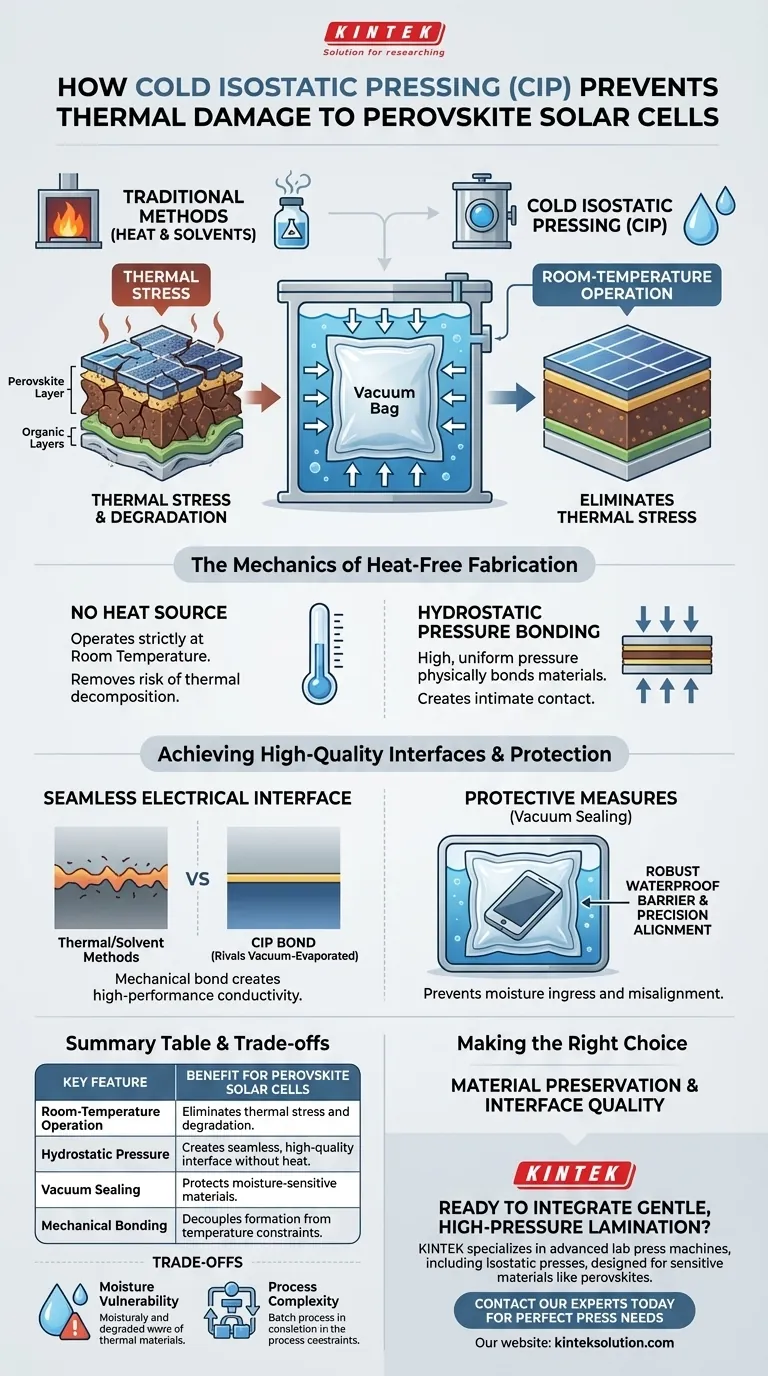
Cold Isostatic Pressing (CIP) circumvents thermal damage by functioning entirely as a room-temperature lamination technique. Instead of relying on heat or solvent evaporation to adhere electrodes, CIP utilizes extreme, uniform hydrostatic pressure to physically bond materials. This approach completely eliminates thermal stress on the heat-sensitive perovskite crystals and organic functional layers, ensuring the intrinsic properties of the solar cell remain intact during fabrication.
By replacing thermal energy with mechanical pressure, CIP decouples the electrode formation process from temperature constraints, preserving the structural integrity of delicate organic photovoltaic layers.
The Mechanics of Heat-Free Fabrication
To understand why CIP is effective, it is necessary to examine how it replaces the function of heat with mechanical force.
Eliminating the Heat Source
Traditional electrode deposition methods often depend on high-temperature sintering or chemical solvents. These processes can easily degrade perovskite materials, which are notoriously sensitive to heat and environmental stress.
CIP operates strictly at room temperature. By removing heat from the equation, it allows for the processing of organic functional layers without the risk of thermal decomposition.
Hydrostatic Pressure as the Bonding Agent
Instead of melting materials together, CIP applies high, uniform hydrostatic pressure.
This pressure physically forces the pre-coated carbon/silver bilayer electrode into the underlying stack. The force is sufficient to press the carbon layer into "intimate contact" with the hole transport layer (HTL).
Achieving High-Quality Interfaces
The mechanical bond created by CIP is not merely superficial.
The process creates a seamless electrical interface that rivals the quality of vacuum-evaporated metal electrodes. This proves that thermal energy is not a prerequisite for high-performance conductivity in these devices.
Protective Measures During Processing
While CIP solves the thermal problem, the process introduces a liquid medium (water) that requires specific management to prevent other forms of damage.
The Critical Role of Vacuum Sealing
The CIP chamber utilizes water to apply pressure, which poses a threat to moisture-sensitive perovskite layers.
A vacuum-sealed bag is employed to act as a robust waterproof barrier. This ensures the device is subjected to the necessary pressure without ever coming into direct contact with the water.
Precision Alignment
Beyond waterproofing, the vacuum bag serves a mechanical purpose.
It holds the loosely placed electrode in the correct position relative to the solar cell stack. This prevents misalignment before the hydrostatic pressure creates the permanent bond.
Understanding the Trade-offs
While CIP offers superior thermal protection, it requires strict adherence to environmental isolation protocols.
Moisture Vulnerability
The primary operational risk in CIP is not heat, but water ingress. Because the hydraulic medium is water, the integrity of the vacuum bag is absolute; any breach leads to immediate degradation of the device.
Process Complexity
CIP is generally a batch process requiring individual bagging and sealing. Compared to continuous thermal processes, this adds a step of preparation to ensure the waterproof barrier is perfectly sealed and the electrode is aligned.
Making the Right Choice for Your Goal
CIP represents a strategic shift from thermal processing to mechanical processing. Consider the following when deciding if this technique suits your fabrication needs:
- If your primary focus is material preservation: CIP is the superior choice because it completely eliminates the thermal degradation risks associated with sintering or solvent evaporation.
- If your primary focus is interface quality: CIP utilizes hydrostatic pressure to achieve a contact quality comparable to vacuum-evaporated metals, ensuring high performance without high temperatures.
By leveraging pressure rather than heat, CIP allows you to build high-efficiency devices without compromising their delicate chemical structure.
Summary Table:
| Key Feature | Benefit for Perovskite Solar Cells |
|---|---|
| Room-Temperature Operation | Eliminates thermal stress and degradation of heat-sensitive perovskite and organic layers. |
| Hydrostatic Pressure | Creates a seamless, high-quality electrical interface without melting or sintering. |
| Vacuum Sealing | Protects moisture-sensitive materials from the water-based pressure medium. |
| Mechanical Bonding | Decouples electrode formation from temperature, preserving structural integrity. |
Ready to integrate gentle, high-pressure lamination into your lab's solar cell fabrication process? KINTEK specializes in advanced lab press machines, including isostatic presses, designed for processing sensitive materials like perovskites. Our equipment helps you achieve superior, damage-free interfaces, ensuring your research maintains the highest material integrity. Contact our experts today to find the perfect press for your laboratory's needs!
Visual Guide
Related Products
- Electric Lab Cold Isostatic Press CIP Machine
- Electric Split Lab Cold Isostatic Pressing CIP Machine
- Automatic Lab Cold Isostatic Pressing CIP Machine
- Manual Cold Isostatic Pressing CIP Machine Pellet Press
- Lab Isostatic Pressing Molds for Isostatic Molding
People Also Ask
- What are the applications of electric lab cold isostatic presses in research settings? Advance Material R&D with High-Pressure CIPs
- What role do electric lab cold isostatic presses play in industrial contexts? Bridge R&D and Manufacturing with Precision
- How does electrical Cold Isostatic Pressing (CIP) contribute to cost savings? Unlock Efficiency and Reduce Expenses
- What are some research applications of electric lab CIPs? Unlock Uniform Powder Densification for Advanced Materials
- What are the characteristics of standard off-the-shelf electric lab CIP solutions? Achieve Immediate, Cost-Effective Processing
















