
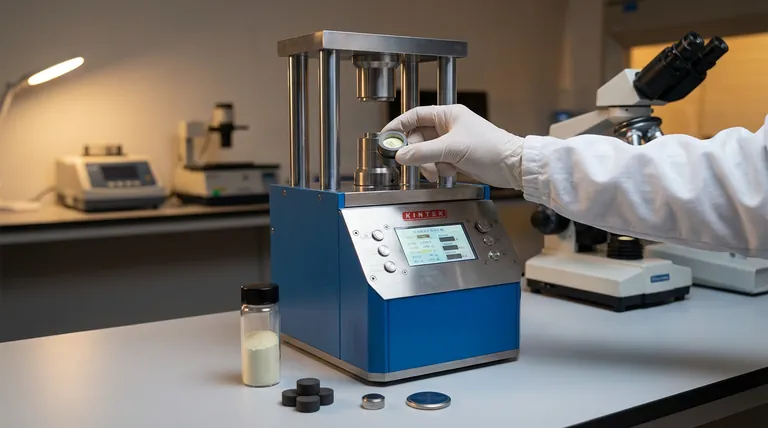
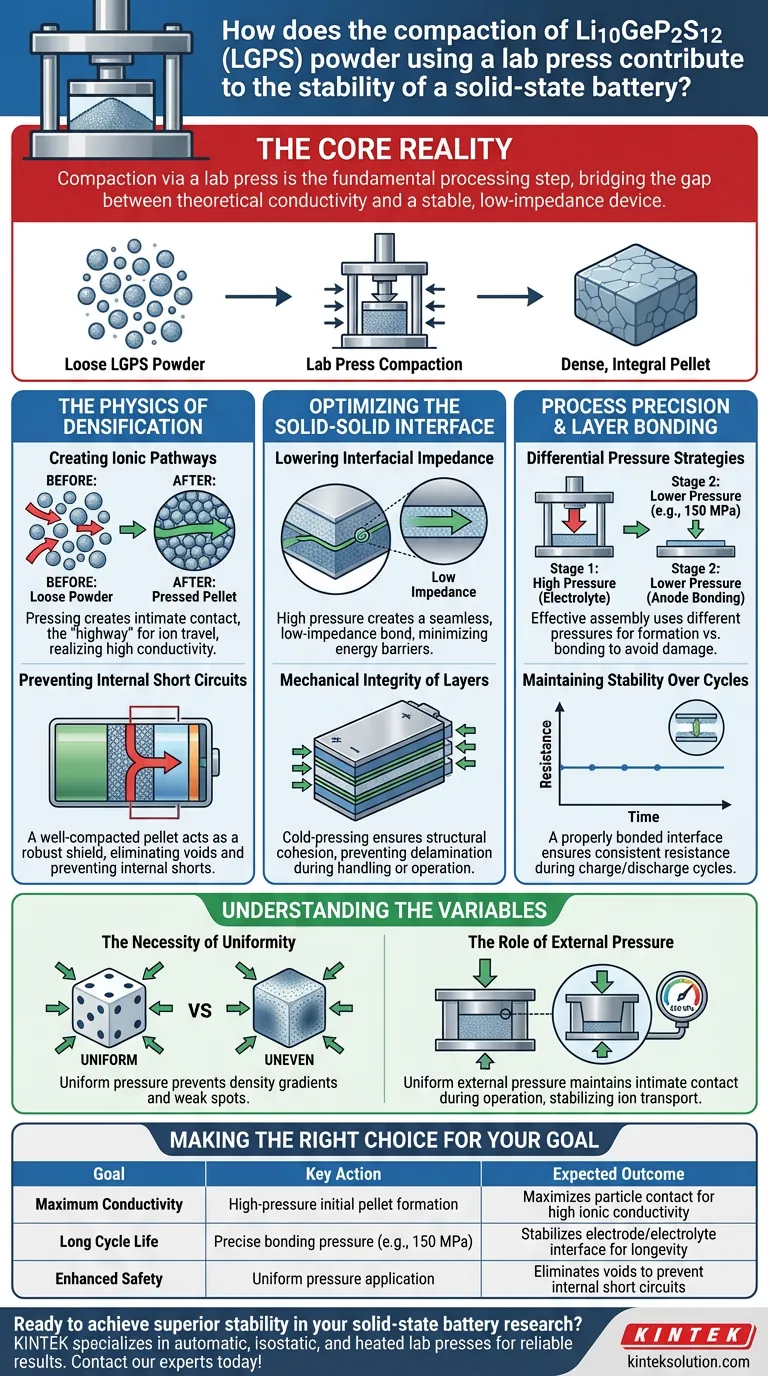
Compaction via a lab press is the fundamental processing step that transforms loose Li10GeP2S12 (LGPS) powder into a functional component capable of sustaining a battery. By applying precise hydraulic pressure, you convert a discontinuous powder into a dense, mechanically integral pellet, establishing the continuous physical contact required for ion transport and structural safety.
The Core Reality A solid-state battery is only as effective as its physical continuity. While the chemistry of LGPS defines its potential, the compaction process determines its actual performance, bridging the gap between theoretical conductivity and a stable, low-impedance device.
The Physics of Densification
Creating Ionic Pathways
Loose LGPS powder has poor conductivity because the gaps between particles act as barriers to ion movement.
Pressing the powder creates intimate contact between these particles. This physical closeness is non-negotiable for realizing high lithium-ion conductivity, as it creates the "highway" required for ions to travel through the electrolyte.
Preventing Internal Short Circuits
A major risk in solid-state batteries is the failure of the electrolyte barrier, leading to shorts.
A well-compacted, high-density pellet acts as a robust physical shield. By eliminating voids and maximizing density, the lab press helps prevent the formation of internal short circuits, directly enhancing the safety profile of the cell.
Optimizing the Solid-Solid Interface
Lowering Interfacial Impedance
The greatest challenge in solid-state batteries is often the resistance at the boundary where materials meet.
Applying high pressure creates a low-impedance solid-solid interface. This seamless bond minimizes the energy barrier ions face when moving between the electrode and electrolyte, which is a prerequisite for efficient battery operation.
Mechanical Integrity of Layers
The battery stack must endure physical stress without delaminating.
Cold-pressing ensures the mechanical integrity of the various material layers. This structural cohesion prevents the components from separating during handling or operation, ensuring the battery remains a single, functional unit.
Process Precision and Layer Bonding
Differential Pressure Strategies
Effective assembly often requires different pressure levels for different stages.
For example, while the initial electrolyte pellet requires high pressure, a lower pressure (such as 150 MPa) is often used to bond the anode material (like a lithium-indium alloy) to the electrolyte. This creates a physically well-connected interface without damaging the components.
Maintaining Stability Over Cycles
The goal of compaction extends beyond the initial assembly.
A properly bonded interface ensures consistent interfacial resistance during charge and discharge cycles. By establishing a stable connection from the start, you prevent the resistance from spiking over time, which preserves the battery's longevity.
Understanding the Variables
The Necessity of Uniformity
Applying pressure is not just about force; it is about distribution.
The lab press must apply uniform pressure across the entire die. Uneven pressure leads to density gradients, creating weak spots where impedance is high or where short circuits are more likely to occur.
The Role of External Pressure
Even after the internal components are pressed, external conditions matter.
Applying a uniform external pressure (e.g., 200 kPa) via a mold ensures the intimate contact is maintained during operation. This minimizes interfacial impedance continuously, stabilizing the ion transport pathway throughout the battery's life.
Making the Right Choice for Your Goal
To maximize the stability of your LGPS solid-state battery, tailor your pressing protocol to your specific performance objectives:
- If your primary focus is Maximum Conductivity: Prioritize high pressure during the initial pellet formation to ensure maximum particle-to-particle contact and density.
- If your primary focus is Cycle Life: Focus on the precision of the secondary bonding step (e.g., 150 MPa) to ensure the anode/electrolyte interface remains stable and low-resistance over time.
- If your primary focus is Safety: Ensure the uniformity of pressure application to eliminate voids that could lead to internal short circuits.
Ultimately, the lab press does not just shape the battery; it enforces the physical boundary conditions that allow the chemistry to work safely and efficiently.
Summary Table:
| Compaction Goal | Key Action | Expected Outcome |
|---|---|---|
| Maximum Conductivity | High-pressure initial pellet formation | Maximizes particle contact for high ionic conductivity |
| Long Cycle Life | Precise bonding pressure (e.g., 150 MPa) | Stabilizes electrode/electrolyte interface for longevity |
| Enhanced Safety | Uniform pressure application | Eliminates voids to prevent internal short circuits |
Ready to achieve superior stability in your solid-state battery research? The right lab press is critical for precise compaction of materials like LGPS. KINTEK specializes in automatic, isostatic, and heated lab presses designed to deliver the uniform pressure and control your laboratory needs for reliable, repeatable results. Contact our experts today to find the perfect press for your specific battery development goals.
Visual Guide
Related Products
- Manual Laboratory Hydraulic Pellet Press Lab Hydraulic Press
- Laboratory Hydraulic Press Lab Pellet Press Button Battery Press
- Laboratory Hydraulic Split Electric Lab Pellet Press
- Automatic Laboratory Hydraulic Press Lab Pellet Press Machine
- Manual Heated Hydraulic Lab Press with Integrated Hot Plates Hydraulic Press Machine
People Also Ask
- What is the primary purpose of a manual lab hydraulic pellet press? Ensure Accurate Sample Prep for XRF and FTIR
- What is the primary purpose of manual lab hydraulic pellet presses? Achieve High-Precision Sample Preparation for Spectroscopy
- What is the purpose of initial axial molding using a lab hydraulic press? Optimizing Electrolyte Green Bodies
- What role does a lab hydraulic press play in researching squishy granular matter? Expert Insights into Material Physics
- What is the primary function of a laboratory hydraulic press in evaluating the ionic conductivity of Li6PS5X (LMSX)?



















