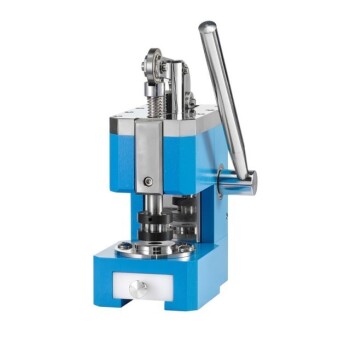
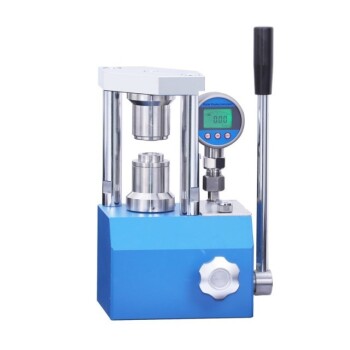
The contribution of a precision disc puncher to testing consistency lies in its ability to standardize the physical geometry of the electrode. It mechanically cuts coated active material sheets into uniform circular discs with a fixed diameter, such as 14 mm. This process ensures that every single battery unit tested begins with identical physical dimensions, serving as the foundational step for accurate comparison.
By eliminating variations in electrode size and mass loading, a precision disc puncher removes physical variables that skew test results. This mechanical consistency prevents current density imbalances, ensuring that long-term cycling data reflects true chemical performance rather than sample preparation errors.
The Mechanics of Standardization
To understand why this equipment is vital, you must look at the variables that affect battery performance. If the physical sample varies, the electrochemical data becomes unreliable.
Ensuring Uniform Reaction Areas
Battery capacity is directly linked to the surface area available for the chemical reaction.
A precision puncher guarantees that the total reaction area is identical across every sample. Without this, a researcher cannot determine if a change in performance is due to the material chemistry or simply because one electrode was slightly larger than another.
Consistent Mass Loading
The amount of active material (mass loading) on the current collector dictates the total energy storage capability.
Because the puncher creates a standardized diameter, it ensures the mass loading of the active material remains highly consistent. This allows for accurate calculation of specific capacity (capacity per unit of mass).
Eliminating Electrical Variables
Beyond simple geometry, the precision of the cut has profound implications for the electrical behavior of the cell during testing.
Preventing Current Density Imbalances
Current density is defined as the current applied divided by the electrode area.
If the electrode size deviates even slightly, the current density changes. A smaller-than-expected area results in higher current density, which can degrade the material faster. The disc puncher eliminates these imbalances, ensuring the electrical stress applied to the material is exactly what the researcher intended.
Reducing Edge Defects
Manual cutting often results in jagged edges or deformation.
A precision puncher uses standardized mechanical processing to create clean cuts. This reduces the risk of physical defects at the electrode edge which could alter the current distribution or cause localized failure points.
The Impact on Data Integrity
The ultimate goal of battery testing is to generate data that can be trusted over time.
Guarantees of Reproducibility
Reproducibility is the ability to get the same result when an experiment is repeated.
By standardizing the input (the electrode disc), the puncher guarantees the reproducibility of the output. This confirms that the results are a property of the battery chemistry, not a fluke of the cutting process.
Reliability in Long-Term Cycling
Battery degradation often happens slowly over hundreds of charge/discharge cycles.
The reference emphasizes that the disc puncher ensures the reliability of long-term cycling test data. Small inconsistencies in size or mass can compound over hundreds of cycles, creating "noise" in the data that obscures the true lifespan of the battery.
Common Pitfalls to Avoid
While a precision disc puncher is essential, it is not a "magic wand." You must be aware of operational trade-offs to maintain consistency.
Burr Formation
If the puncher die is dull or poor quality, it may leave small metal tags known as burrs on the edge of the disc. These can pierce the separator and cause short circuits, rendering the precision of the cut useless.
Coating Delamination
Applying too much pressure or punching brittle coatings can cause the active material to crack or flake off (delaminate). This alters the mass loading unpredictably, negating the consistency the tool is meant to provide.
Cross-Contamination
Precision punchers are often used for different materials. Failure to clean the die between batches can introduce foreign particles, affecting the reliability of the chemical results.
Making the Right Choice for Your Goal
The value of a precision disc puncher depends on what aspect of battery performance you are prioritizing.
- If your primary focus is Fundamental Research: Use the puncher to ensure mass loading consistency, allowing you to calculate specific capacity with high precision.
- If your primary focus is Cycle Life Analysis: Rely on the puncher to maintain uniform reaction areas, which prevents current density errors from artificially shortening the battery's lifespan data.
By removing the variable of physical geometry, you transform your testing process from a rough estimation into a rigorous scientific standard.
Summary Table:
| Feature | Impact on Consistency | Key Benefit for Researchers |
|---|---|---|
| Standardized Diameter | Uniform reaction area | Eliminates physical size as a variable |
| Fixed Geometry | Consistent mass loading | Enables accurate specific capacity calculation |
| Mechanical Precision | Uniform current density | Prevents localized material degradation |
| Clean Edge Cutting | Reduced edge defects | Minimizes risk of short circuits and noise |
| Repeatable Process | High reproducibility | Ensures data reflects chemistry, not prep errors |
Elevate Your Battery Research with KINTEK Precision
In the world of battery research, consistency is the difference between a breakthrough and a failed experiment. KINTEK specializes in comprehensive laboratory pressing and preparation solutions, offering manual, automatic, heated, and glovebox-compatible models designed to meet the rigorous demands of modern electrochemical testing.
By choosing KINTEK, you ensure your electrode preparation is flawless, from mass loading consistency to the elimination of current density imbalances. Whether you need standard disc punchers or advanced cold/warm isostatic presses, we provide the tools necessary for reliable, long-term cycling data.
Ready to standardize your results? Contact us today to find the perfect solution for your lab!
References
- Keun‐il Kim. Interface Stabilization of Aqueous Aluminum Batteries via Non-Flammable Co-Solvent. DOI: 10.3390/batteries11090324
This article is also based on technical information from Kintek Solution Knowledge Base .
Related Products
- Manual Laboratory Hydraulic Press Lab Pellet Press
- Laboratory Hydraulic Split Electric Lab Pellet Press
- Laboratory Hydraulic Press Lab Pellet Press Machine for Glove Box
- Lab Round Bidirectional Press Mold
- Square Bidirectional Pressure Mold for Lab
People Also Ask
- How does a laboratory manual hydraulic press assist in powder canning? Maximize Density and Structural Integrity
- What is the primary objective of using a laboratory manual hydraulic press at 20 MPa? Achieve Perfect Green Body Shaping
- What is the primary purpose of manual lab hydraulic pellet presses? Achieve High-Precision Sample Preparation for Spectroscopy
- What is the primary purpose of a manual lab hydraulic pellet press? Ensure Accurate Sample Prep for XRF and FTIR
- How do lab pellet presses support customization and flexibility? Optimize Your Sample Prep for Any Material