
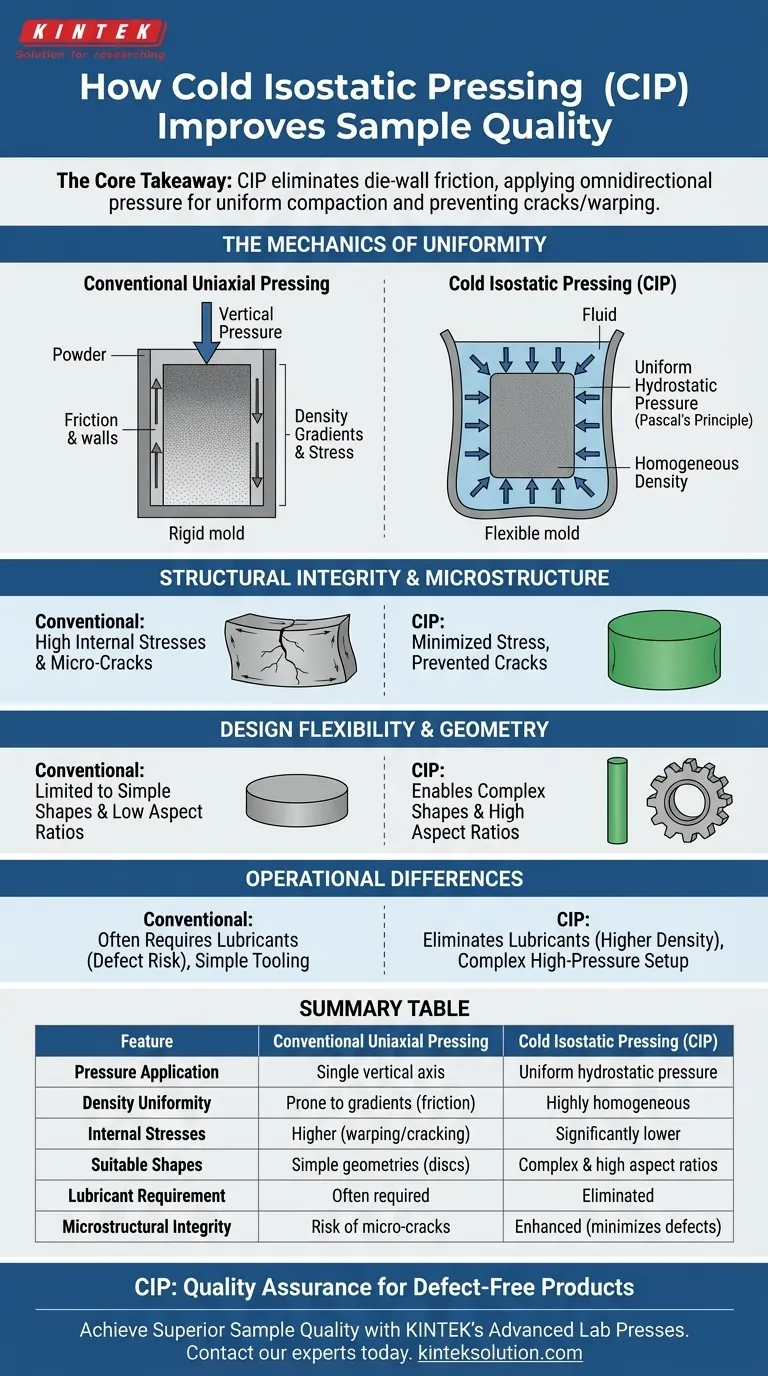
Cold Isostatic Pressing (CIP) fundamentally improves sample quality by utilizing Pascal’s principle to apply uniform hydrostatic pressure from every direction, rather than a single vertical axis. By replacing rigid dies with fluid pressure, CIP eliminates the density gradients and internal stresses inherent to conventional uniaxial pressing, resulting in a mechanically superior and microstructurally uniform "green" body.
The Core Takeaway The superiority of Cold Isostatic Pressing lies in its ability to eliminate "die-wall friction," the primary cause of uneven density in conventional pressing. By applying pressure omnidirectionally, CIP ensures that every cubic millimeter of the material is compacted equally, preventing the cracks and warping that often occur during the subsequent sintering phase.
The Mechanics of Uniformity
Eliminating Die-Wall Friction
In conventional uniaxial pressing, the powder is compressed in a rigid mold. As pressure is applied, friction generates between the powder and the die walls.
This friction creates a "shielding" effect, resulting in significant density variations within the part. CIP uses elastomeric molds submerged in fluid, completely eliminating this friction and the resulting gradients.
Achieving Homogeneous Density
Because pressure is applied hydrostatically (via liquid or gas), the force is identical on all surfaces of the sample.
This allows the powder particles to achieve an extremely high packing density that is consistent throughout the entire volume of the material. This homogeneity is the most critical factor for reliable performance.
Structural Integrity and Microstructure
Minimizing Internal Stresses
Uniaxial pressing often locks internal stresses into the compacted part due to uneven force distribution.
CIP creates a "green body" (the compacted powder before heating) with significantly lower internal stress. This is vital for maintaining the shape integrity of the part once it is removed from the mold.
Preventing Micro-Cracks
The uniformity provided by isostatic pressing is particularly beneficial for brittle or fine powders.
By avoiding stress concentrations, CIP minimizes the formation of micro-cracks. This directly enhances the mechanical reliability and ionic transport uniformity of the finished component.
Design Flexibility and Geometry
Overcoming Aspect Ratio Limits
Uniaxial pressing is strictly limited by the ratio of the part's cross-section to its height. If a part is too tall and thin, pressure cannot travel through it effectively.
CIP does not have this limitation. Because pressure comes from the sides as well as the top and bottom, long or tall parts can be compacted with the same uniformity as short ones.
Enabling Complex Shapes
Uniaxial pressing is restricted to simple shapes with fixed dimensions due to the nature of rigid tooling.
CIP uses flexible elastomeric molds. This allows for the compaction of complex geometries and shapes that would be impossible to eject from a rigid metal die.
Understanding the Operational Differences
Lubricant Elimination
Uniaxial pressing often requires lubricants to mitigate die-wall friction. These lubricants must be burned out later, which can cause defects.
CIP eliminates the need for die-wall lubricants. This allows for higher pressed densities and removes the risks associated with lubricant removal during sintering.
Tooling Complexity
Uniaxial pressing is described as "straightforward" and is typically used for simple shapes like electrode discs.
While CIP offers superior quality, it employs a more complex setup involving fluid mediums and high-pressure vessels (up to 300 MPa) to achieve these results.
Making the Right Choice for Your Goal
While CIP offers superior material properties, the choice between methods depends on your specific requirements for geometry and performance.
- If your primary focus is basic geometry and simplicity: Conventional uniaxial pressing is a straightforward, effective method for preparing simple shapes like discs where minor density gradients are acceptable.
- If your primary focus is high performance and reliability: Cold Isostatic Pressing is essential to ensure a uniform microstructure, high density, and the elimination of micro-cracks, particularly for complex shapes or brittle materials.
Ultimately, CIP is not just a shaping method; it is a quality assurance step that lays the necessary foundation for a defect-free final product.
Summary Table:
| Feature | Conventional Uniaxial Pressing | Cold Isostatic Pressing (CIP) |
|---|---|---|
| Pressure Application | Single vertical axis | Uniform hydrostatic pressure (omnidirectional) |
| Density Uniformity | Prone to gradients due to die-wall friction | Highly homogeneous throughout the sample |
| Internal Stresses | Higher, can lead to warping/cracking | Significantly lower |
| Suitable Shapes | Simple geometries (e.g., discs) | Complex shapes and high aspect ratios |
| Lubricant Requirement | Often required | Eliminated |
| Microstructural Integrity | Risk of micro-cracks | Enhanced, minimizes defects |
Ready to achieve superior sample quality with Cold Isostatic Pressing?
KINTEK's advanced lab press machines, including our range of Cold Isostatic Presses, are designed to deliver the uniform density and structural integrity your research demands.
Whether you are working with brittle ceramics, advanced batteries, or complex material geometries, our expertise ensures you get reliable, high-performance results.
Let us help you build a stronger foundation for your next breakthrough.
Contact our pressing experts today to discuss your specific application needs!
Visual Guide
Related Products
- Electric Lab Cold Isostatic Press CIP Machine
- Electric Split Lab Cold Isostatic Pressing CIP Machine
- Automatic Lab Cold Isostatic Pressing CIP Machine
- Manual Cold Isostatic Pressing CIP Machine Pellet Press
- Lab Isostatic Pressing Molds for Isostatic Molding
People Also Ask
- What are the applications of electric lab cold isostatic presses in research settings? Advance Material R&D with High-Pressure CIPs
- What role do electric lab cold isostatic presses play in industrial contexts? Bridge R&D and Manufacturing with Precision
- How does electrical Cold Isostatic Pressing (CIP) contribute to cost savings? Unlock Efficiency and Reduce Expenses
- What are some research applications of electric lab CIPs? Unlock Uniform Powder Densification for Advanced Materials
- What are the characteristics of standard off-the-shelf electric lab CIP solutions? Achieve Immediate, Cost-Effective Processing
















