
Hydraulic presses have fundamentally altered ceramics manufacturing by shifting the shaping process from a thermal-based approach to a mechanical one. Instead of relying on the time-consuming and energy-intensive environment of a heated kiln to form shapes, producers can now compress materials at room temperature.
Core Takeaway The introduction of hydraulic presses allows for the rapid densification of ceramic powders into solid forms without immediate heat. This shift significantly reduces processing time and enables the efficient production of high-performance industrial items like tiles and bricks at room temperature.
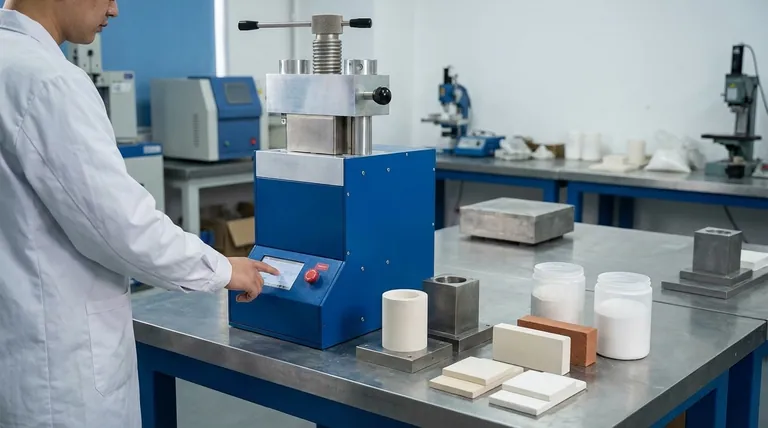
The Shift from Thermal to Mechanical Shaping
Decoupling Heat from Formation
Traditionally, shaping ceramics was deeply intertwined with the heating process in a kiln. Hydraulic presses have changed this dynamic by operating effectively at room temperature.
By removing the requirement for heat during the initial compression phase, manufacturers gain greater control over the production environment. This allows for a distinct separation between forming the object and any subsequent firing that may be required.
Drastic Reduction in Processing Time
The most immediate impact of this technology is speed. The reference material notes that hydraulic presses require significantly less time to form objects compared to traditional kiln methods.
What once took extended periods to settle and form under heat can now be achieved rapidly through mechanical compression. This throughput capability is essential for modern mass production.
Enhancing Material Properties
Achieving Densification
Beyond simple shaping, hydraulic presses are critical for the densification of ceramic materials. The machinery takes loose ceramic powders and compresses them into a cohesive, solid state.
This process ensures that the internal structure of the material is uniform and tightly packed. Densification is a prerequisite for creating durable, structural ceramics.
Creating High-Performance Products
The ability to shape and densify powders reliably has opened the door for high-performance ceramics. This method is not just for artistic wares but is specifically used for industrial applications.
Common outputs of this process include bathroom tiles, bricks, and cement. These products require the structural integrity that is achieved through the consistent application of hydraulic force.
Understanding the Operational Context
Efficiency vs. Complexity
While the hydraulic press offers speed, it specifically utilizes minimal pressure to achieve these results compared to the energy required for thermal shaping. This suggests a highly efficient transfer of energy.
However, this process is heavily dependent on the state of the raw material. The process relies on preparing ceramic powders, implying that raw materials must be processed into a specific powder form before the press can be effective.
Specificity of Application
The shift to hydraulic pressing is most evident in the production of uniform, standardized shapes. The references highlight specific items like tiles and bricks.
This indicates that the technology is best suited for producing consistent, geometric forms rather than organic, irregular shapes often associated with manual ceramic artistry.
Making the Right Choice for Your Goal
When evaluating whether hydraulic pressing is the right approach for a ceramics project, consider your end goals regarding volume and material density.
- If your primary focus is speed: Use hydraulic presses to compress materials in a fraction of the time required for kiln-based shaping.
- If your primary focus is material integrity: Rely on this method to densify ceramic powders into high-performance solids suitable for industrial use.
- If your primary focus is energy management: Leverage the ability to shape materials at room temperature to reduce the thermal load during the forming stage.
Hydraulic pressing transforms ceramics from a slow, heat-dependent craft into a rapid, room-temperature industrial process capable of delivering high-density solids.
Summary Table:
| Aspect | Traditional Kiln Method | Hydraulic Press Method |
|---|---|---|
| Shaping Process | Thermal-based, in kiln | Mechanical compression |
| Operating Temperature | High heat required | Room temperature |
| Processing Time | Slow, time-consuming | Rapid, significantly faster |
| Primary Outcome | Basic shaping | Shaping + Densification |
| Ideal For | Artistic wares, irregular shapes | Standardized, high-volume items (tiles, bricks) |
Ready to revolutionize your ceramics production with efficient, room-temperature shaping?
At KINTEK, we specialize in high-performance lab press machines, including automatic and heated lab presses, designed to meet the precise demands of modern laboratory and industrial settings. Our hydraulic presses can help you achieve rapid densification and superior material integrity for your high-volume ceramic products.
Contact us today to discover the right press for your needs and enhance your manufacturing efficiency!
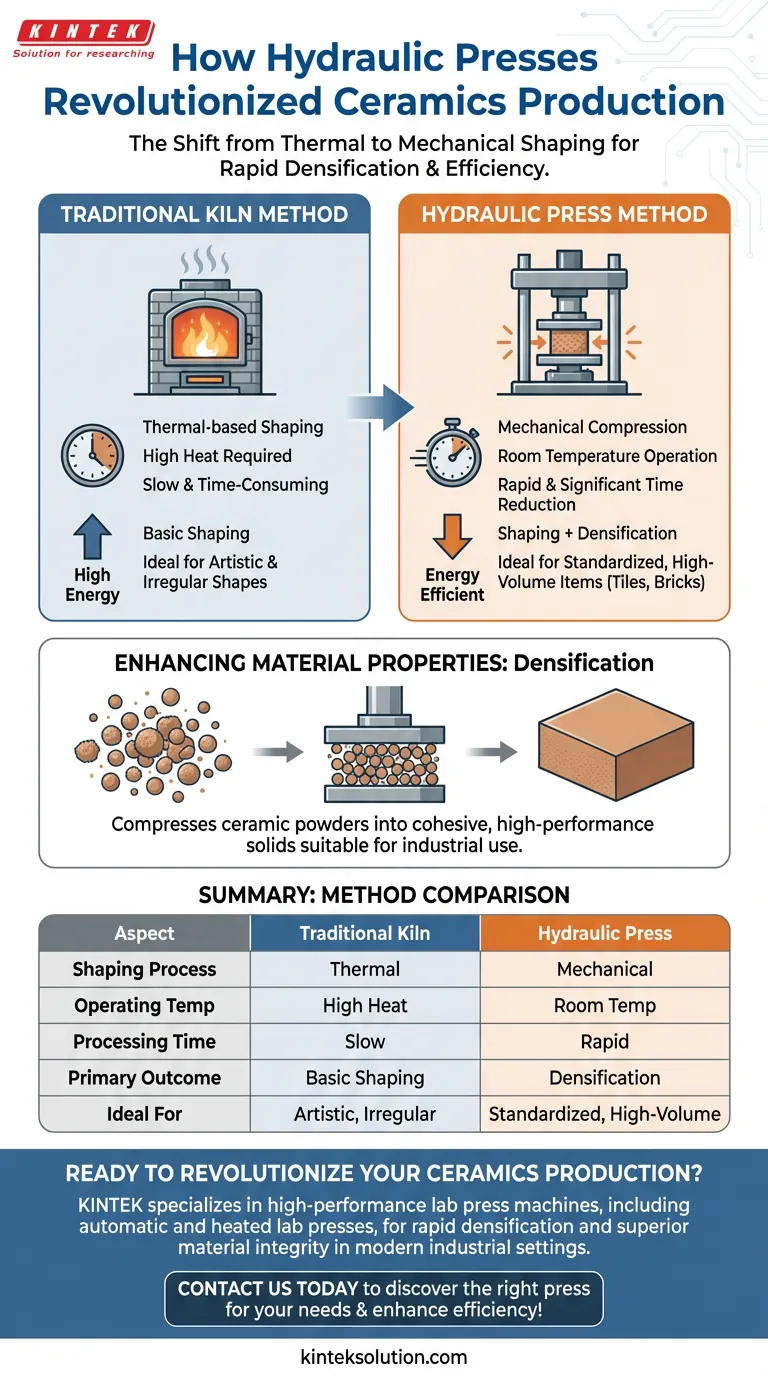
Visual Guide
Related Products
- Automatic High Temperature Heated Hydraulic Press Machine with Heated Plates for Lab
- Manual Heated Hydraulic Lab Press with Integrated Hot Plates Hydraulic Press Machine
- Heated Hydraulic Press Machine with Heated Plates for Vacuum Box Laboratory Hot Press
- Laboratory Hydraulic Press 2T Lab Pellet Press for KBR FTIR
- Laboratory Hydraulic Press Lab Pellet Press Machine for Glove Box
People Also Ask
- Function of a Laboratory Hydraulic Press with Heated Platens in SSE? Enhance Battery Density & Conductivity
- How does a laboratory heated hydraulic press facilitate PBN sample prep for WAXS? Achieve Precise X-Ray Scattering
- What are the requirements for electrode pressing with high-viscosity ionic liquids like EMIM TFSI? Optimize Performance
- What are the industrial applications of heated hydraulic presses? Master Heat & Force for Precision Manufacturing
- Why is a laboratory hydraulic press with heating plates required for PLA/TEC films? Achieve Precise Sample Integrity



















