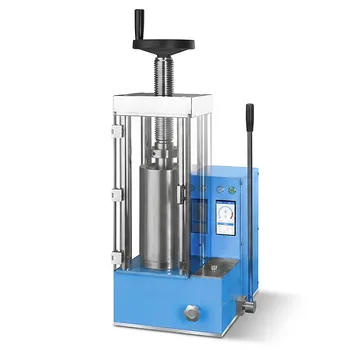
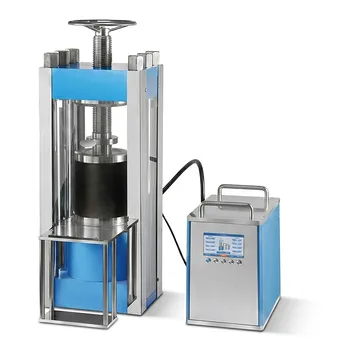
Standardizing the evaluation of SEBS/HNT masterbatches requires a precise transformation from raw pellets into analytical specimens. An electric heated flat laboratory press achieves this by applying simultaneous thermal energy and mechanical pressure to create uniform, orientation-free sheets suitable for high-precision material characterization.
The laboratory press serves as a critical bridge between masterbatch production and performance testing, ensuring that subsequent mechanical analyses reflect the intrinsic properties of the polymer composite rather than the artifacts of the molding process.
The Mechanics of Sample Reconstruction
Simultaneous Thermal and Mechanical Stress
The press operates by applying a controlled environment of high temperature and high pressure to the SEBS/HNT pellets. In a typical evaluation, the material is subjected to temperatures around 165°C and pressures near 12.5 MPa.
Achieving Geometric Uniformity
This process effectively melts and compresses the masterbatch into flat, dense sheets. This specific geometry is essential for maintaining a consistent thickness across the entire sample area.
Ensuring Material Density
The high-pressure environment eliminates internal voids or air pockets within the polymer matrix. This density is crucial for ensuring that the Halloysite Nanotubes (HNT) are properly embedded within the Styrene-Ethylene-Butylene-Styrene (SEBS) matrix.
Eliminating Processing Artifacts
The Problem with Injection Molding
Traditional injection molding introduces complex orientation effects due to the rapid flow of molten polymer into a mold. These flow-induced stresses can align the polymer chains and HNT fillers in a way that biases mechanical test results.
Establishing an Isotropic Baseline
Compression molding via a flat press minimizes these orientation effects by applying pressure evenly across the surface. This produces a standardized sample surface that is more representative of the material's bulk properties.
Reducing Internal Stress
Because the material is not forced through narrow gates or channels, the resulting sheets have lower residual internal stresses. This stability is vital for obtaining reproducible data during sensitive analytical procedures.
Enabling Downstream Analytical Techniques
Dynamic Mechanical Analysis (DMA)
The uniform sheets produced by the press are the ideal starting point for DMA. This technique measures the viscoelastic properties of the SEBS/HNT composite as a function of temperature or frequency.
Nanoindentation Testing
For surface-level evaluation, the flat and dense nature of the sheets allows for nanoindentation. This provides precise measurements of hardness and elastic modulus at the micro and nano scales.
Nanoscratch Performance
The standardized surface also facilitates nanoscratch testing to evaluate the wear resistance and adhesion of the HNT fillers within the SEBS matrix. A smooth, flat surface is mandatory to ensure the probe maintains consistent contact during the test.
Understanding the Trade-offs
Static vs. Dynamic Flow
While compression molding eliminates orientation effects, it does not simulate the dynamic flow conditions found in industrial manufacturing. Results may not perfectly predict how the material will behave during high-speed injection molding.
Cycle Time and Throughput
Compression molding is generally a slower process compared to automated injection molding. It is optimized for accuracy and standardization in a laboratory setting rather than high-volume specimen production.
Thermal History Sensitivity
The specific temperature and cooling rate used in the press can influence the crystallinity and morphology of the SEBS. Inconsistent cooling protocols between batches can lead to variations in the final performance data.
How to Apply This to Your Evaluation
Strategic Recommendations
Effective utilization of a laboratory press depends on aligning the molding parameters with your specific analytical goals.
- If your primary focus is intrinsic material properties: Use the flat press to produce sheets for DMA to ensure that orientation effects do not skew your stiffness and damping measurements.
- If your primary focus is surface durability: Ensure the press plates are highly polished to create the smoothest possible surface for nanoindentation and nanoscratch testing.
- If your primary focus is filler dispersion: Use standardized compression molded samples to perform cross-sectional analysis, as this provides a clearer view of the HNT distribution without flow-induced clustering.
By utilizing thermal compression molding, researchers can decouple the inherent performance of the SEBS/HNT masterbatch from the variables introduced by the molding process itself.
Summary Table:
| Process Feature | Standard Parameter | Analytical Benefit |
|---|---|---|
| Temperature | ~165°C | Ensures uniform polymer melting and filler integration |
| Pressure | ~12.5 MPa | Eliminates internal voids for maximum sample density |
| Sample Geometry | Flat, dense sheets | Provides consistent thickness for precise characterization |
| Material State | Isotropic baseline | Minimizes orientation effects found in injection molding |
| Surface Quality | Highly polished | Enables accurate nanoindentation and scratch testing |
Precision Sample Preparation with KINTEK Pressing Solutions
Unlock the full potential of your material evaluation by ensuring perfectly standardized specimens. KINTEK specializes in comprehensive laboratory pressing solutions, offering manual, automatic, heated, multifunctional, and glovebox-compatible models, alongside cold and warm isostatic presses—technology widely applied in cutting-edge battery research and polymer science.
Our presses provide the precise thermal and mechanical control necessary to eliminate flow-induced stress and achieve isotropic material baselines for high-accuracy DMA and nanoindentation testing.
Ready to elevate your lab's efficiency and data reproducibility? Contact KINTEK today to discover the ideal pressing solution tailored to your research needs!
References
- Zina Vuluga, Valentin Rădițoiu. The Effect of SEBS/Halloysite Masterbatch Obtained in Different Extrusion Conditions on the Properties of Hybrid Polypropylene/Glass Fiber Composites for Auto Parts. DOI: 10.3390/polym13203560
This article is also based on technical information from Kintek Solution Knowledge Base .
Related Products
- Cylindrical Lab Electric Heating Press Mold for Laboratory Use
- Automatic Heated Hydraulic Lab Press Machine 200x200 Plate Size for Battery Research and Materials Science
- Automatic Heated Hydraulic Press Machine with Hot Plates for Laboratory
- 24T 30T 60T Heated Hydraulic Lab Press Machine with Hot Plates for Laboratory
- Automatic High Temperature Heated Hydraulic Press Machine with Heated Plates for Lab
People Also Ask
- How does a laboratory electric heated press ensure sample quality? Optimize SiR-EPDM vulcanization and molding.
- What role does a laboratory electric heated press play in polymer composite fabrication? Key for Standardized Specimens
- What role does a laboratory electric heating press play in NBR molding? Master Vulcanization & Material Density
- Why is a laboratory electric heating press required for PP/EPDM molding? Achieve Superior Specimen Integrity
- What is the purpose of incorporating cartridge heaters into a lab press mold for MLCC block compression? Optimize Results