
Cold Isostatic Pressing (CIP) is a powder consolidation technique utilized in the mass production of advanced ceramics to create high-density, complex components by applying uniform hydrostatic pressure to a flexible mold. Unlike uniaxial pressing which exerts force from a single direction, CIP subjects the ceramic powder to equal pressure from all sides, resulting in parts with superior microstructural uniformity and near-net-shape precision.
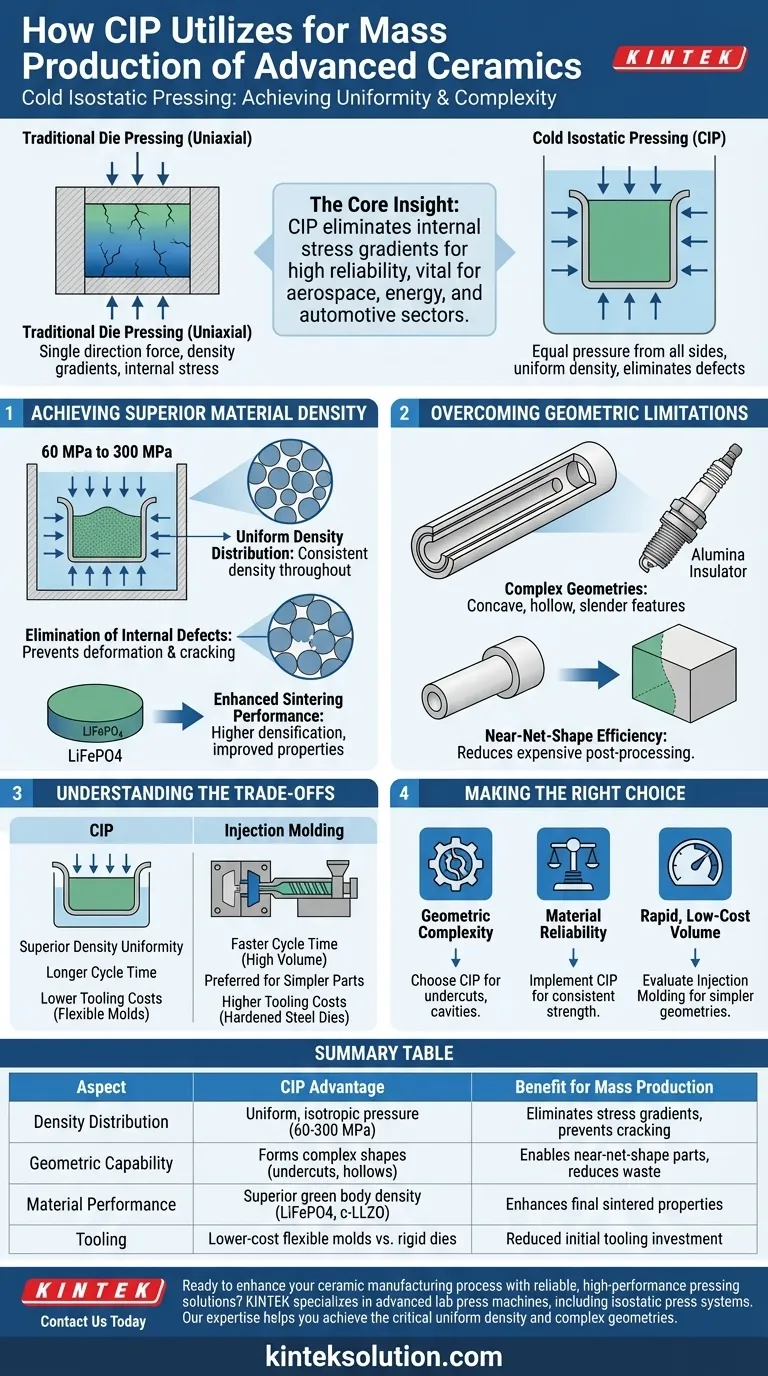
The Core Insight While traditional die pressing is faster for simple shapes, CIP is indispensable for mass-producing ceramics that require uniform density distributions and complex geometries. It eliminates the internal stress gradients that lead to cracking, ensuring high reliability for critical components in aerospace, energy, and automotive sectors.
Achieving Superior Material Density
The primary technical advantage of CIP in mass production is its ability to manipulate the microstructure of the ceramic "green body" (the unfired part) before sintering.
Uniform Density Distribution
In traditional manufacturing, friction against die walls creates density gradients. CIP eliminates this by using fluid dynamics to apply pressure—often ranging from 60 MPa to 300 MPa—evenly across the entire surface. This results in a green body with consistent density throughout the part.
Elimination of Internal Defects
Because the pressure is isotropic (equal in all directions), the macroscopic pores between particles are effectively closed. This rearrangement of particles prevents stress concentrations that typically cause deformation or cracking during the high-temperature sintering phase.
Enhanced Sintering Performance
For advanced materials like LiFePO4 or c-LLZO (solid-state battery electrolytes), this density is critical. CIP creates a compact structure that allows for higher densification during firing, significantly improving ionic conductivity and mechanical strength.
Overcoming Geometric Limitations
Mass production often struggles with complex shapes; CIP solves this by decoupling the forming process from rigid metal tooling.
Production of Complex Geometries
CIP is capable of forming shapes that are impossible for uniaxial die pressing. This includes components with concave, hollow, or slender features. A classic mass-production example is the alumina insulator found in spark plugs, which requires a specific, elongated internal geometry.
Near-Net-Shape Efficiency
The process produces parts that are very close to their final dimensions. This "near-net-shape" capability significantly reduces the need for expensive and time-consuming post-processing (machining), leading to substantial raw material savings.
Understanding the Trade-offs
To make an objective decision, you must weigh the benefits of CIP against other industrial methods like injection molding.
Cycle Time vs. Quality
While CIP offers superior density uniformity, it generally has a longer cycle time than injection molding. Injection molding is often preferred for high-volume runs of smaller, less critical parts where speed is the priority over microstructural perfection.
Tooling Costs
CIP typically uses flexible molds (like rubber bags), which have lower tooling costs compared to the expensive, hardened steel dies required for injection molding or dry pressing. However, the lifespan of these flexible molds can be shorter, requiring a different maintenance strategy for mass production lines.
Making the Right Choice for Your Goal
When integrating Cold Isostatic Pressing into a manufacturing workflow, consider your specific performance requirements.
- If your primary focus is geometric complexity: Choose CIP for parts with undercuts, long aspect ratios, or internal cavities that rigid dies cannot release.
- If your primary focus is material reliability: Implement CIP to eliminate density gradients in high-performance ceramics, ensuring consistent shrinkage and strength after sintering.
- If your primary focus is rapid, low-cost volume: Evaluate if injection molding can meet your quality standards, as it may offer faster throughput for simpler geometries.
By leveraging CIP, manufacturers can bridge the gap between material science and mass production, delivering advanced ceramics that do not compromise on structural integrity.
Summary Table:
| Aspect | CIP Advantage | Benefit for Mass Production |
|---|---|---|
| Density Distribution | Uniform, isotropic pressure (60-300 MPa) | Eliminates internal stress gradients, prevents cracking during sintering |
| Geometric Capability | Forms complex shapes (undercuts, hollows, slender features) | Enables near-net-shape parts, reduces post-processing and material waste |
| Material Performance | Superior green body density for materials like LiFePO4, c-LLZO | Enhances final sintered properties (ionic conductivity, mechanical strength) |
| Tooling | Lower-cost flexible molds vs. rigid dies | Reduced initial tooling investment for complex parts |
Ready to enhance your ceramic manufacturing process with reliable, high-performance pressing solutions?
At KINTEK, we specialize in advanced lab press machines, including isostatic press systems, designed to meet the rigorous demands of laboratory and R&D settings. Our expertise helps you achieve the uniform density and complex geometries critical for developing next-generation advanced ceramics.
Contact us today to discuss how our pressing technology can bridge the gap between your material science and production goals.
Visual Guide
Related Products
- Electric Lab Cold Isostatic Press CIP Machine
- Electric Split Lab Cold Isostatic Pressing CIP Machine
- Automatic Lab Cold Isostatic Pressing CIP Machine
- Manual Cold Isostatic Pressing CIP Machine Pellet Press
- Lab Isostatic Pressing Molds for Isostatic Molding
People Also Ask
- What are the applications of electric lab cold isostatic presses in research settings? Advance Material R&D with High-Pressure CIPs
- What role do electric lab cold isostatic presses play in industrial contexts? Bridge R&D and Manufacturing with Precision
- How does electrical Cold Isostatic Pressing (CIP) contribute to cost savings? Unlock Efficiency and Reduce Expenses
- What are some research applications of electric lab CIPs? Unlock Uniform Powder Densification for Advanced Materials
- What are the characteristics of standard off-the-shelf electric lab CIP solutions? Achieve Immediate, Cost-Effective Processing
















