
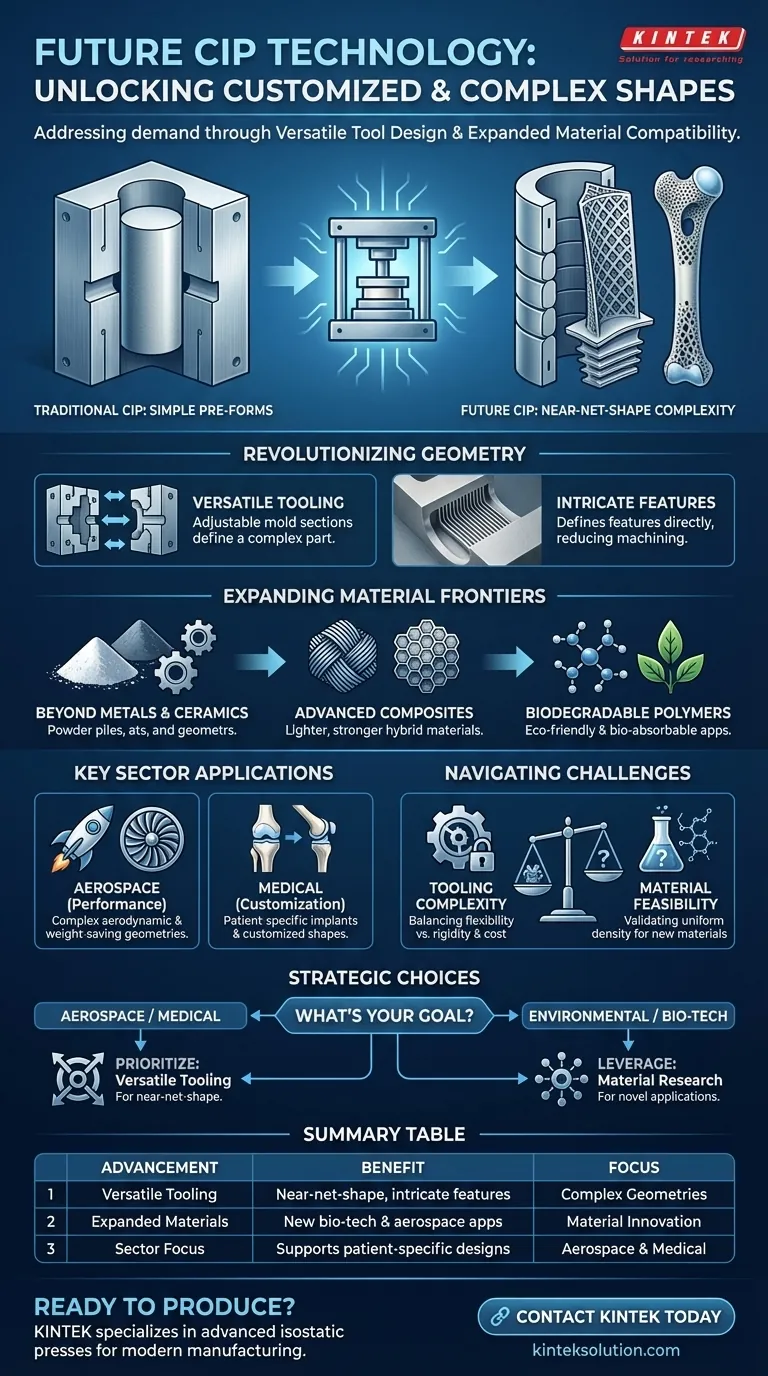
Future Cold Isostatic Pressing (CIP) technology is addressing the demand for complex shapes primarily through advancements in versatile tool design. This evolution enables the production of highly intricate, customized components that were previously impossible to manufacture using traditional powder consolidation methods, specifically targeting the high-performance needs of the aerospace and medical sectors.
While traditional CIP was often limited to simple pre-forms, the future of the technology lies in bridging the gap between material density and geometric complexity. By combining flexible tooling with expanded material compatibility, CIP is transforming from a bulk processing method into a solution for precision component manufacturing.
Revolutionizing Component Geometry
The Shift to Versatile Tooling
To meet the demand for customization, future CIP systems are moving away from rigid, standard molds.
The focus is on adaptable tool designs that can withstand high pressures while defining non-standard shapes. This versatility allows manufacturers to move beyond simple rods and tubes to create near-net-shape parts.
Enabling Intricate Features
Previously, complex geometries were a significant barrier for isostatic pressing.
New tooling technologies allow for the inclusion of intricate features directly during the pressing stage. This reduces the need for extensive post-process machining, preserving material integrity and reducing waste.
Impact on High-Performance Sectors
The ability to produce complex shapes is driven by specific industry needs.
In aerospace, performance often dictates complex aerodynamic or weight-saving geometries. In the medical field, patient-specific implants require highly customized shapes that standard tooling cannot produce.
Expanding Material Compatibility
Beyond Metals and Ceramics
While CIP has traditionally focused on metal and ceramic powders, the scope is widening.
Current research is exploring the feasibility of processing advanced composites. This allows engineers to design parts that benefit from the uniform density of CIP while utilizing lighter, stronger hybrid materials.
New Frontiers in Polymers
The technology is also adapting to accommodate biodegradable polymers.
This expansion opens new applications in biomedicine and environmental technology. It allows for the creation of complex, density-optimized components that are also eco-friendly or bio-absorbable.
Understanding the Challenges and Trade-offs
The Complexity of Tool Design
While versatile tooling enables complex shapes, it introduces new engineering challenges.
Designing molds that are flexible enough to transmit pressure uniformly but rigid enough to define intricate details is difficult. Increased geometric complexity often correlates with higher initial tooling costs and longer development cycles.
Material Feasibility
Expanding into composites and polymers requires rigorous validation.
Not all materials respond to isostatic pressure in the same way as metals. Research into these new materials must ensure that the benefits of CIP—such as uniform density—are not lost when applied to polymers with different compressibility factors.
Making the Right Choice for Your Goal
As CIP technology evolves, your strategy should align with your specific industry requirements.
- If your primary focus is Aerospace or Medical Components: Prioritize investments in versatile tooling designs that allow for near-net-shape manufacturing of complex geometries to reduce machining costs.
- If your primary focus is Environmental or Bio-Tech Innovation: Monitor the research on material compatibility, specifically regarding biodegradable polymers and advanced composites, to leverage CIP for novel applications.
Future CIP technology is positioning itself not just as a densification process, but as a critical enabler of next-generation product design.
Summary Table:
| Aspect | Future CIP Advancement | Key Benefit |
|---|---|---|
| Tooling | Versatile, adaptable tool designs | Enables near-net-shape parts with intricate features |
| Materials | Expanded compatibility with composites & biodegradable polymers | Opens new applications in aerospace, medical, and bio-tech |
| Sectors | Focus on aerospace and medical components | Supports complex geometries and patient-specific designs |
Ready to produce complex, high-performance components with precision?
At KINTEK, we specialize in advanced lab press machines, including isostatic presses, designed to meet the evolving demands of modern manufacturing. Whether you're in aerospace, medical, or bio-tech, our equipment supports versatile tooling and material compatibility for customized solutions.
Contact us today to explore how our CIP technology can enhance your component design and production efficiency!
Visual Guide
Related Products
- Electric Lab Cold Isostatic Press CIP Machine
- Electric Split Lab Cold Isostatic Pressing CIP Machine
- Automatic Lab Cold Isostatic Pressing CIP Machine
- Manual Cold Isostatic Pressing CIP Machine Pellet Press
- Lab Isostatic Pressing Molds for Isostatic Molding
People Also Ask
- What role do electric lab cold isostatic presses play in industrial contexts? Bridge R&D and Manufacturing with Precision
- What are the applications of electric lab cold isostatic presses in research settings? Advance Material R&D with High-Pressure CIPs
- How does electrical Cold Isostatic Pressing (CIP) contribute to cost savings? Unlock Efficiency and Reduce Expenses
- What are some research applications of electric lab CIPs? Unlock Uniform Powder Densification for Advanced Materials
- What are the characteristics of standard off-the-shelf electric lab CIP solutions? Achieve Immediate, Cost-Effective Processing
















