
Shock compression technology consolidates nanopowders by subjecting loose particles to extremely short, high-pressure shock waves. This rapid application of force achieves full material density while effectively bypassing the prolonged heating stages that typically degrade the unique properties of nanomaterials.
The defining characteristic of shock compression is its ability to achieve full compaction without grain growth. By utilizing speed and pressure rather than sustained heat, this method preserves the nanostructure of the material while eliminating voids.
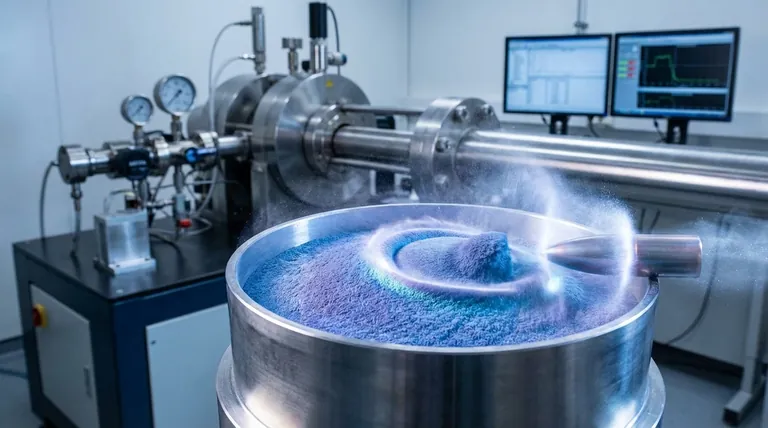
The Challenge of Nanopowder Compaction
The Thermal Dilemma
Traditional consolidation methods often rely on sintering, which uses high heat over time to bond particles.
Unfortunately, this heat causes grain growth, causing nanopowders to lose the specific microscopic properties that made them valuable in the first place.
The Shock Solution
Shock compression solves this by substituting thermal energy with kinetic energy.
The process subjects the powder to a high-pressure shock wave that lasts only a fraction of a second.
This instantaneous force compacts the particles into a solid mass before they have time to thermally expand or coarsen.
Methods of Generating Shock Waves
Explosive Compaction
One primary method utilizes explosive shock waves to generate the necessary pressure.
This approach releases a massive amount of energy instantly, driving the powder particles together with extreme force.
Gas and Air Guns
For more controlled or laboratory-scale applications, air guns are frequently utilized.
These devices propel a projectile at high velocities to impact the powder container, generating a precise shock wave through the material.
Understanding the Trade-offs
Process Intensity vs. Material Quality
This is an aggressive, high-energy process designed for high-performance results.
While it is a "promising solution" for high-quality products, it requires specialized equipment (explosives or gas guns) compared to standard pressing.
The Density Advantage
The primary trade-off usually favors the final product's integrity.
While the input energy is high, the result is a fully dense product that retains the original nanomaterial characteristics, a combination rarely achieved by other means.
Making the Right Choice for Your Goal
If you are evaluating shock compression for your manufacturing process, consider your primary objectives:
- If your primary focus is Microstructural Preservation: This technology is ideal because it compacts materials without the heat-induced grain growth that destroys nanostructures.
- If your primary focus is Material Density: This method offers a superior solution for creating fully dense, void-free solids from difficult-to-compact powders.
Shock compression represents the critical bridge between loose nanopowders and high-performance, fully dense bulk materials.
Summary Table:
| Aspect | Traditional Sintering | Shock Compression |
|---|---|---|
| Primary Mechanism | Sustained Heat | Instantaneous High Pressure |
| Impact on Nanostructure | Causes Grain Growth | Preserves Nanostructure |
| Final Density | May have voids | Achieves Full Density |
| Process Duration | Long (hours) | Extremely Short (microseconds) |
Ready to Consolidate Your Nanopowders Without Compromising Their Properties?
KINTEK specializes in advanced laboratory pressing solutions. While shock compression is a specialized field, our expertise in lab press machines—including automatic, isostatic, and heated lab presses—can help you achieve superior material compaction for your research and development needs.
Let us help you bridge the gap between loose powders and high-performance materials. Contact our experts today to discuss your specific application and discover the ideal compaction strategy for your laboratory.
Visual Guide

Related Products
People Also Ask
- What is the purpose of incorporating cartridge heaters into a lab press mold for MLCC block compression? Optimize Results
- Why is precise cooling management of the lab press mold necessary? Protect Core Integrity in Thermoforming
- What is the function of a pressing tool in thermoplastic panels? Master Precision Shaping & Fusion Bonding
- Why is a high-performance laboratory molding press critical for in-situ electrolyte formation? Unlock Battery Success
- How do the design and geometric precision of pressing molds and mandrels affect the quality of PTFE composite samples?

