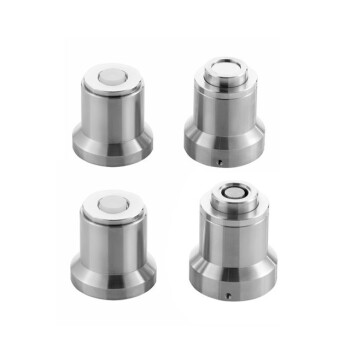
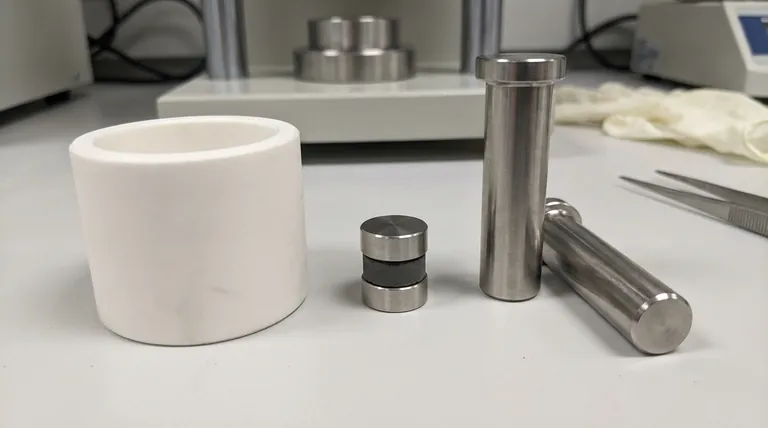
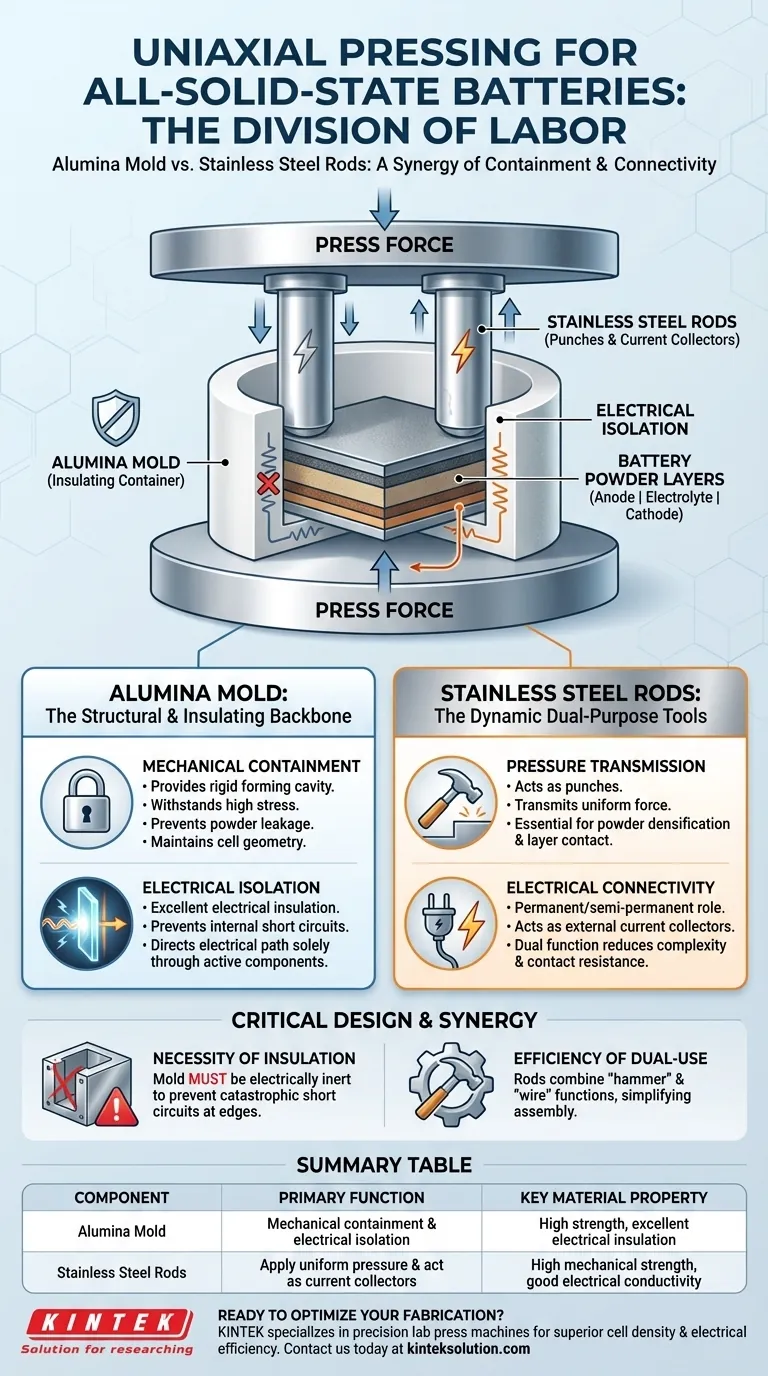
In the uniaxial pressing fabrication of all-solid-state batteries, the process relies on a specific division of labor between the alumina mold and the stainless steel rods. The alumina mold serves as a rigid, electrically insulating container that defines the cell's shape and prevents short circuits, while the stainless steel rods function as dual-purpose tools that apply mechanical pressure and act as the battery's electrical interface.
Efficient battery fabrication requires decoupling mechanical containment from electrical connectivity. The alumina mold isolates the cell structure to ensure safety, while the stainless steel rods integrate the pressing mechanism directly into the battery's electrical circuit.
The Role of the Alumina Mold
The alumina mold is the structural backbone of the assembly. It is selected to manage the high physical stresses of fabrication without interfering with the battery's electrochemical performance.
Mechanical Containment
The primary function of the alumina mold is to provide a forming cavity with high mechanical strength.
During the uniaxial pressing process, the battery powder is subjected to significant force.
The alumina mold withstands this stress, ensuring the powder does not leak from the sides and maintaining the precise geometry of the cell.
Electrical Isolation
Beyond structural support, the material properties of alumina are critical for the battery's function.
Alumina provides excellent electrical insulation surrounding the active materials.
This insulation is mandatory to prevent internal short circuits, acting as a non-conductive barrier that keeps the electrical path directed solely through the active components.
The Role of Stainless Steel Rods
The stainless steel rods are dynamic components within the assembly. They bridge the gap between the manufacturing equipment and the functional battery cell.
Pressure Transmission
Mechanically, the stainless steel rods act as punches.
They transmit the force from the press directly to the battery powder.
Crucially, they are designed to apply this pressure uniformly, which is essential for densifying the powder and creating solid contact between layers.
Electrical Connectivity
Unlike traditional manufacturing tools that are removed after processing, these rods serve a permanent or semi-permanent electrical role.
They act simultaneously as the external current collectors for the battery.
This dual functionality allows the device used to compress the cell to also serve as the conduit for electrical energy during testing or operation.
Critical Design Requirements
When evaluating this fabrication setup, it is important to understand why these specific materials are paired. The success of the process depends on their distinct material properties.
The Necessity of Insulation
You cannot substitute the mold material for a metal without catastrophic failure.
Because the mold interacts with the edges of the anode, cathode, and electrolyte, it must be electrically inert.
Any conductivity in the mold walls would bypass the electrolyte and immediately short-circuit the battery.
The Efficiency of Dual-Use Components
The stainless steel rods introduce efficiency by combining two distinct engineering requirements.
By serving as both the "hammer" (punch) and the "wire" (collector), they reduce the complexity of the assembly.
This ensures that the surface applying the pressure is the exact same surface collecting the current, minimizing contact resistance.
Making the Right Choice for Your Goal
Understanding the specific contribution of each component allows you to troubleshoot fabrication issues more effectively.
- If your primary focus is preventing leakage and short circuits: Ensure the alumina mold maintains high structural integrity and provides a flaw-free insulating barrier around the cavity.
- If your primary focus is cell density and electrical efficiency: Verify that the stainless steel rods are aligned to apply uniform pressure and maintain clean contact surfaces for optimal current collection.
The synergy between the insulating strength of alumina and the conductive utility of stainless steel creates a robust platform for solid-state battery fabrication.
Summary Table:
| Component | Primary Function | Key Material Property |
|---|---|---|
| Alumina Mold | Mechanical containment & electrical isolation | High strength, excellent electrical insulation |
| Stainless Steel Rods | Apply uniform pressure & act as current collectors | High mechanical strength, good electrical conductivity |
Ready to optimize your solid-state battery fabrication process? KINTEK specializes in precision lab press machines, including automatic and heated lab presses, designed to meet the exacting demands of laboratory research. Our equipment ensures the reliable performance of critical components like alumina molds and stainless steel rods. Let our expertise help you achieve superior cell density and electrical efficiency. Contact us today to discuss your specific needs!
Visual Guide
Related Products
- Lab Infrared Press Mold for Laboratory Applications
- Carbide Lab Press Mold for Laboratory Sample Preparation
- Lab Cylindrical Press Mold for Laboratory Use
- Warm Isostatic Press for Solid State Battery Research Warm Isostatic Press
- Lab Button Battery Tablet Press Sealing Mold
People Also Ask
- What is the purpose of incorporating cartridge heaters into a lab press mold for MLCC block compression? Optimize Results
- Why is a high-performance laboratory molding press critical for in-situ electrolyte formation? Unlock Battery Success
- What is the function of a pressing tool in thermoplastic panels? Master Precision Shaping & Fusion Bonding
- Why is precise cooling management of the lab press mold necessary? Protect Core Integrity in Thermoforming
- What challenges are associated with recycling textiles, and how do laboratory presses help? Overcome Recycling Hurdles with Precision Tools