
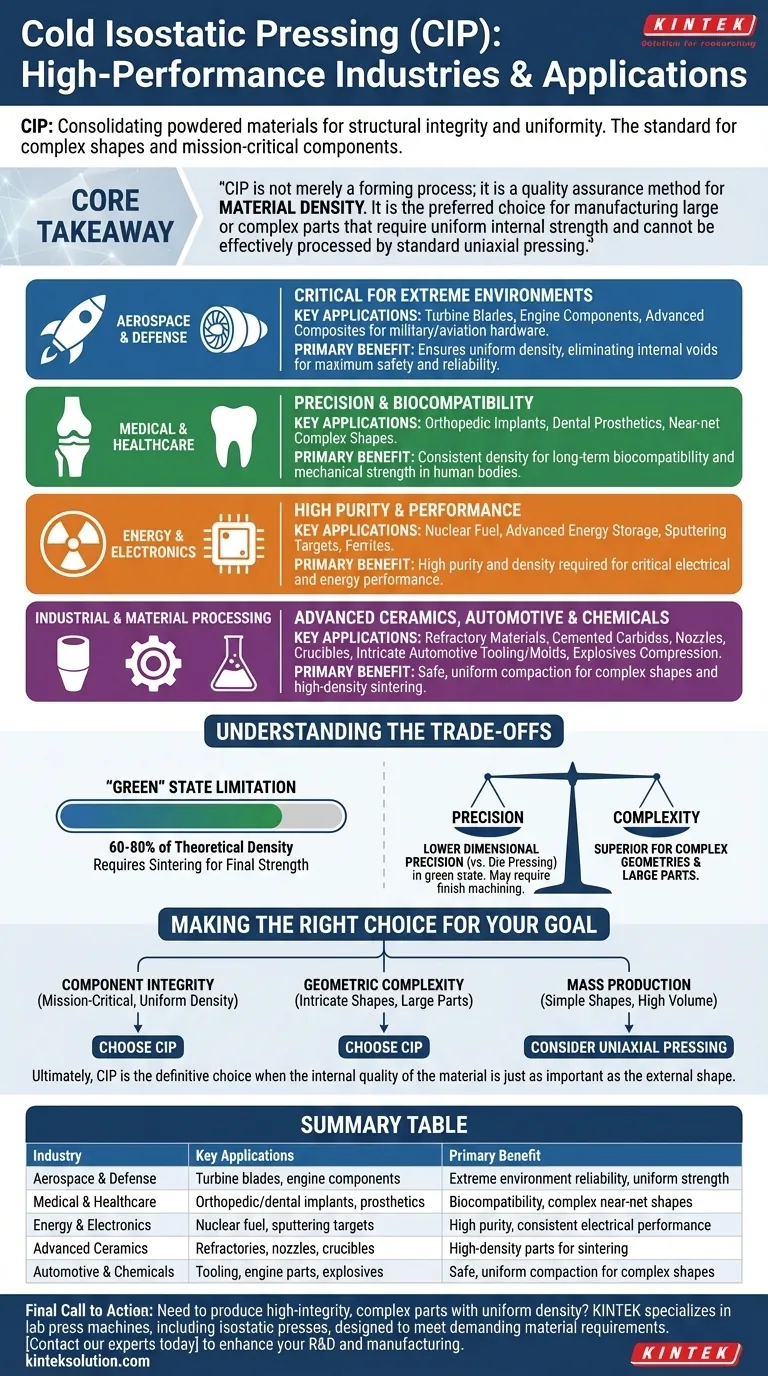
Cold Isostatic Pressing (CIP) is primarily utilized in high-performance industries such as aerospace, medical, automotive, and energy, where material integrity and structural uniformity are paramount. It is the manufacturing standard for consolidating powdered materials—including ceramics, metals, and composites—into complex shapes for applications ranging from turbine blades and orthopedic implants to nuclear fuels and electronic components.
Core Takeaway CIP is not merely a forming process; it is a quality assurance method for material density. It is the preferred choice for manufacturing large or complex parts that require uniform internal strength and cannot be effectively processed by standard uniaxial pressing.
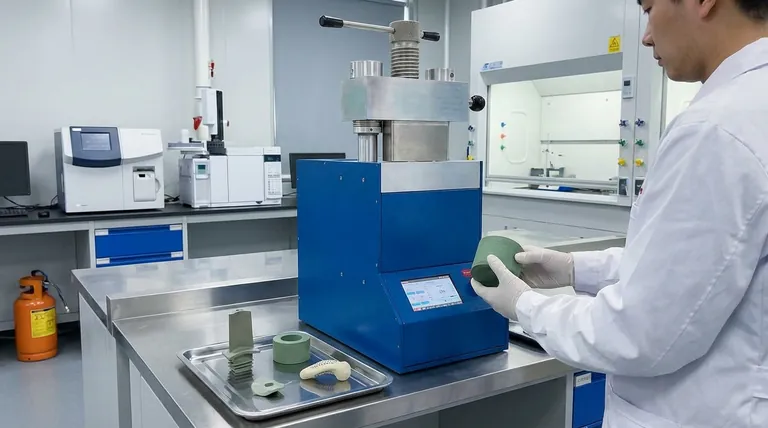
High-Performance Manufacturing Sectors
Aerospace and Defense
In the aerospace sector, CIP is critical for producing components that must withstand extreme environments, such as high temperatures and pressure. It is used to create turbine blades and engine parts where material failure is not an option.
Reducing Failure Rates
By ensuring uniform density across the entire part, CIP eliminates internal voids that often lead to structural weaknesses. This consistency is essential for manufacturing advanced ceramics and composites used in military and aviation hardware, significantly improving safety and reliability.
Medical and Healthcare
The medical industry relies on CIP to manufacture high-performance implants and prosthetics. The process allows for the creation of complex, near-net shapes that are difficult to machine from solid blocks of metal or ceramic.
Biocompatibility and Precision
Orthopedic and dental implants require precise material properties to function correctly within the human body. CIP ensures that materials like titanium or zirconia have consistent density, which is vital for long-term biocompatibility and mechanical strength.
Industrial and Material Processing
Advanced Ceramics and Refractories
A vast portion of CIP usage lies in the production of refractory materials, cemented carbides, and graphite. It is used to form high-density ceramic parts, such as nozzles, crucibles, and insulators, which are subsequently sintered.
Energy and Electronics
The technology is applied in the energy sector for nuclear fuel production and advanced energy storage systems. In electronics, it is employed to manufacture ferrites and targets used in sputtering processes, ensuring the high purity and density required for electrical performance.
Automotive and Chemicals
Automotive manufacturers use CIP to produce intricate tooling, molds, and specific engine components. Additionally, the chemical industry utilizes the process for compressing explosives and other chemical powders where safe, uniform compaction is necessary.
Understanding the Trade-offs
The "Green" State Limitation
It is important to understand that CIP produces a "green" part, typically achieving 60% to 80% of theoretical density. These parts are not fully finished; they require a subsequent sintering process to achieve final strength and hardness.
Precision vs. Complexity
While CIP is superior for complex geometries and parts that are too large for uniaxial presses, it generally offers lower dimensional precision in the green state compared to die pressing. If your project requires tight tolerances immediately after pressing, additional machining or finishing will likely be necessary after sintering.
Making the Right Choice for Your Goal
Cold Isostatic Pressing is a specialized solution for specific material challenges. To determine if it fits your manufacturing pipeline, consider your primary constraints:
- If your primary focus is Component Integrity: Choose CIP for mission-critical parts (aerospace, medical) where internal voids are unacceptable and uniform density is required.
- If your primary focus is Geometric Complexity: Use CIP for creating intricate shapes or large components (such as long tubes or heavy billets) that standard rigid dies cannot accommodate.
- If your primary focus is Mass Production of Simple Shapes: You may find uniaxial pressing more efficient, as CIP is often a batch process better suited for high-value or low-to-medium volume runs.
Ultimately, CIP is the definitive choice when the internal quality of the material is just as important as the external shape.
Summary Table:
| Industry | Key Applications | Primary Benefit |
|---|---|---|
| Aerospace & Defense | Turbine blades, engine components | Extreme environment reliability, uniform strength |
| Medical & Healthcare | Orthopedic/dental implants, prosthetics | Biocompatibility, complex near-net shapes |
| Energy & Electronics | Nuclear fuel, sputtering targets | High purity, consistent electrical performance |
| Advanced Ceramics | Refractories, nozzles, crucibles | High-density parts for sintering |
| Automotive & Chemicals | Tooling, engine parts, explosives | Safe, uniform compaction for complex shapes |
Need to produce high-integrity, complex parts with uniform density?
KINTEK specializes in lab press machines, including isostatic presses, designed to meet the demanding requirements of advanced materials development and small-scale production. Our expertise helps laboratories in the aerospace, medical, and energy sectors achieve superior material consistency and part reliability.
Contact our experts today to discuss how our isostatic pressing solutions can enhance your R&D and manufacturing processes.
Visual Guide
Related Products
- Electric Lab Cold Isostatic Press CIP Machine
- Electric Split Lab Cold Isostatic Pressing CIP Machine
- Automatic Lab Cold Isostatic Pressing CIP Machine
- Manual Cold Isostatic Pressing CIP Machine Pellet Press
- Lab Isostatic Pressing Molds for Isostatic Molding
People Also Ask
- What are the applications of electric lab cold isostatic presses in research settings? Advance Material R&D with High-Pressure CIPs
- What role do electric lab cold isostatic presses play in industrial contexts? Bridge R&D and Manufacturing with Precision
- How does electrical Cold Isostatic Pressing (CIP) contribute to cost savings? Unlock Efficiency and Reduce Expenses
- What are some research applications of electric lab CIPs? Unlock Uniform Powder Densification for Advanced Materials
- What are the characteristics of standard off-the-shelf electric lab CIP solutions? Achieve Immediate, Cost-Effective Processing
















