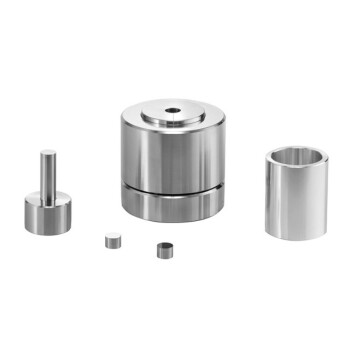
Cold Isostatic Pressing (CIP) creates a distinct advantage in powder metallurgy by applying uniform, omnidirectional pressure to metal powder via a fluid medium. Unlike conventional die pressing, which exerts force from a single direction using rigid tools, CIP utilizes flexible molds to achieve consistent density and superior structural integrity across complex geometries.
Core Takeaway The fundamental limitation of conventional die pressing is friction, which creates uneven density and internal stress. CIP eliminates this by applying hydrostatic pressure from all sides simultaneously, ensuring that the resulting component—regardless of its complexity—has a uniform internal structure that remains stable during sintering.
The Mechanics of Uniform Density
Isotropic vs. Uniaxial Pressure
Conventional die pressing (uniaxial pressing) applies force from top to bottom. This often results in density gradients, where the powder is tightly packed near the punch but looser elsewhere.
CIP applies isotropic pressure (equal force from all directions) using a liquid medium like oil or water. This ensures every millimeter of the powder is compressed equally, regardless of its location in the mold.
Overcoming Wall Friction
In rigid die pressing, significant pressure is lost due to friction between the metal powder and the die walls. This friction prevents the pressure from reaching the center of the part efficiently.
CIP solves this by using a flexible mold (typically urethane or rubber). Because the mold deforms with the powder under pressure, friction against the mold walls is effectively eliminated, removing the primary cause of density variations.
Minimizing Structural Defects
Non-uniform particle packing in die pressing frequently leads to internal stresses, which manifest as distortions or cracking.
By ensuring uniform packing density, CIP significantly minimizes these risks. The result is a "green compact" (the pressed part before heating) that possesses isotropic physical properties and higher structural reliability.
Geometric and Process Advantages
Enabling Complex Geometries
Rigid dies are limited to shapes that can be ejected vertically. This restricts design freedom.
Because CIP uses flexible molds and fluid pressure, it can produce components with complex shapes, intricate geometries, and large dimensions that are impossible to form with uniaxial pressing.
Enhancing Material Purity
Conventional pressing often requires lubricants or wax binders to facilitate ejection from the die. These additives must be burned off later, which can leave residues.
CIP often eliminates the need for lubricants and the associated dewaxing process. This results in a higher-purity microstructure and allows for increased green density, which is critical for high-performance applications like Cr-Ni alloy steel or rhenium components.
Understanding the Operational Trade-offs
Process Complexity vs. Speed
While the provided references highlight the quality advantages of CIP, it is important to note the operational differences. CIP involves sealing powder in flexible bags and submerging them in high-pressure fluid vessels (up to 410 MPa).
This is fundamentally different from the rapid cycle times of mechanical die pressing. CIP is a solution specifically engineered for parts where quality, density uniformity, and geometric complexity outweigh the simplicity of uniaxial pressing.
Making the Right Choice for Your Goal
To determine if Cold Isostatic Pressing is the correct solution for your application, consider your specific manufacturing priorities:
- If your primary focus is Structural Integrity: CIP is essential for eliminating density gradients and preventing the cracking or distortion often seen in die-pressed parts.
- If your primary focus is Complex Design: CIP is the superior choice for producing intricate shapes or parts with high dimensional accuracy that rigid dies cannot accommodate.
- If your primary focus is Material Purity: CIP allows you to bypass the use of binders and lubricants, ensuring a cleaner microstructure for high-performance alloys.
Ultimately, CIP transforms the compaction step from a mechanical compromise into a precise, hydraulic process that guarantees consistency before the part ever reaches the furnace.
Summary Table:
| Feature | Conventional Die Pressing | Cold Isostatic Pressing (CIP) |
|---|---|---|
| Pressure Direction | Uniaxial (Top-Bottom) | Isotropic (Omnidirectional) |
| Density Uniformity | Low (Friction-based gradients) | High (Equal compression) |
| Shape Complexity | Simple/Vertical Ejection only | Highly Complex/Intricate |
| Lubricants Needed | Often required for ejection | Generally not required |
| Structural Risks | High risk of cracking/distortion | Minimal internal stress |
| Material Purity | Potential for residue | High purity microstructure |
Elevate Your Material Research with KINTEK
As a leader in laboratory pressing solutions, KINTEK provides the precision and reliability your research demands. Whether you are developing next-generation battery technologies or high-performance alloys, our comprehensive range of manual, automatic, heated, and multifunctional presses—including specialized Cold and Warm Isostatic Presses (CIP/WIP)—ensures optimal density and structural integrity for your samples.
Our value to you:
- Expert Solutions: Specialized equipment for battery research and advanced powder metallurgy.
- Versatility: From glovebox-compatible models to high-capacity isostatic systems.
- Quality Assurance: Achieve superior material purity and uniform density with ease.
Ready to optimize your lab's performance? Contact us today to find the perfect pressing solution!
References
- A. S. Wronski, João Mascarenhas. Recent Developments in the Powder Metallurgy Processing of Steels. DOI: 10.4028/www.scientific.net/msf.455-456.253
This article is also based on technical information from Kintek Solution Knowledge Base .
Related Products
- Electric Lab Cold Isostatic Press CIP Machine
- Electric Split Lab Cold Isostatic Pressing CIP Machine
- Automatic Lab Cold Isostatic Pressing CIP Machine
- Manual Cold Isostatic Pressing CIP Machine Pellet Press
- Warm Isostatic Press for Solid State Battery Research Warm Isostatic Press
People Also Ask
- What are the applications of electric lab cold isostatic presses in research settings? Advance Material R&D with High-Pressure CIPs
- What role do electric lab cold isostatic presses play in industrial contexts? Bridge R&D and Manufacturing with Precision
- How does electrical Cold Isostatic Pressing (CIP) contribute to cost savings? Unlock Efficiency and Reduce Expenses
- What are some research applications of electric lab CIPs? Unlock Uniform Powder Densification for Advanced Materials
- What are the characteristics of standard off-the-shelf electric lab CIP solutions? Achieve Immediate, Cost-Effective Processing