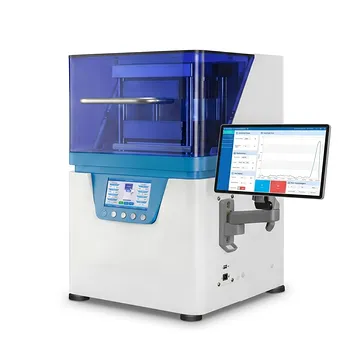
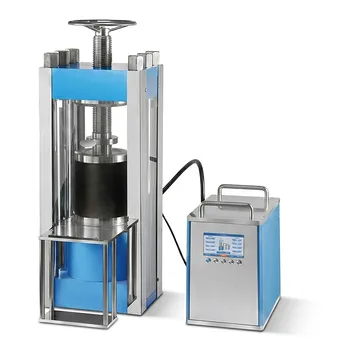
Induction heating for hot pressing provides superior process control, characterized primarily by the complete independence of applied pressure from the inductive power source. This method is uniquely suited for processing powders that develop a liquid phase and remains highly effective even when operating at low pressures.
The core value of induction heating lies in its ability to separate thermal parameters from mechanical force, offering a versatile solution for complex sintering requirements where precise control over liquid phases is required.
How the Process Works
Electromagnetic Heat Generation
In this method, heat is not applied externally but is produced directly within a graphite or steel mold.
The mold containing the powder is placed inside an induction coil, which generates a high-frequency electromagnetic field.
Simultaneous Pressure Application
While the mold heats up via induction, pressure is applied to the material using one or two cylinders acting on punches.
This combination allows for the consolidation of powder into a solid mass through the simultaneous application of heat and mechanical force.
Technical Advantages of Induction
Independence of Process Variables
The most significant advantage of induction heating is the complete independence of pressure and inductive power.
Unlike some resistance sintering methods where contact resistance (and therefore heat) relies on pressure, induction allows you to adjust the temperature without altering the mechanical force applied to the sample.
Suitability for Liquid Phase Processing
Induction heating is specifically identified as being suitable for processing powders that possess a liquid phase.
The ability to finely tune thermal input without relying on mechanical contact ensures that the liquid phase can be managed effectively during the sintering process.
Operational Versatility at Low Pressures
The system maintains high efficiency even when operating at low pressures.
Because the heat generation mechanism (electromagnetic coupling) does not rely on the physical pressure between the punch and the die to generate heat, the process remains stable regardless of the force applied.
Understanding the Trade-offs
Thermal Gradient Risks
Induction relies on the "skin effect," where the magnetic field typically penetrates only 0.5mm to 3mm into the mold.
This can create temperature differences between the mold's surface and its core. If the heat-up rate is too aggressive, these gradients can cause thermal shock, potentially destroying the mold.
Equipment Complexity and Cost
The requirement for a high-frequency generator makes induction systems significantly more expensive than simpler heating elements.
Alignment Sensitivity
The process depends heavily on good inductive coupling.
Proper alignment of the mold within the coil is critical; misalignment can lead to uneven heat distribution, compromising the precision of the final part.
Making the Right Choice for Your Goal
To determine if induction heating is the correct method for your hot pressing application, consider your specific processing needs:
- If your primary focus is complex sintering with liquid phases: Choose induction heating for its ability to manage these states without relying on high pressure.
- If your primary focus is independent variable control: Select induction heating to decouple your temperature profiles from your pressure profiles completely.
- If your primary focus is minimizing initial capital investment: Be aware that the cost of high-frequency generators may make this method less attractive than standard resistance heating.
Induction heating transforms hot pressing from a brute-force consolidation method into a precision instrument for advanced materials processing.
Summary Table:
| Feature | Induction Heating Advantage | Benefit to Materials Research |
|---|---|---|
| Process Control | Full independence of pressure and power | Precise tuning of sintering cycles without mechanical interference |
| Liquid Phase | High suitability for liquid phase powders | Better management of complex sintering and material consolidation |
| Heat Generation | Internal electromagnetic coupling | Efficient heating within the mold regardless of applied force |
| Low Pressure | Stable efficiency at low pressures | Versatile processing for delicate or porous material structures |
Elevate Your Material Research with KINTEK
Are you looking to master complex sintering processes? KINTEK specializes in comprehensive laboratory pressing solutions, offering manual, automatic, heated, multifunctional, and glovebox-compatible models, as well as cold and warm isostatic presses widely applied in battery research.
Whether you need the precise independent control of induction heating or specialized isostatic solutions, our expert team is ready to help you find the perfect equipment to achieve superior material density and performance.
Contact us today to find your ideal pressing solution!
Related Products
- Heated Hydraulic Press Machine with Heated Plates for Vacuum Box Laboratory Hot Press
- Automatic Heated Hydraulic Press Machine with Hot Plates for Laboratory
- Automatic High Temperature Heated Hydraulic Press Machine with Heated Plates for Lab
- Automatic Hydraulic Heat Press Machine with Multi Stage Programmable Control and Integrated Water Cooling Plate Size 180x180mm
- Automatic Heated Hydraulic Lab Press 120x120mm Plate Fully Automated Material Research Press
People Also Ask
- What are the requirements for electrode pressing with high-viscosity ionic liquids like EMIM TFSI? Optimize Performance
- How does a laboratory heated hydraulic press facilitate PBN sample prep for WAXS? Achieve Precise X-Ray Scattering
- What are the industrial applications of heated hydraulic presses? Master Heat & Force for Precision Manufacturing
- Function of a Laboratory Hydraulic Press with Heated Platens in SSE? Enhance Battery Density & Conductivity
- How are heated hydraulic presses utilized in the preparation of thin films? Key Mechanisms and Applications