
For manufacturing high-performance components, the primary benefits of Cold Isostatic Pressing (CIP) are vastly improved material strength, exceptional shape uniformity, and the ability to create complex geometries that are impossible with other methods. By immersing a powdered material in a fluid and applying extreme, uniform pressure, CIP consolidates the powder into a solid form with consistent density and integrity throughout the entire part.
The core advantage of CIP is not just one specific benefit, but how its unique application of uniform pressure solves the fundamental limitations of traditional pressing. This makes it the definitive choice for creating critical components where geometric complexity and absolute material integrity are non-negotiable.
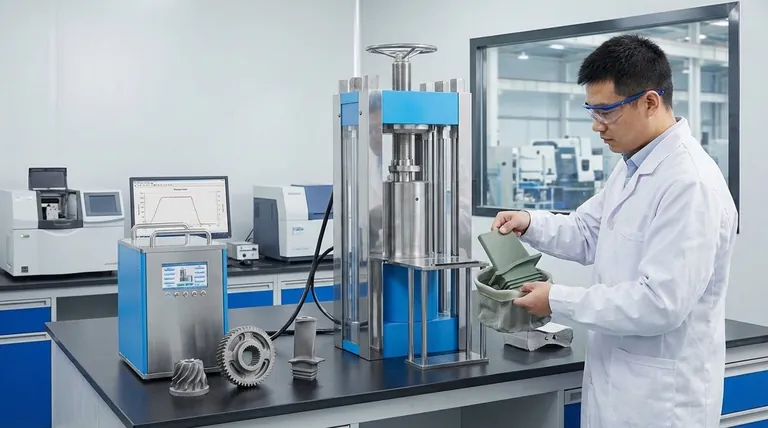
How Uniform Pressure Transforms Powder into Performance
The defining feature of Cold Isostatic Pressing is its method of applying pressure. Unlike conventional uniaxial pressing, which compacts powder from only one or two directions, CIP uses a liquid medium to exert equal force on every surface of the component simultaneously.
The Principle of Isostatic Pressure
The process begins by placing powdered material into a flexible, sealed mold. This mold is then submerged in a pressure vessel filled with a fluid, typically water or oil.
When the vessel is pressurized, the fluid transmits that pressure evenly across the entire surface of the mold. This isostatic pressure ensures that every part of the powder compact is subjected to the exact same compressive force.
Achieving Uniform Density
This uniform pressure application is the key to eliminating the internal voids and density gradients common in other methods. With uniaxial pressing, friction against the die walls prevents the powder from compacting evenly, creating weak spots.
CIP overcomes this entirely, resulting in a pre-sintered part, or "green compact," with remarkably consistent density from the surface to the core.
From Uniform Density to Superior Strength
This uniform density directly translates to superior and more predictable final part characteristics. During the subsequent heating process (sintering), the part shrinks uniformly, preventing the warping and internal stresses that plague less evenly compacted materials.
The final result is a component with significantly enhanced mechanical properties, including greater strength, ductility, and corrosion resistance, because it lacks the built-in weak points found in components made with other pressing techniques.
The Strategic Advantages in Manufacturing
Understanding the core principle of uniform pressure reveals why CIP is such a powerful tool for modern manufacturing. Its benefits extend beyond material quality to include design freedom and production efficiency.
Unlocking Complex Geometries
Because pressure is applied by a fluid, it perfectly conforms to any shape. This frees engineers to design intricate, irregular, or complex parts that would be difficult or impossible to produce with rigid dies.
CIP is particularly effective for components with a large aspect ratio, such as long, thin rods or tubes, which are notoriously difficult to press uniformly with other methods.
The Importance of "Green Strength"
A key practical advantage of CIP is the high green strength of the compacted part. Before it undergoes final hardening, the green compact is solid and durable enough to be handled, moved, and even machined.
This ability to perform "green machining" allows for the creation of features like threads or holes at an early stage, dramatically reducing final machining time and minimizing waste of the fully hardened, more valuable material.
Driving Down Production Costs
While CIP involves sophisticated equipment, it can be highly cost-effective. The process leads to reduced raw material waste and predictable shrinkage, which lowers the scrap rate.
For high-volume needs, automated "dry bag" CIP systems significantly reduce cycle times and manual labor. Modern electrical CIP systems offer even more precise pressure control and can cut forming time by 40-60% compared to older manual setups.
Understanding the Process and Its Trade-offs
To leverage CIP effectively, it's crucial to understand its operational requirements and limitations. The process is precise and powerful, but it is not the right solution for every application.
Critical Process Control
Successful CIP is not just about high pressure; it's about controlled pressure. The rates of pressurization and depressurization must be carefully managed to ensure uniform compaction and prevent defects like cracking. Rushing this step can negate the core benefits of the process.
Wet Bag vs. Dry Bag Technology
CIP technology is generally divided into two categories, which serve different production scales:
- Wet Bag CIP: The mold is manually loaded and unloaded from the pressure vessel. This method is highly versatile for different shapes and sizes, making it ideal for prototypes and low-volume production.
- Dry Bag CIP: The flexible mold is integrated into the pressure vessel itself. This approach is designed for automation and high-volume production of specific part designs.
Tooling and Cycle Time Considerations
The flexible molds used in CIP are less expensive than the hardened steel dies of uniaxial presses, but they have a shorter lifespan. Furthermore, while automated CIP is fast, the cycle times for simple, high-volume parts may not compete with the sheer speed of traditional mechanical stamping.
Making the Right Choice for Your Application
Selecting the right manufacturing process requires aligning the technology’s strengths with your primary goal.
- If your primary focus is maximum material integrity and performance: CIP is the superior choice for creating parts with uniform density and predictable strength for demanding aerospace, medical, or industrial applications.
- If your primary focus is producing complex shapes or large-aspect-ratio parts: CIP provides unmatched design freedom and is often more cost-effective than trying to machine the same geometry from a solid block of material.
- If your primary focus is prototyping or low-volume specialty runs: The versatility and lower tooling cost of wet-bag CIP allow for rapid and efficient development of intricate component designs.
- If your primary focus is mass production of a consistent, complex part: Automated dry-bag CIP offers a scalable and efficient path to producing high-quality components with minimal waste and labor.
Ultimately, Cold Isostatic Pressing empowers you to manufacture parts whose internal structure is as precisely controlled as their external geometry.
Summary Table:
| Benefit | Key Feature |
|---|---|
| Improved Material Strength | Uniform density eliminates weak spots, enhancing mechanical properties |
| Exceptional Shape Uniformity | Isostatic pressure ensures consistent compaction for precise parts |
| Complex Geometries | Fluid-based pressure allows intricate designs impossible with other methods |
| High Green Strength | Enables green machining to reduce waste and costs |
| Cost Efficiency | Reduced material waste and predictable shrinkage lower production expenses |
Unlock the full potential of Cold Isostatic Pressing for your laboratory needs! KINTEK specializes in lab press machines, including automatic lab presses, isostatic presses, and heated lab presses, designed to deliver precise, high-quality results. Whether you're prototyping or scaling production, our solutions enhance material integrity and efficiency. Contact us today to discuss how we can support your manufacturing goals with reliable, advanced equipment.
Visual Guide

Related Products
- Electric Lab Cold Isostatic Press CIP Machine
- Electric Split Lab Cold Isostatic Pressing CIP Machine
- Automatic Lab Cold Isostatic Pressing CIP Machine
- Manual Cold Isostatic Pressing CIP Machine Pellet Press
- Lab Isostatic Pressing Molds for Isostatic Molding
People Also Ask
- What are the applications of electric lab cold isostatic presses in research settings? Advance Material R&D with High-Pressure CIPs
- What role do electric lab cold isostatic presses play in industrial contexts? Bridge R&D and Manufacturing with Precision
- How does electrical Cold Isostatic Pressing (CIP) contribute to cost savings? Unlock Efficiency and Reduce Expenses
- What are some research applications of electric lab CIPs? Unlock Uniform Powder Densification for Advanced Materials
- What are the characteristics of standard off-the-shelf electric lab CIP solutions? Achieve Immediate, Cost-Effective Processing
















