
Isostatic pressing fundamentally improves pharmaceutical manufacturing by applying uniform pressure from all directions, creating tablets and formulations with superior density and structural integrity. This technique directly addresses critical challenges in drug delivery, enabling the production of high-density formulations that offer improved bioavailability, higher drug content per dose, and exceptional dosing consistency compared to traditional uniaxial pressing methods.
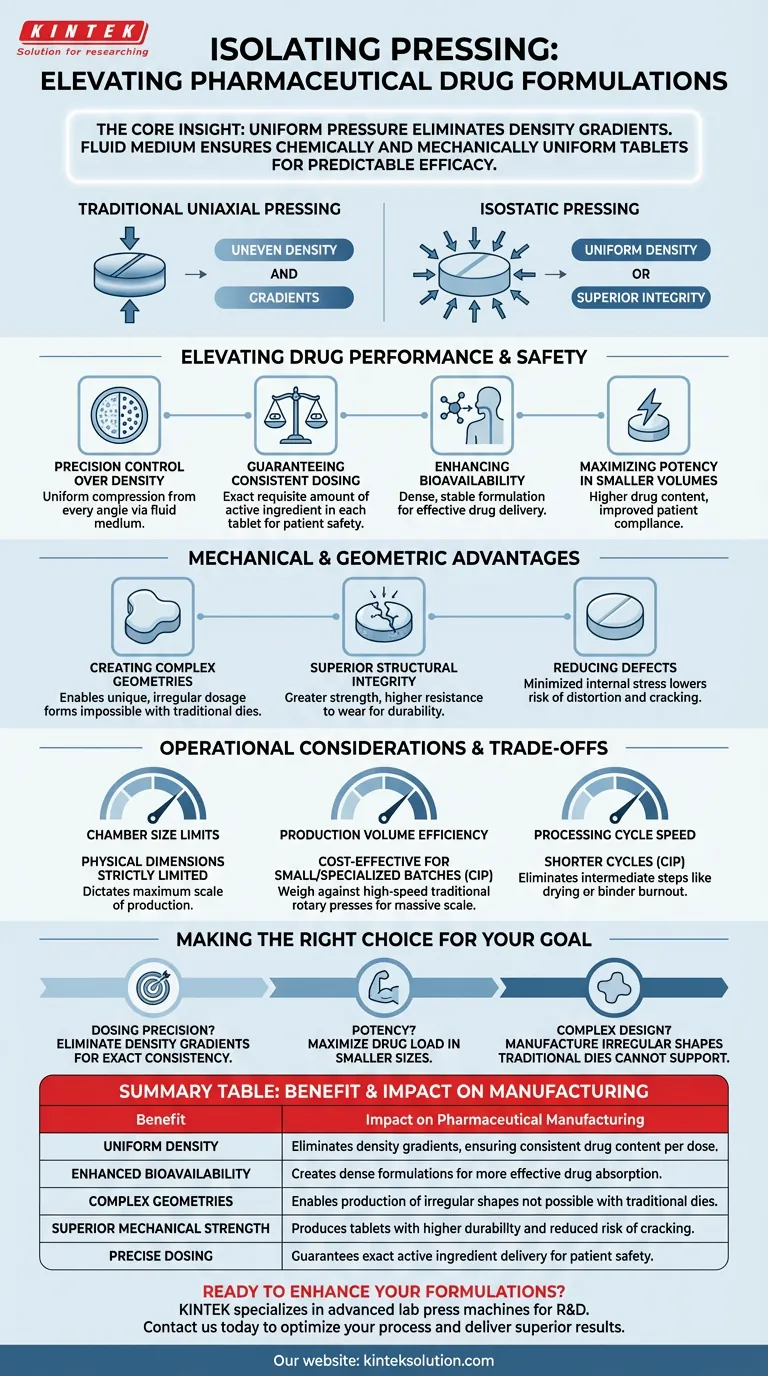
The Core Insight: The primary value of isostatic pressing lies in its ability to eliminate density gradients. By using a fluid medium to apply equal pressure on all surfaces, manufacturers can produce chemically and mechanically uniform tablets, ensuring that every dose performs exactly as intended.
Elevating Drug Performance and Safety
The transition to isostatic pressing is often driven by the need for higher precision in drug delivery systems. This method impacts the final product's efficacy in three distinct ways.
Precision Control Over Density
In traditional manufacturing, pressure is applied from one direction, often resulting in uneven density within a tablet. Isostatic pressing uses a fluid medium to compress the powder uniformly from every angle.
Guaranteeing Consistent Dosing
This uniform compression is critical for patient safety. By eliminating density variations, the process ensures that each tablet contains the exact requisite amount of active ingredient. This leads to reliable, consistent dosing and predictable therapeutic efficacy for the patient.
Enhancing Bioavailability
Isostatic pressing can significantly improve the bioavailability of pharmaceutical compounds. The process creates a dense, stable formulation that facilitates more effective drug delivery systems. This allows the body to absorb the medication more efficiently.
Maximizing Potency in Smaller Volumes
Manufacturers can achieve a higher drug content within a smaller dosage form. This is particularly valuable for high-potency drugs where reducing the tablet size improves patient compliance without sacrificing therapeutic impact.
Mechanical and Geometric Advantages
Beyond the chemistry of the drug, isostatic pressing offers substantial physical benefits during the manufacturing of solid dosage forms.
Creating Complex Geometries
Traditional dies limit tablets to simple shapes. Isostatic pressing removes these constraints, enabling the creation of complex or irregular shapes. This flexibility allows engineers to design unique dosage forms that were previously difficult or impossible to manufacture.
Superior Structural Integrity
The uniform pressure application results in products with improved mechanical properties. Tablets produced this way exhibit greater strength and higher resistance to wear. This durability is vital for maintaining tablet integrity during packaging, transport, and handling.
Reducing Defects
Because the pressure is applied evenly, "pressing gradients" are significantly reduced. This minimization of internal stress lowers the risk of distortion and cracking in the final product.
Operational Considerations and Trade-offs
While isostatic pressing offers high-performance results, it is essential to understand the operational context compared to standard methods.
Chamber Size Limitations
The physical dimensions of the final product are strictly limited by the size of the press chamber. While there are no inherent theoretical limits to the component size, the actual machinery available dictates the maximum scale of production.
Production Volume Efficiency
Cold Isostatic Pressing (CIP) is noted for being particularly cost-effective for small production runs. The low cost of molds makes it an attractive option for specialized or low-volume batches. However, for massive-scale commodity production, these economics should be weighed against high-speed traditional rotary presses.
Processing Cycle Speed
CIP can offer shorter processing cycle times compared to some alternative methods. This efficiency is gained by eliminating certain intermediate steps, such as drying or binder burnout, which streamlines the manufacturing workflow.
Making the Right Choice for Your Goal
Isostatic pressing is not a universal replacement for all tableting, but it is the superior choice for high-performance applications.
- If your primary focus is Dosing Precision: Utilize this method to eliminate density gradients and ensure exact consistency in active ingredient delivery.
- If your primary focus is Potency: Choose isostatic pressing to maximize drug load in smaller tablet sizes, improving patient experience.
- If your primary focus is Complex Design: Leverage the fluid-medium pressure to manufacture irregular shapes that traditional dies cannot support.
Summary: Isostatic pressing transforms pharmaceutical production by substituting mechanical force with uniform hydraulic pressure, delivering a denser, stronger, and more biologically effective product.
Summary Table:
| Benefit | Impact on Pharmaceutical Manufacturing |
|---|---|
| Uniform Density | Eliminates density gradients, ensuring consistent drug content per dose. |
| Enhanced Bioavailability | Creates dense formulations for more effective drug absorption. |
| Complex Geometries | Enables production of irregular shapes not possible with traditional dies. |
| Superior Mechanical Strength | Produces tablets with higher durability and reduced risk of cracking. |
| Precise Dosing | Guarantees exact active ingredient delivery for patient safety. |
Ready to enhance your pharmaceutical formulations with precise, high-density tablets? KINTEK specializes in advanced lab press machines, including isostatic presses, designed to meet the demanding needs of laboratory research and development. Our equipment ensures uniform compression, improved bioavailability, and consistent dosing for your most critical drug formulations. Contact us today to discover how our solutions can optimize your manufacturing process and deliver superior results.
Visual Guide
Related Products
- Warm Isostatic Press for Solid State Battery Research Warm Isostatic Press
- Electric Lab Cold Isostatic Press CIP Machine
- Automatic Lab Cold Isostatic Pressing CIP Machine
- Lab Isostatic Pressing Molds for Isostatic Molding
- Manual Cold Isostatic Pressing CIP Machine Pellet Press
People Also Ask
- Why must composite cathodes be sealed in vacuum lamination bags for WIP? Ensure Battery Stability and Density
- How do sacrificial volume materials (SVM) maintain microchannels in isostatic pressing? Ensure Structural Integrity
- What is the function of elastic molds in warm isostatic pressing? Achieve Uniform Density in Composite Particles
- What is the role of the flexible material in warm isostatic pressing? Key to Uniform Density & Precision
- What is the mechanism of a Warm Isostatic Press (WIP) on cheese? Master Cold Pasteurization for Superior Safety



















