
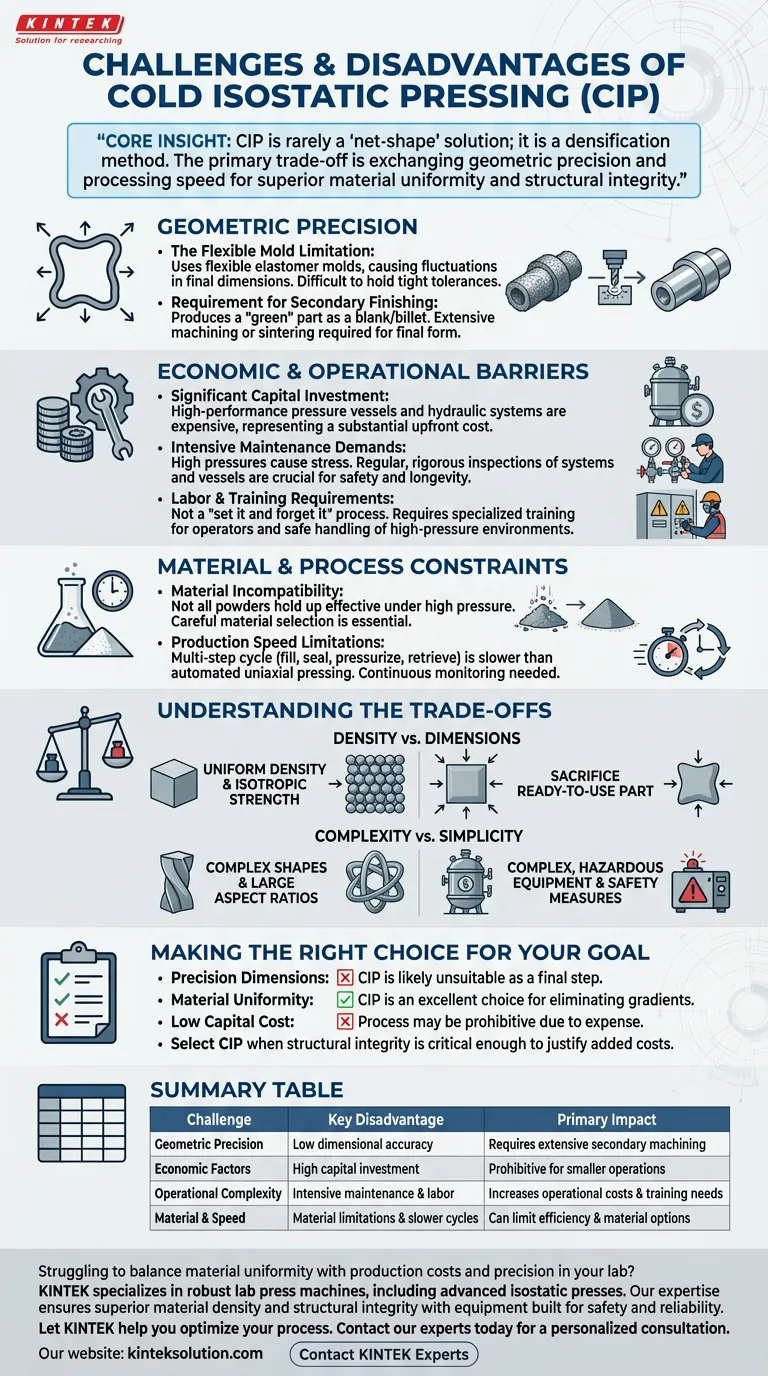
Cold Isostatic Pressing (CIP) faces primary challenges related to low geometric accuracy, high capital costs, and operational complexity. While the process delivers exceptional uniform density, the reliance on flexible elastomer molds limits dimensional precision, often necessitating extensive secondary machining. Furthermore, the extreme pressures required demand robust, expensive machinery and rigorous safety protocols.
Core Insight: CIP is rarely a "net-shape" solution; it is a densification method. The primary trade-off is exchanging geometric precision and processing speed for superior material uniformity and structural integrity.
The Challenge of Geometric Precision
The Flexible Mold Limitation
A notable disadvantage of CIP is its low geometric accuracy. Because the process uses flexible elastomer molds (bags) rather than rigid dies, the final dimensions of the compacted part can fluctuate. This lack of rigidity makes it difficult to hold tight tolerances during the pressing stage.
Requirement for Secondary Finishing
CIP produces a "raw" or "green" part that typically acts as a blank or billet. Because the initial shape is not precise, additional finishing processes are almost always required. Manufacturers must account for extra time and cost to machine or sinter the part into its final form.
Economic and Operational Barriers
Significant Capital Investment
Implementing CIP requires high-performance pressure vessels and hydraulic systems. The equipment is expensive, representing a substantial upfront capital investment. This barrier to entry can be prohibitive for smaller operations or low-volume production runs.
Intensive Maintenance Demands
The high pressures involved place immense stress on machinery. To prevent equipment failure, operators must perform regular maintenance, including frequent inspections of hydraulic systems and pressure vessels. Neglecting this maintenance compromises both safety and process longevity.
Labor and Training Requirements
CIP is not a "set it and forget it" operation. It has specific labor requirements that often necessitate specialized training for operators. Effectively managing the process requires streamlining workflows and ensuring staff can safely handle high-pressure environments.
Material and Process Constraints
Material Incompatibility
Not all powders respond well to isostatic pressing. There are distinct material limitations, as certain compounds do not hold up effectively under the high-pressure conditions required by CIP. Careful material selection is essential to ensure the powder creates a viable compact.
Production Speed Limitations
The process involves filling molds, sealing them, placing them in a vessel, pressurizing, and then retrieving the part. This cycle is generally slower than automated uniaxial pressing. Without continuous monitoring and process adjustments, efficiency can suffer, leading to increased waste.
Understanding the Trade-offs
Density vs. Dimensions
The central trade-off in CIP is between internal quality and external precision. You gain uniform density and isotropic strength (equal in all directions) because pressure is applied via a fluid based on Pascal's law. However, you sacrifice the ability to produce a ready-to-use part directly from the mold.
Complexity vs. Simplicity
CIP allows for the compaction of complex shapes and parts with large aspect ratios that rigid dies cannot handle. The downside is that the equipment required to achieve this is significantly more complex and hazardous than standard mechanical pressing, requiring robust safety measures to manage the stored energy in the pressure vessel.
Making the Right Choice for Your Goal
If you are evaluating Cold Isostatic Pressing for your manufacturing line, consider these specific alignments:
- If your primary focus is Precision Dimensions: CIP is likely unsuitable as a final step; plan for significant machining or consider rigid-die pressing methods.
- If your primary focus is Material Uniformity: CIP is an excellent choice, as it eliminates density gradients and prevents distortion during subsequent firing.
- If your primary focus is Low Capital Cost: This process may be prohibitive due to the expense of high-pressure vessels and necessary safety infrastructure.
Select CIP when the structural integrity of the material is critical enough to justify the added costs of equipment and post-processing.
Summary Table:
| Challenge | Key Disadvantage | Primary Impact |
|---|---|---|
| Geometric Precision | Low dimensional accuracy from flexible molds | Requires extensive secondary machining |
| Economic Factors | High capital investment for equipment | Prohibitive for smaller operations |
| Operational Complexity | Intensive maintenance and specialized labor | Increases operational costs and training needs |
| Material & Speed | Material limitations and slower production cycles | Can limit efficiency and material options |
Struggling to balance material uniformity with production costs and precision in your lab?
At KINTEK, we specialize in designing and supplying robust lab press machines, including advanced isostatic presses, that help you navigate these challenges. Our expertise ensures you achieve the superior material density and structural integrity of CIP with equipment built for safety, reliability, and your specific laboratory needs.
Let KINTEK help you optimize your process. Contact our experts today for a personalized consultation to find the right press solution for your application.
Visual Guide
Related Products
- Electric Lab Cold Isostatic Press CIP Machine
- Electric Split Lab Cold Isostatic Pressing CIP Machine
- Automatic Lab Cold Isostatic Pressing CIP Machine
- Manual Cold Isostatic Pressing CIP Machine Pellet Press
- Lab Isostatic Pressing Molds for Isostatic Molding
People Also Ask
- What role do electric lab cold isostatic presses play in industrial contexts? Bridge R&D and Manufacturing with Precision
- What are the applications of electric lab cold isostatic presses in research settings? Advance Material R&D with High-Pressure CIPs
- How does electrical Cold Isostatic Pressing (CIP) contribute to cost savings? Unlock Efficiency and Reduce Expenses
- What are some research applications of electric lab CIPs? Unlock Uniform Powder Densification for Advanced Materials
- What are the characteristics of standard off-the-shelf electric lab CIP solutions? Achieve Immediate, Cost-Effective Processing
















