
Dry bag isostatic pressing is a high-volume manufacturing process characterized by fixing a flexible membrane directly inside the pressure vessel. Unlike "wet bag" methods where molds are submerged and removed for each cycle, the dry bag method isolates the pressure fluid from the mold, allowing for rapid, automated compaction of powders into solid, high-density components.
Core Insight: While wet bag pressing offers versatility for large, complex parts, dry bag pressing is engineered specifically for speed and automation. By permanently integrating the pressure membrane into the vessel, it drastically reduces cycle times to as little as one minute, making it the definitive choice for mass-producing small, uniform components.
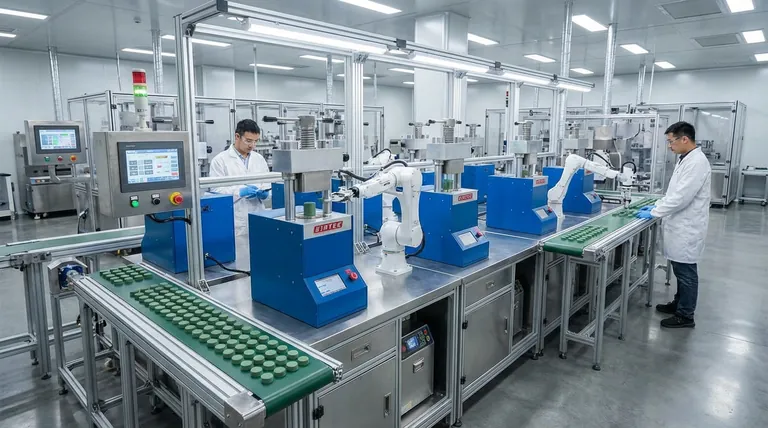
The Mechanics of the Dry Bag Process
The Fixed Membrane Architecture
The defining characteristic of this technology is the flexible membrane sealed permanently within the pressure vessel. In this configuration, the forming mold acts as a barrier, preventing the hydraulic fluid from ever coming into direct contact with the pressurized part.
Because the fluid remains isolated behind this membrane, the workspace remains "dry." This eliminates the need to dry molds between cycles and prevents cross-contamination between the pressure fluid and the powder.
Rapid Cycle Automation
The integration of the mold into the vessel allows for a streamlined workflow. Powder is loaded directly into the cavity, pressurized, and ejected without removing the tooling from the vessel.
This setup enables significant speed advantages. While wet bag cycles can take up to 30 minutes, dry bag cycles are frequently completed in as little as one minute.
Key Operational Advantages
Optimized for Mass Production
The dry bag method is specifically designed for high production rates. Its ability to support continuous operation makes it the superior choice for manufacturing environments requiring high throughput of identical parts.
Process Cleanliness and Consistency
Since the pressure fluid is isolated by the built-in membrane, the risk of "wet powder" contamination is virtually eliminated. This results in a cleaner manufacturing environment and reduces the downtime typically associated with vessel cleaning.
Furthermore, because the pressure is applied isostatically (uniformly from all directions), the resulting components exhibit uniform density and a compact microstructure with minimal internal stress.
Understanding the Limitations and Trade-offs
Geometric Constraints
The primary trade-off for this speed is a reduction in flexibility. Because the pressurized master mold is fixed, the process is limited regarding the size and complexity of the parts it can produce. It is generally not suitable for large, intricate components that require the free-floating nature of the wet bag method.
Higher Input Costs
While the process reduces labor costs through automation, it often requires higher-quality raw materials. The automated feeding systems typically used in dry bag pressing may require more expensive, free-flowing powders (often spray-dried) to ensure consistent filling of the mold at high speeds.
Strategic Implementation: When to Choose Dry Bag
To determine if dry bag isostatic pressing aligns with your production goals, consider the following distinctions:
- If your primary focus is High-Volume Production: Implement dry bag pressing to leverage automation and achieve cycle times as fast as one minute per batch.
- If your primary focus is Complex or Large Geometries: Opt for wet bag pressing, as the fixed tooling of dry bag pressing restricts shape complexity and part size.
- If your primary focus is Material Purity: Choose dry bag pressing to utilize the isolated membrane system, which prevents fluid contamination of your powder.
For manufacturers targeting the mass production of small, high-density components, dry bag isostatic pressing offers the optimal balance of speed, cleanliness, and efficiency.
Summary Table:
| Characteristic | Application/Benefit |
|---|---|
| Fixed Membrane | Isolates powder from fluid; ensures process cleanliness and prevents contamination. |
| Rapid Cycle Time (~1 min) | Ideal for high-volume, automated mass production of small, identical parts. |
| Uniform Isostatic Pressure | Produces components with consistent density and minimal internal stress. |
| Geometric Limitations | Best suited for simpler, smaller shapes rather than large, complex geometries. |
Ready to Accelerate Your Lab's Production?
If you are mass-producing small, high-density components and need the speed and cleanliness of dry bag isostatic pressing, KINTEK has the solution. Our expertise in automatic lab presses and isostatic presses ensures you get a system tailored for maximum efficiency and throughput.
Contact us today to discuss how our lab press machines can optimize your high-volume manufacturing process.
Get in touch with our experts →
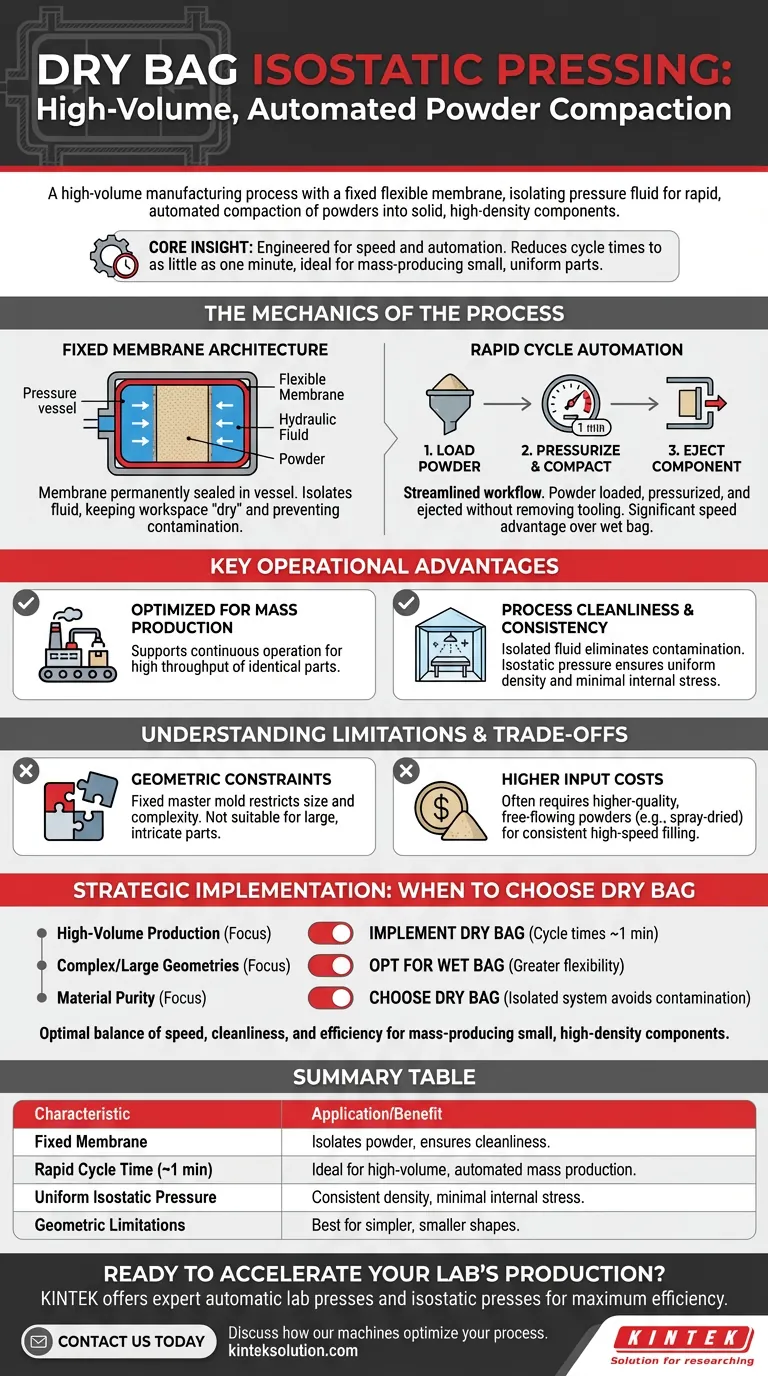
Visual Guide
Related Products
- Manual Cold Isostatic Pressing CIP Machine Pellet Press
- Automatic Lab Cold Isostatic Pressing CIP Machine
- Electric Lab Cold Isostatic Press CIP Machine
- Warm Isostatic Press for Solid State Battery Research Warm Isostatic Press
- Electric Split Lab Cold Isostatic Pressing CIP Machine
People Also Ask
- Why is Cold Isostatic Pressing (CIP) necessary for SBN ceramics? Achieve High-Density and Crack-Free Sintering
- Why is Cold Isostatic Pressing (CIP) applied after uniaxial pressing? Optimize Superconductor Precursor Density
- What are the process advantages of using Cold Isostatic Pressing (CIP) for LSMO? Achieve Defect-Free Density
- What types of equipment are available for cold isostatic pressing? Explore CIP Solutions for Labs and Production
- What are the technical advantages of cold isostatic pressing equipment compared to uniaxial compression equipment? Learn More!







