
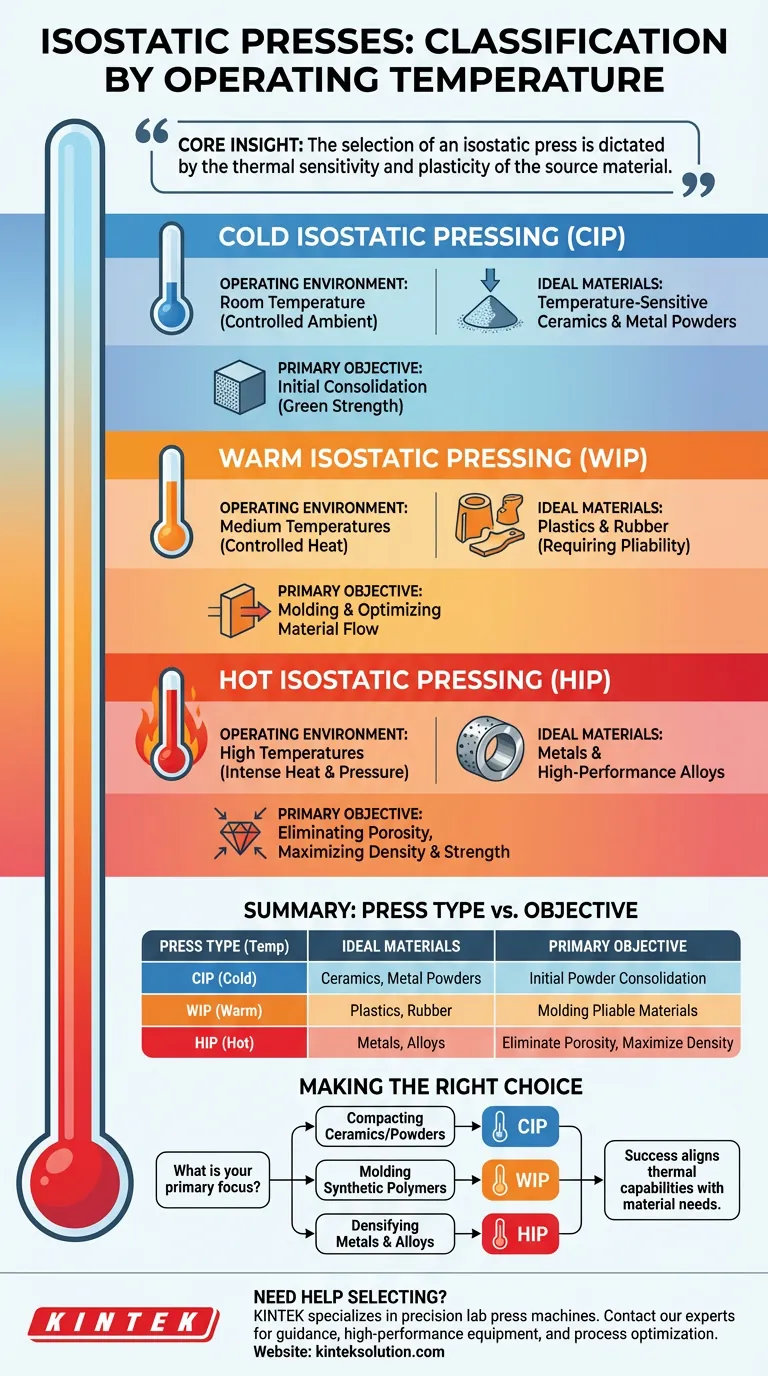
Isostatic presses are primarily categorized into three distinct types based on operating temperature: Cold Isostatic Presses (CIP), Warm Isostatic Presses (WIP), and Hot Isostatic Presses (HIP). Each classification is engineered to handle specific material properties, ranging from temperature-sensitive powders at room temperature to robust metals requiring extreme heat for densification.
Core Insight: The selection of an isostatic press is dictated by the thermal sensitivity and plasticity of the source material. While cold pressing focuses on initial consolidation (green strength), warm pressing targets softer polymers, and hot pressing is essential for maximizing density in metals.
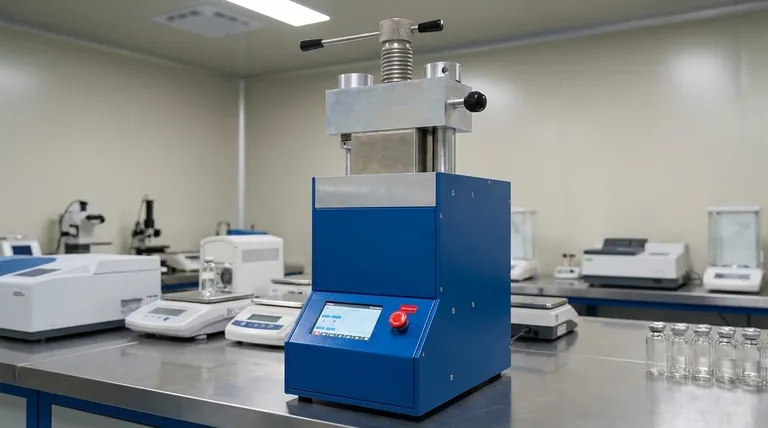
Cold Isostatic Pressing (CIP)
Operating Environment
Cold Isostatic Presses operate at room temperature. This environment is strictly controlled to ensure no thermal energy is applied to the workload during the pressurization cycle.
Ideal Materials
This method is specifically designed for temperature-sensitive materials. It is the standard choice for consolidating ceramics and metal powders that might degrade or react unexpectedly under heat.
The Objective
The primary goal of CIP is usually to compact powder into a solid shape before a secondary process, such as sintering.
Warm Isostatic Pressing (WIP)
Operating Environment
Warm Isostatic Presses function at medium temperatures. Unlike the ambient environment of CIP, WIP involves a controlled elevation of heat to facilitate material flow without reaching melting points.
Ideal Materials
This category is best suited for materials that require pliability but cannot withstand extreme heat. Common applications include the molding of plastics and rubber.
Critical Success Factors
Success in warm isostatic pressing relies on a delicate balance of variables. Operators must strictly manage the working temperature, ambient temperature, and working static pressure to ensure the material molds correctly without degrading.
Hot Isostatic Pressing (HIP)
Operating Environment
Hot Isostatic Presses operate at high temperatures. This equipment is built to withstand and deliver simultaneous high pressure and intense heat.
Ideal Materials
HIP is required for materials with high-temperature requirements, specifically metals and high-performance alloys.
The Objective
The combination of heat and pressure allows for the elimination of internal porosity. This process densifies the material to a level that cold or warm pressing cannot achieve, resulting in superior mechanical properties.
Understanding the Trade-offs
Material Limitations
The primary trade-off in selecting a press is material compatibility. Using a Hot Isostatic Press on temperature-sensitive ceramics or plastics would destroy the material, while using a Cold Isostatic Press on certain alloys may fail to achieve necessary density.
Process Complexity
As operating temperatures rise, the complexity of the process increases. Warm Isostatic Pressing introduces more variables than CIP, specifically the need to balance ambient and working temperatures against pressure to prevent defects in plastics.
Making the Right Choice for Your Goal
To select the correct equipment, you must match the press type to your material's thermal limits and the desired end-state of the product.
- If your primary focus is compacting ceramics or metal powders: Choose Cold Isostatic Pressing to consolidate materials at room temperature without thermal degradation.
- If your primary focus is molding synthetic polymers: Choose Warm Isostatic Pressing to process plastics and rubber at medium temperatures where flow is optimized.
- If your primary focus is densifying metals and alloys: Choose Hot Isostatic Pressing to utilize high heat for eliminating porosity and maximizing structural integrity.
Success in isostatic pressing is ultimately defined by aligning the thermal capabilities of the equipment with the physical requirements of your material.
Summary Table:
| Press Type | Operating Temperature | Ideal Materials | Primary Objective |
|---|---|---|---|
| Cold Isostatic Press (CIP) | Room Temperature | Temperature-sensitive ceramics, metal powders | Initial powder consolidation (green strength) |
| Warm Isostatic Press (WIP) | Medium Temperature | Plastics, rubber | Molding materials requiring pliability |
| Hot Isostatic Press (HIP) | High Temperature | Metals, high-performance alloys | Eliminate porosity, maximize density & strength |
Need Help Selecting the Right Isostatic Press?
Choosing the correct press is critical for your material's success. The wrong temperature can lead to product failure, while the right match ensures optimal density and structural integrity.
KINTEK specializes in precision lab press machines, including a full range of isostatic presses (automatic, heated, and isostatic). We help laboratories like yours navigate these critical decisions.
We provide:
- Expert Guidance: Match your specific material (ceramics, polymers, or metals) to the ideal press type.
- High-Performance Equipment: Reliable CIP, WIP, and HIP systems built for consistent results.
- Process Optimization: Achieve your goals for compaction, molding, or densification.
Let's discuss your application. Contact our experts today to find the perfect isostatic press solution for your laboratory's needs.
Visual Guide
Related Products
- Warm Isostatic Press for Solid State Battery Research Warm Isostatic Press
- Electric Lab Cold Isostatic Press CIP Machine
- Automatic Lab Cold Isostatic Pressing CIP Machine
- Lab Isostatic Pressing Molds for Isostatic Molding
- Manual Cold Isostatic Pressing CIP Machine Pellet Press
People Also Ask
- Why must composite cathodes be sealed in vacuum lamination bags for WIP? Ensure Battery Stability and Density
- How do sacrificial volume materials (SVM) maintain microchannels in isostatic pressing? Ensure Structural Integrity
- What is the function of elastic molds in warm isostatic pressing? Achieve Uniform Density in Composite Particles
- What is the role of the flexible material in warm isostatic pressing? Key to Uniform Density & Precision
- What are the advantages of using a Warm Isostatic Press (WIP) for batteries? Achieve Superior Interface Contact



















