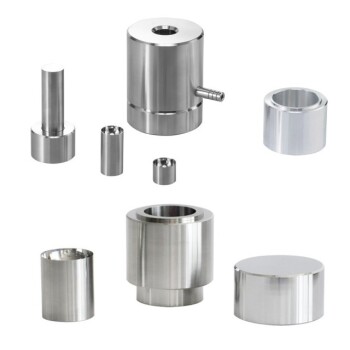
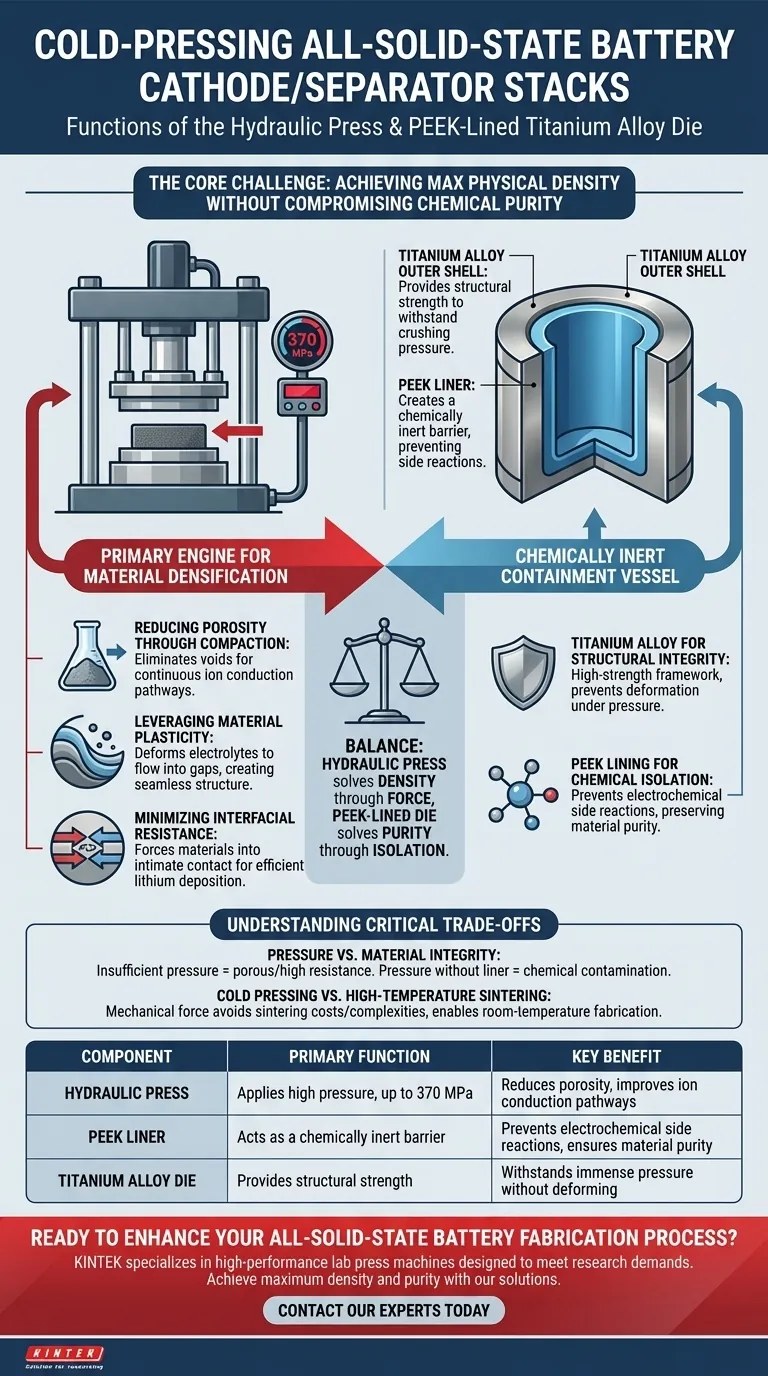
In the fabrication of all-solid-state batteries, the hydraulic press serves as the primary engine for material densification, while the specialized PEEK-lined titanium die functions as a chemically inert containment vessel.
The hydraulic press applies immense force—often reaching 370 MPa—to compact cathode composites and separator powders, effectively reducing porosity and leveraging the room-temperature plasticity of solid electrolytes. The die itself is engineered with a dual purpose: the titanium alloy exterior provides the structural strength to withstand this crushing pressure, while the PEEK liner creates a barrier that prevents electrochemical side reactions between the reactive battery materials and the metal die.
The core challenge in cold-pressing solid-state batteries is achieving maximum physical density without compromising chemical purity. The hydraulic press solves the density problem through force, while the PEEK-lined die solves the purity problem through isolation.

The Role of the Hydraulic Press: Densification and Contact
The hydraulic press is not merely shaping the material; it is altering the physical properties of the battery stack to enable performance.
Reducing Porosity through Compaction
The primary function of the press is to eliminate voids within the cathode composite and separator powder. By applying extreme pressure, the press compacts the powder particles into a dense pellet.
This reduction in porosity is essential for establishing continuous ion conduction pathways, allowing lithium ions to move freely through the material.
Leveraging Material Plasticity
Certain solid-state electrolytes, particularly sulfides, exhibit excellent room-temperature plasticity.
The hydraulic press applies precise pressure to deform these materials, ensuring they flow into gaps and create a seamless, non-porous solid structure without the need for heat.
Minimizing Interfacial Resistance
Efficient battery performance depends on the quality of the interface between layers.
The press forces the electrolyte and current collector into intimate physical contact. This tight junction significantly lowers interfacial resistance, which is critical for efficient lithium deposition and stable stripping cycles.
The Architecture of the Die: Strength Meets Inertness
Standard metal dies are often unsuitable for solid-state battery fabrication due to the high reactivity of the materials involved. The PEEK-lined titanium alloy die addresses this specific limitation.
Titanium Alloy for Structural Integrity
The pressures required for cold-pressing (e.g., 370 MPa) are immense.
A standard polymer die would shatter, and soft metals would deform. The titanium alloy outer shell provides the necessary high-strength framework to contain these forces without yielding.
PEEK Lining for Chemical Isolation
Under high pressure, active battery materials can become highly reactive and may chemically interact with a metal die.
PEEK (Polyether ether ketone) is chemically inert. By lining the die with PEEK, you create a shield that prevents electrochemical side reactions, preserving the purity of the cathode and separator.
Understanding the Critical Trade-offs
While cold-pressing offers a pathway to high-performance batteries, the process involves balancing mechanical and chemical constraints.
Pressure vs. Material Integrity
Applying insufficient pressure results in a porous structure with poor conductivity and high resistance.
However, applying this pressure without a protective liner leads to chemical contamination. The active materials can react with the die wall, degrading the battery's potential performance before it is even assembled.
Cold Pressing vs. High-Temperature Sintering
Cold pressing utilizes the hydraulic press to achieve density through mechanical force rather than thermal energy.
This approach avoids the costs and complexities associated with high-temperature sintering. It allows for the fabrication of effective anode-free batteries at room temperature, provided the die materials can withstand the mechanical stress without reacting.
Making the Right Choice for Your Fabrication Process
The selection of your pressing equipment and die materials directly dictates the electrochemical stability of your final cell.
- If your primary focus is minimizing internal resistance: Ensure your hydraulic press is capable of delivering uniform, high pressure (up to 370 MPa) to fully leverage the plasticity of the electrolyte.
- If your primary focus is preventing material degradation: You must utilize a PEEK-lined die to strictly isolate active materials from metal surfaces during the high-pressure phase.
By combining high-pressure mechanics with chemically inert tooling, you ensure that the physical density of the battery is maximized while its chemical composition remains uncompromised.
Summary Table:
| Component | Primary Function | Key Benefit |
|---|---|---|
| Hydraulic Press | Applies high pressure (up to 370 MPa) for compaction | Reduces porosity, improves ion conduction pathways |
| PEEK Liner | Acts as a chemically inert barrier | Prevents electrochemical side reactions, ensures material purity |
| Titanium Alloy Die | Provides structural strength | Withstands immense pressure without deforming |
Ready to enhance your all-solid-state battery fabrication process? KINTEK specializes in high-performance lab press machines, including automatic and heated lab presses, designed to meet the precise demands of laboratory research. Our equipment, like the presses and dies described here, helps you achieve maximum material density and purity for superior battery performance. Contact our experts today to discuss how our solutions can power your innovation.
Visual Guide
Related Products
- Lab Ball Press Mold
- Lab Ring Press Mold for Sample Preparation
- Lab Infrared Press Mold for No Demolding
- Lab Heat Press Special Mold
- Lab Cylindrical Press Mold with Scale
People Also Ask
- What is the purpose of incorporating cartridge heaters into a lab press mold for MLCC block compression? Optimize Results
- What are the requirements for pressing molds when using SSCG? Key Materials for Complex Single Crystal Production
- How do the design and geometric precision of pressing molds and mandrels affect the quality of PTFE composite samples?
- How does the geometry of laboratory molds influence mycelium-based composites? Optimize Density and Strength
- What role do precision positioning and pressure molds play in single-lap joints? Ensure 100% Data Integrity