
To create high-quality KBr pellets, you must strictly prioritize moisture control and precise component ratios. Success relies on heating your die set components to ensure complete dryness, using desiccant-stored KBr powder, and ensuring all materials—powder, anvils, and die—are at the same temperature to prevent cloudy, wet pellets.
The quality of your FTIR spectrum depends entirely on the transparency of the pellet, which is achieved by eliminating environmental moisture and maintaining a specific sample-to-matrix ratio of approximately 1:100.
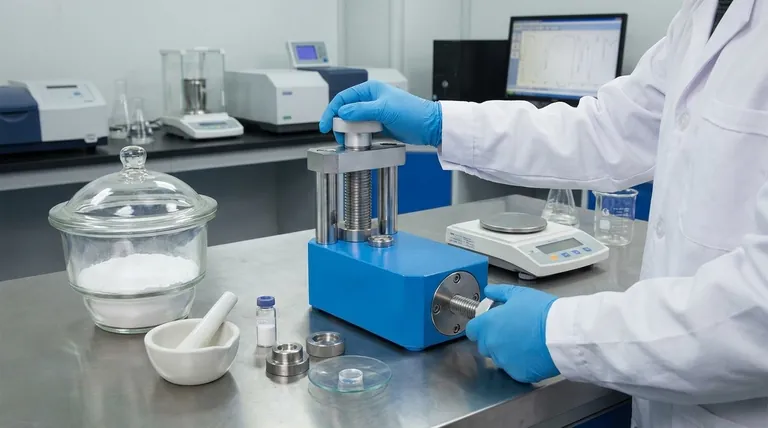
Critical Preparation Standards
Eliminating Moisture
Moisture is the primary cause of poor spectral quality and cloudy pellets. You must ensure the KBr powder is completely dry, ideally stored in a heated case or desiccator. Furthermore, heat the anvils and the body of the die set prior to use to drive off any residual humidity.
Thermal Equilibrium
It is not enough for the components to be dry; they must also be thermally stable. Ensure the KBr powder, the anvils, and the die set are all at the same temperature before you begin. Mixing components of different temperatures can induce condensation, resulting in a wet, unusable pellet.
The Manufacturing Process
Establishing the Correct Ratio
The standard mixture consists of a very small quantity of sample diluted within the KBr matrix. Aim for a ratio of approximately 1 part sample to 100 parts KBr by weight. Typically, this translates to 1–2 mg of sample mixed with 100–200 mg of KBr powder.
Grinding and Mixing
Thoroughly grind the sample material first to ensure homogeneity and reduce particle size. Mix this sample into the KBr powder to ensure an even distribution.
Protecting the Crystal Structure
While mixing is essential, be careful not to excessively grind the KBr powder itself. Over-grinding KBr exposes new crystal facets which can rapidly absorb atmospheric moisture.
Compression and Formation
Place the mixture into the die assembly, ensuring vacuum seals are positioned correctly if a vacuum is used. Apply a load of 8 to 10 tons (up to 10 tonnes for a 13 mm die) using a hydraulic press. This pressure fuses the powder into a solid, transparent disc suitable for infrared transmission.
Avoiding Common Pitfalls
The Risk of Excess Powder
One of the most frequent errors is using too much KBr powder in the die. A thicker pellet requires significantly more force to compress effectively.
Consequences of Overloading
If you use too much powder and cannot apply inordinate force, the press will be incomplete. This results in pellets containing white spots or pellets that become wedged inside the die. Use the minimum amount of KBr necessary to create a thin, even coat on the anvil face.
Optimizing for Spectral Quality
To ensure you generate usable data every time, adhere to these specific focus areas:
- If your primary focus is optical clarity: Ensure strict thermal equilibrium between the die and powder to prevent the formation of opaque, wet pellets.
- If your primary focus is mechanical stability: Avoid overloading the die with KBr powder to prevent wedging and ensure the pellet consolidates uniformly without white spots.
- If your primary focus is signal accuracy: Adhere to the 1-2% sample concentration range to keep the absorbance within the linear detection limits of the FTIR instrument.
Treat the elimination of moisture as the single most critical variable in the entire KBr pellet workflow.
Summary Table:
| Key Focus Area | Critical Action | Desired Outcome |
|---|---|---|
| Optical Clarity | Ensure thermal equilibrium between die and powder | Prevent opaque, wet pellets |
| Mechanical Stability | Avoid overloading the die with KBr powder | Prevent wedging and white spots |
| Signal Accuracy | Maintain 1-2% sample concentration | Keep absorbance within FTIR linear detection limits |
Struggling with cloudy KBr pellets or inconsistent FTIR results? KINTEK specializes in laboratory press machines, including automatic lab presses and heated lab presses designed specifically for reliable pellet production. Our equipment ensures the precise pressure control and temperature stability your lab needs for perfect KBr pellets every time. Contact our experts today to discover how our solutions can enhance your analytical workflow and deliver superior spectral quality.
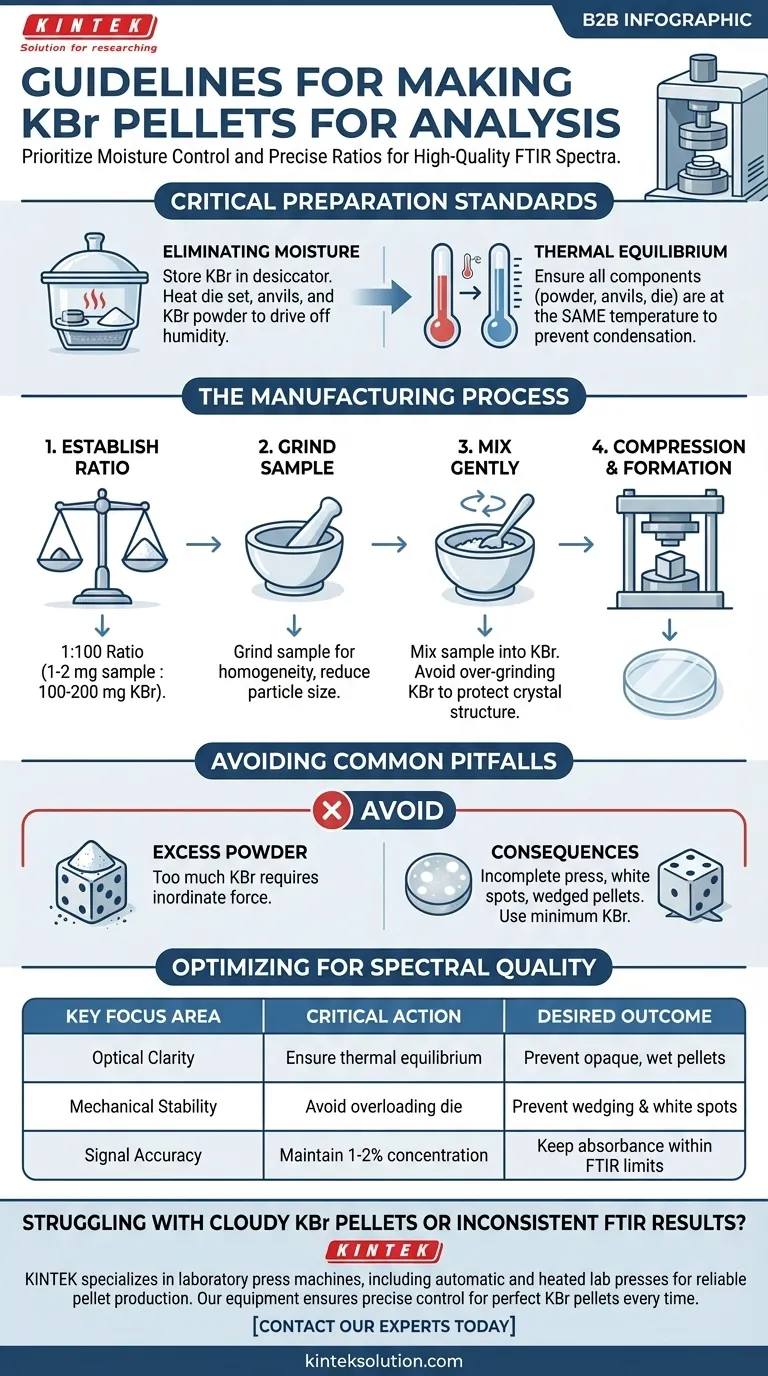
Visual Guide
Related Products
- Laboratory Hydraulic Press 2T Lab Pellet Press for KBR FTIR
- XRF KBR Plastic Ring Lab Powder Pellet Pressing Mold for FTIR
- XRF KBR Steel Ring Lab Powder Pellet Pressing Mold for FTIR
- Laboratory Hydraulic Pellet Press for XRF KBR FTIR Lab Press
- Automatic Laboratory Hydraulic Press for XRF and KBR Pellet Pressing
People Also Ask
- What is the role of a laboratory pressure machine and KBr in FTIR? Master Sample Preparation for Flame Retardants
- What is the role of a laboratory hydraulic press in high-loading NCM811 cathode prep for solid-state batteries?
- What role does a laboratory hydraulic press play in reaction pellets? Optimizing Lunar Soil and Metal Fuel Density
- Why is a laboratory hydraulic press necessary for sample preparation? Precise Pelleting for Spiro Heterocyclic Analysis
- What is a laboratory hydraulic press? Essential Guide to Precision Sample Preparation and Testing



















