
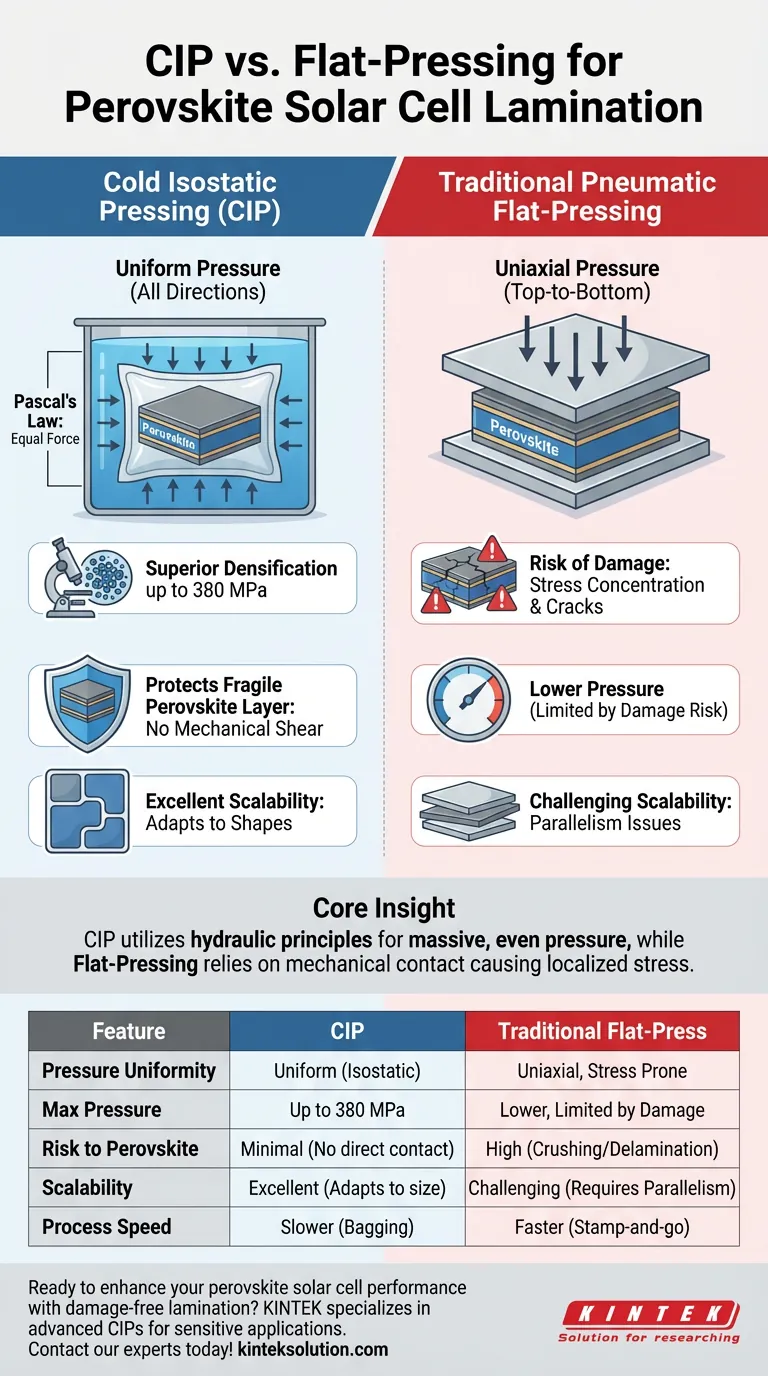
Cold Isostatic Pressing (CIP) offers a definitive advantage over traditional pneumatic flat-pressing by utilizing a fluid medium to transmit pressure uniformly in all directions. This method eliminates the mechanical shear and localized stress concentrations inherent in rigid plate-to-plate pressing, which are the primary causes of damage to fragile perovskite functional layers.
The Core Insight: While traditional presses rely on mechanical contact that crushes high points and misses low points, CIP utilizes hydraulic principles to apply massive pressure (up to 380 MPa) evenly across every micron of the surface. This allows for superior electrode densification without compromising the structural integrity of the delicate solar cell stack.
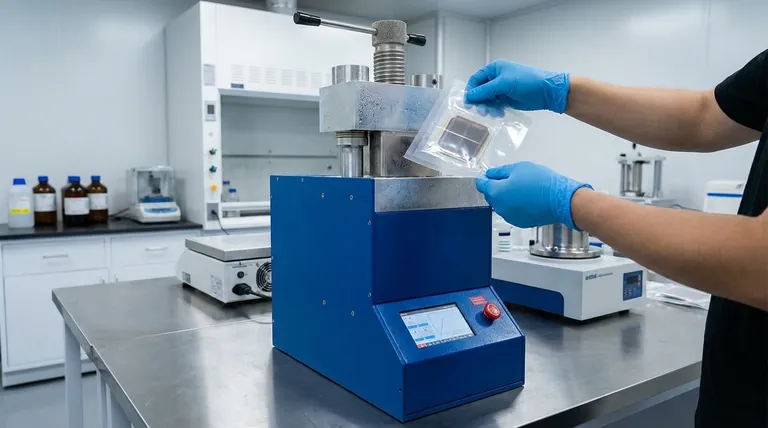
The Mechanics of Uniformity
Eliminating Stress Concentration
Traditional pneumatic presses operate uniaxially, applying force from top to bottom. If there are even microscopic variations in the thickness of the sample or the flatness of the plates, pressure accumulates at "high spots."
In contrast, CIP submerges the solar cell assembly in a liquid medium. Following Pascal's Law, the pressure is transmitted equally in all directions. This ensures that the force applied to the edges is identical to the force applied to the center, completely avoiding the pressure gradients that lead to cracks.
Protecting the Perovskite Layer
Perovskite layers are notoriously fragile and susceptible to mechanical damage. The rigid contact of a flat press often induces fractures in these underlying layers during electrode lamination.
CIP mitigates this risk by "wrapping" the pressure around the component. This allows manufacturers to apply significantly higher total pressure to improve lamination quality without the risk of crushing or delaminating the active perovskite material.
Optimization of Material Properties
Achieving High-Density Lamination
Effective solar cells require intimate contact between the electrode and the transport layers to minimize series resistance. CIP allows for the application of extremely high pressures—up to 380 MPa in specific solar applications.
This creates a denser, more uniform electrode interface than is possible with pneumatic pressing. The result is improved electrical connectivity and charge extraction efficiency across the entire active area of the cell.
Consistency in Scaling
Scaling up from small lab cells to larger modules is difficult with flat presses due to the challenge of maintaining perfect plate parallelism over large areas.
CIP removes this geometric constraint. Because the pressure medium is fluid, it adapts to the shape and size of the component. This allows for the simultaneous processing of complex shapes or large-area modules with the same consistency achieved on smaller test cells.
Understanding the Trade-offs
Process Complexity and Cycle Time
While CIP offers superior quality, it generally introduces more process steps than a simple "stamp-and-go" flat press. Samples must be sealed (bagged) to isolate them from the hydraulic fluid, and the pressurization/depressurization cycles take longer.
Equipment Maintenance
CIP systems rely on high-pressure vessels and hydraulic pumps. These require more rigorous maintenance schedules—checking seals, monitoring hydraulic fluids, and inspecting pressure vessels—compared to the relatively simple mechanics of a pneumatic press.
Making the Right Choice for Your Goal
When deciding between CIP and flat-pressing for perovskite manufacturing, consider your primary objective:
- If your primary focus is Device Performance and Yield: Choose CIP. The uniform pressure minimizes internal damage to the perovskite layer, leading to higher efficiency and fewer short-circuited devices.
- If your primary focus is Electrode Density: Choose CIP. The ability to apply up to 380 MPa ensures maximum compaction of the electrode material, reducing resistance.
- If your primary focus is Rapid Prototyping Speed: A flat press may offer faster cycle times for rough initial testing, provided the lower yield and potential for damage are acceptable risks.
Ultimately, CIP transforms the lamination process from a mechanical crushing action into a controlled densification event, essential for high-efficiency perovskite devices.
Summary Table:
| Feature | Cold Isostatic Press (CIP) | Traditional Pneumatic Flat-Press |
|---|---|---|
| Pressure Uniformity | Uniform in all directions (Isostatic) | Uniaxial, prone to stress concentration |
| Max Pressure (Typical) | Up to 380 MPa | Lower, limited by risk of damage |
| Risk to Perovskite Layer | Minimal (No direct mechanical contact) | High (Risk of crushing/delamination) |
| Scalability | Excellent (Adapts to shape/size) | Challenging (Requires perfect plate parallelism) |
| Process Speed | Slower (Bagging, pressurization cycles) | Faster ("Stamp-and-go") |
Ready to enhance your perovskite solar cell performance and yield with damage-free lamination?
KINTEK specializes in laboratory press machines, including advanced Cold Isostatic Presses (CIPs) designed for sensitive applications like perovskite electrode lamination. Our CIPs deliver the uniform, high-pressure densification (up to 380 MPa) essential for maximizing device efficiency and protecting your fragile functional layers.
Contact our experts today to discuss how a KINTEK CIP can transform your manufacturing process. Let us help you achieve superior electrode interfaces and consistent results, from R&D to large-area modules.
👉 Get in touch via our Contact Form
Visual Guide
Related Products
- Electric Lab Cold Isostatic Press CIP Machine
- Electric Split Lab Cold Isostatic Pressing CIP Machine
- Automatic Lab Cold Isostatic Pressing CIP Machine
- Manual Cold Isostatic Pressing CIP Machine Pellet Press
- Lab Isostatic Pressing Molds for Isostatic Molding
People Also Ask
- What are the applications of electric lab cold isostatic presses in research settings? Advance Material R&D with High-Pressure CIPs
- What role do electric lab cold isostatic presses play in industrial contexts? Bridge R&D and Manufacturing with Precision
- How does electrical Cold Isostatic Pressing (CIP) contribute to cost savings? Unlock Efficiency and Reduce Expenses
- What are some research applications of electric lab CIPs? Unlock Uniform Powder Densification for Advanced Materials
- What are the characteristics of standard off-the-shelf electric lab CIP solutions? Achieve Immediate, Cost-Effective Processing
















