
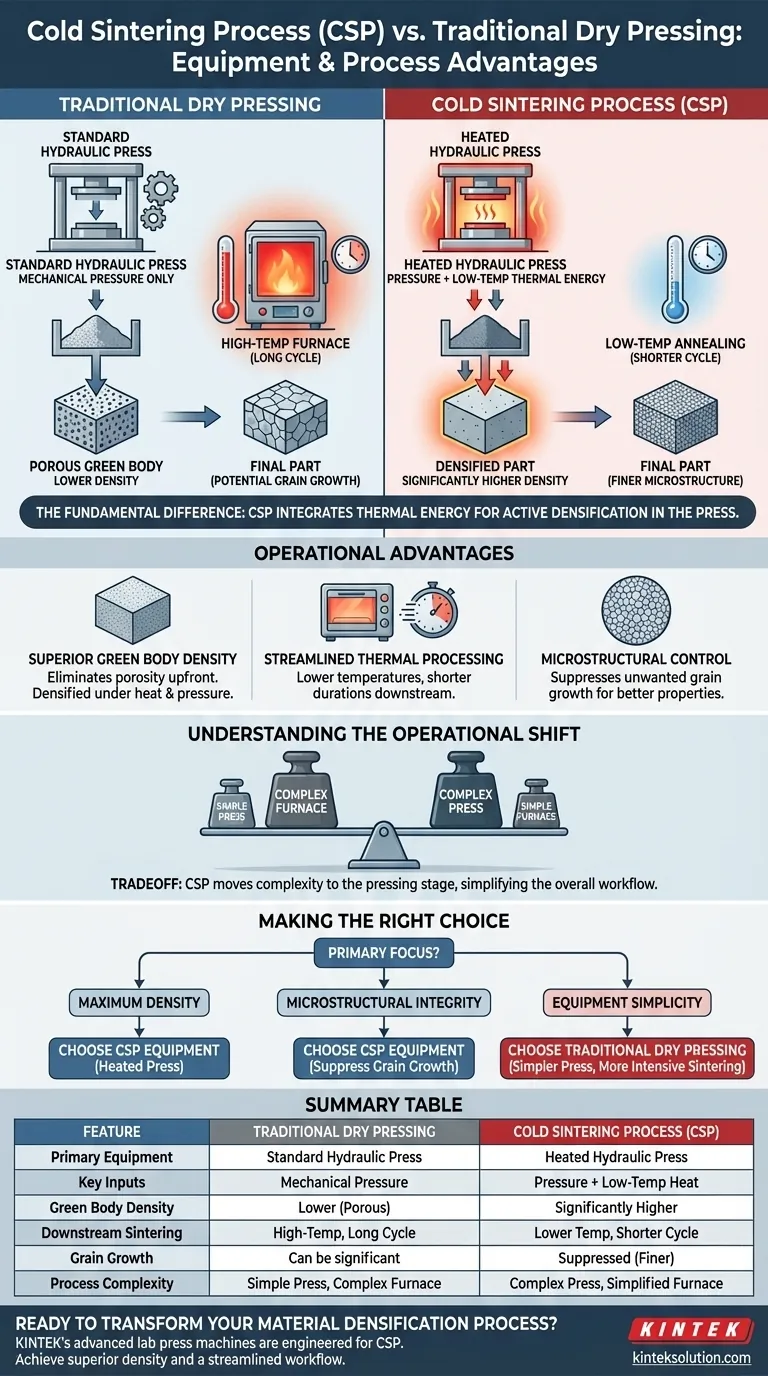
The fundamental difference lies in the integration of thermal energy directly into the compaction stage. While traditional dry pressing relies on a standard hydraulic press for mechanical force alone, the Cold Sintering Process (CSP) utilizes a heated hydraulic press. This specialized equipment applies pressure and low-temperature thermal energy simultaneously, allowing the material to densify inside the press rather than waiting for a separate, high-temperature furnace cycle.
Core Takeaway The equipment used in CSP transforms the pressing stage from a simple shaping step into an active densification process. By combining heat and pressure in a single unit, CSP achieves superior initial density and drastically reduces the need for lengthy, high-temperature thermal treatment downstream.
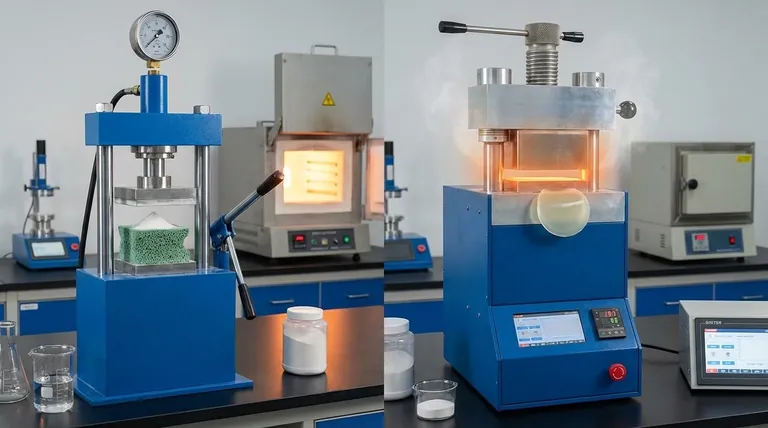
The Equipment Architecture
Traditional Dry Pressing
Traditional setups utilize a standard hydraulic press. The equipment’s sole function is mechanical compaction, forcing powder into a shape known as a "green body."
Because no heat is applied during this stage, the resulting part is relatively porous. To achieve strength and density, the part must be moved to a separate furnace for a lengthy, high-temperature sintering step.
Cold Sintering Process (CSP)
CSP replaces the standard unit with a heated hydraulic press. This equipment is designed to manage two variables at once: mechanical pressure and thermal energy.
This synergy allows the majority of densification to occur directly within the press. The equipment does not just shape the powder; it actively bonds the material at low temperatures.
Operational Advantages
Superior Green Body Density
The most significant immediate advantage of the heated press is the quality of the output. The initial density of a part produced via CSP is significantly higher than one produced via traditional dry pressing.
Because the material is densified under heat and pressure simultaneously, the porosity common in traditional green bodies is largely eliminated before the part ever leaves the mold.
Streamlined Thermal Processing
Because the CSP equipment achieves such high density upfront, the downstream processing requirements change drastically. Traditional methods require intense heat to close pores.
With CSP, the subsequent annealing step requires lower temperatures and shorter durations. The heavy lifting of densification has already been done by the press.
Microstructural Control
The equipment capabilities of CSP directly impact the material's final microstructure. High temperatures in traditional furnaces often lead to unwanted grain growth, which can degrade material properties.
By utilizing a heated press to densify at low temperatures, CSP suppresses this grain growth. This results in a finer, more controlled grain structure in the final product.
Understanding the Operational Shift
While CSP offers distinct advantages, adopting this equipment represents a shift in manufacturing philosophy.
Complexity at the Press
Traditional pressing is mechanically simple. The complexity in that workflow lies entirely in the furnace schedule.
CSP moves the complexity to the pressing stage. The equipment must precisely control temperature alongside pressure to achieve the "synergy" required for densification. This requires more sophisticated pressing hardware than the passive compaction of dry pressing.
The Trade-off of Throughput vs. Steps
CSP simplifies the overall workflow by reducing furnace time. However, the residence time in the press itself may be longer or more complex than a rapid-fire dry press cycle.
You are effectively trading a long, separate sintering cycle for a more involved, active pressing cycle.
Making the Right Choice for Your Goal
The choice between traditional dry pressing and CSP equipment depends on whether your priority is mechanical simplicity or material density.
- If your primary focus is Maximum Density: Choose CSP equipment, as the heated press achieves significantly higher initial density and creates a more compact microstructure.
- If your primary focus is Microstructural Integrity: Choose CSP equipment to suppress unwanted grain growth by avoiding prolonged exposure to high furnace temperatures.
- If your primary focus is Equipment Simplicity: Traditional dry pressing utilizes simpler, mechanical-only presses, though it necessitates a more intensive sintering infrastructure later.
Ultimately, CSP equipment is not just a tool for shaping; it is a tool for densification that reduces the thermal budget of your entire manufacturing line.
Summary Table:
| Feature | Traditional Dry Pressing | Cold Sintering Process (CSP) |
|---|---|---|
| Primary Equipment | Standard Hydraulic Press | Heated Hydraulic Press |
| Key Inputs | Mechanical Pressure Only | Pressure + Low-Temperature Heat |
| Green Body Density | Lower (Porous) | Significantly Higher |
| Downstream Sintering | High-Temperature, Long Cycle | Lower Temperature, Shorter Cycle |
| Grain Growth | Can be significant | Suppressed (Finer Microstructure) |
| Process Complexity | Simple Press, Complex Furnace Cycle | More Complex Press, Simplified Furnace Step |
Ready to transform your material densification process?
KINTEK's advanced lab press machines, including automatic and heated lab presses, are engineered to meet the precise demands of the Cold Sintering Process. By integrating thermal energy directly into the pressing stage, our equipment helps you achieve superior density, controlled microstructures, and a streamlined workflow with a reduced thermal budget.
Let KINTEK be your partner in innovation. Contact our experts today to discuss how our pressing solutions can optimize your laboratory's capabilities and accelerate your R&D.
Visual Guide
References
- Yu Tong, Hongtao Zhang. Current understanding and applications of the cold sintering process. DOI: 10.1007/s11705-019-1832-1
This article is also based on technical information from Kintek Solution Knowledge Base .
Related Products
- Automatic High Temperature Heated Hydraulic Press Machine with Heated Plates for Lab
- Automatic Heated Hydraulic Press Machine with Heated Plates for Laboratory
- Automatic Heated Hydraulic Press Machine with Hot Plates for Laboratory
- 24T 30T 60T Heated Hydraulic Lab Press Machine with Hot Plates for Laboratory
- Heated Hydraulic Press Machine with Heated Plates for Vacuum Box Laboratory Hot Press
People Also Ask
- Function of a Laboratory Hydraulic Press with Heated Platens in SSE? Enhance Battery Density & Conductivity
- What are the requirements for electrode pressing with high-viscosity ionic liquids like EMIM TFSI? Optimize Performance
- How does a laboratory heated hydraulic press facilitate PBN sample prep for WAXS? Achieve Precise X-Ray Scattering
- What are the industrial applications of heated hydraulic presses? Master Heat & Force for Precision Manufacturing
- Why is a laboratory hydraulic press with heating plates required for PLA/TEC films? Achieve Precise Sample Integrity



















