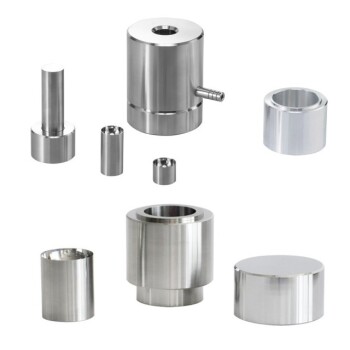
Traditional Equal Channel Angular Pressing (ECAP) mold designs face significant scalability hurdles. The primary limitations are a restriction to processing small, millimeter-scale bulk samples and a strict requirement for simple geometries, such as cylinders or cubes. Furthermore, the extreme mechanical pressure required for the process imposes high stress on the equipment, resulting in significant costs and preventing the manufacturing of large-scale or complex industrial components.
Core Takeaway While ECAP is effective for microstructural refinement, the mold designs are inherently non-scalable. The process is constrained by high equipment costs and the inability to produce complex or large-scale shapes, limiting its utility primarily to basic research rather than mass production of intricate parts.
The Geometry and Scale Barrier
To understand why ECAP struggles to leave the laboratory, one must look at the physical constraints of the mold channels.
Restriction to Simple Shapes
The fundamental design of an ECAP mold relies on intersecting channels. This geometry restricts the feedstock to simple cylinders or cubes.
You cannot introduce pre-shaped or complex components into the workflow. The mold dictates the shape, and that shape is invariably basic.
The Limitation of Millimeter Scale
Current mold designs are generally capable of processing only millimeter-scale bulk samples.
This size constraint effectively rules out the production of large structural components. If your application requires substantial copper billets or sheets, traditional ECAP molds cannot accommodate the volume.
The Economic and Mechanical Reality
Beyond geometry, the physics of the operation imposes severe demands on the hardware itself.
Managing Massive Mechanical Pressure
The extrusion process generates massive mechanical pressure to force the copper through the angled channel.
The molds must be engineered to endure extreme stress without deforming or failing. This requirement limits the choice of mold materials to high-strength, expensive alloys.
High Equipment Costs
Because of the durability required to survive the stress, the equipment costs are prohibitively high.
Developing molds that can withstand these forces makes the process expensive to implement and maintain. This creates a high barrier to entry for industrial manufacturers looking for cost-effective solutions.
Understanding the Trade-offs
When evaluating ECAP, it is crucial to recognize the inherent conflict between microstructural quality and manufacturing flexibility.
Material Strength vs. Shape Complexity
The trade-off is clear: ECAP provides exceptional grain refinement (ultrafine-grained materials), but it demands a total sacrifice of geometric complexity.
You obtain superior material properties, but you are left with a simple bar or rod that requires extensive post-processing to become a usable part.
Durability vs. Scalability
The rigidity required for the molds to survive the process makes them difficult to scale.
Designing a larger mold to handle bigger parts increases the mechanical forces exponentially, often pushing the equipment beyond practical engineering or economic limits.
Making the Right Choice for Your Goal
The suitability of ECAP depends entirely on whether you need a material sample or a finished component.
- If your primary focus is fundamental research: The geometric limitations are acceptable because the goal is simply to analyze the properties of ultrafine-grained copper.
- If your primary focus is industrial manufacturing: You must account for the inability to produce complex shapes and the high cost of tooling, which may render ECAP unviable for mass production.
Success with ECAP requires accepting that it is currently a material refinement tool, not a net-shape manufacturing process.
Summary Table:
| Limitation Category | Description | Impact on Production |
|---|---|---|
| Geometric Constraints | Limited to simple cylinders or cubes | Prevents manufacturing of complex or net-shape components |
| Scalability | restricted to millimeter-scale bulk samples | Unsuitable for large-scale industrial structural components |
| Mechanical Stress | Massive pressure required during extrusion | Requires expensive, high-strength mold materials and alloys |
| Economic Factor | High equipment and maintenance costs | High barrier to entry for cost-effective mass production |
| Processing Focus | Material refinement only | Necessitates extensive post-processing for usable parts |
Optimize Your Materials Research with KINTEK Precision Solutions
Are you facing challenges with material refinement and scalability? KINTEK specializes in comprehensive laboratory pressing solutions, offering a versatile range of manual, automatic, heated, multifunctional, and glovebox-compatible models, alongside advanced cold and warm isostatic presses.
Whether you are pioneering battery research or exploring ultrafine-grained materials, our expert-engineered equipment provides the reliability and precision your lab demands. Don't let traditional design limitations hold back your innovation.
Contact KINTEK today to find the perfect press for your application!
References
- Zongxuan Li, Zidong Wang. In-Situ Fabrication, Microstructure and Mechanical Performance of Nano Iron-Rich Precipitate Reinforced Cu and Cu Alloys. DOI: 10.3390/met12091453
This article is also based on technical information from Kintek Solution Knowledge Base .
Related Products
- Lab XRF Boric Acid Powder Pellet Pressing Mold for Laboratory Use
- Square Lab Press Mold for Laboratory Use
- Lab Round Bidirectional Press Mold
- Lab Polygon Press Mold
- XRF KBR Steel Ring Lab Powder Pellet Pressing Mold for FTIR
People Also Ask
- Why are pellets used in XRF analysis, and what is their limitation? Boost Accuracy and Speed in Your Lab
- What are the primary factors to consider when deciding between a manual and an automatic XRF pellet press? Optimize Your Lab's Efficiency
- What are the differences between manual and automatic XRF pellet presses? Choose the Right Press for Your Lab's Needs
- What are the different pellet pressing options for XRF sample preparation? Choose the Best Method for Accurate Analysis
- What are specialized XRF pellet preparation presses designed for? Boost Lab Efficiency with High-Throughput Automation