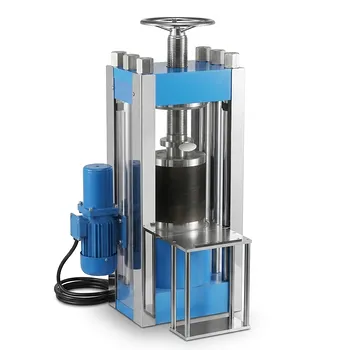
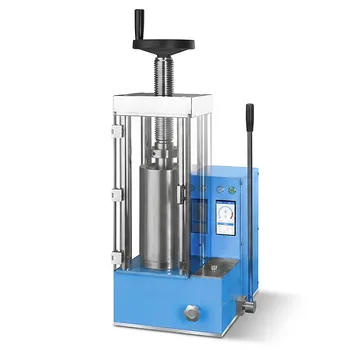
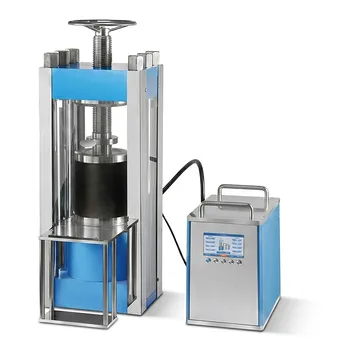
Isostatic compaction offers distinct structural advantages over cold pressing by utilizing omnidirectional pressure to achieve superior density and uniformity. While cold pressing is limited by unidirectional force and rigid dies, isostatic compaction creates parts that are freer from defects, exhibit higher green strength, and can sustain complex geometries without the constraints of traditional tooling.
Core Takeaway Unlike cold pressing, which creates internal density gradients due to unidirectional force and die friction, isostatic compaction applies pressure equally from all sides using a fluid medium. This fundamental difference eliminates common structural defects, removes the need for lubricants, and ensures uniform shrinkage during the sintering process.
The Mechanics of Density and Uniformity
Omnidirectional Pressure Application
The primary advantage lies in how pressure is delivered. Isostatic compaction uses a working fluid to apply pressure uniformly over the entire surface of a flexible mold.
In contrast, cold pressing applies pressure unidirectionally (axially) within rigid dies. This uniform application allows isostatic methods to achieve significantly higher density levels at similar pressure ratings.
Elimination of Internal Gradients
Standard cold pressing creates pressure gradients within the part, leading to uneven density.
Isostatic pressing effectively eliminates these internal pressure gradients. This ensures that particles—whether metal or ceramic—reach a high degree of uniform compactness in all directions.
Absence of Die-Wall Friction
A major factor limiting density in cold pressing is friction between the powder and the rigid die wall.
In isostatic compaction, the mold is flexible and the pressure is hydraulic. Consequently, die-wall friction is absent. This allows for a much more even density distribution throughout the component.
Structural Integrity and Material Quality
Prevention of Defects
Because the density is uniform, isostatic compaction significantly reduces the risk of compact defects.
This uniformity prevents non-uniform shrinkage, warping, or cracking during the subsequent sintering phase. This is particularly critical for brittle materials or fine powders, such as electrolytes or transparent ceramics, where microscopic defects can ruin the final product.
Superior Green Strength
Cold isostatic pressing (CIP) yields significantly stronger pre-sintered parts ("green bodies").
References indicate that CIP can result in green strengths approximately 10 times greater than those achieved by cold compaction in metal dies.
Lubricant-Free Processing
Cold pressing typically requires lubricants to mitigate die friction, which creates weaker bonds between particles.
Isostatic compaction does not require added lubricant. This not only contributes to the higher green strength mentioned above but also eliminates the "burn-off" stage required to remove lubricants during sintering, simplifying the thermal cycle.
Geometric Freedom
Complex Shape Capabilities
Rigid dies restrict part geometry to simple shapes that can be ejected vertically.
Isostatic compaction removes these constraints. Because the mold is flexible and pressure is applied from all sides, manufacturers can compact complex, irregular shapes that would be impossible to form using uniaxial pressing.
Efficient Material Utilization
The process allows for near-net-shape forming.
This capability leads to efficient material utilization, reducing waste and the need for extensive post-process machining.
Understanding the Operational Differences
While isostatic compaction offers superior material properties, it involves a fundamentally different operational approach than cold pressing.
Fluid Medium Requirement
The process relies on a liquid medium to transmit pressure. This requires sealing the powder in a hermetic, flexible container or membrane to prevent the fluid from contaminating the powder.
Process Complexity
Compared to the direct mechanical action of a hydraulic press, isostatic systems involve managing high-pressure fluids and flexible tooling. However, for high-performance applications, this complexity is a necessary trade-off to achieve densities up to 95% and ensure structural homogeneity.
Making the Right Choice for Your Goal
To determine if isostatic compaction is the correct solution for your specific application, consider the following distinct needs:
- If your primary focus is Component Integrity: Choose isostatic compaction to eliminate internal stress gradients and prevent cracking during sintering, especially for brittle materials.
- If your primary focus is Geometric Complexity: Choose isostatic compaction to bypass the design limitations of rigid dies and produce complex, near-net shapes.
- If your primary focus is Material Purity: Choose isostatic compaction to eliminate the need for die-wall lubricants and the associated burn-off steps.
Isostatic compaction is the definitive choice when uniform density and structural reliability outweigh the simplicity of uniaxial pressing.
Summary Table:
| Feature | Cold Pressing (Uniaxial) | Isostatic Compaction (CIP) |
|---|---|---|
| Pressure Direction | Unidirectional (Axial) | Omnidirectional (All sides) |
| Internal Density | Gradient present (Uneven) | Uniform (Homogeneous) |
| Die Friction | High (Wall friction) | None (Flexible mold) |
| Green Strength | Standard | High (Up to 10x stronger) |
| Lubricants | Required (Affects purity) | Not Required (Pure processing) |
| Geometric Capability | Simple shapes only | Complex, irregular shapes |
Elevate Your Lab's Material Synthesis with KINTEK
Are you struggling with internal defects or limited geometry in your battery research or ceramic development? KINTEK specializes in comprehensive laboratory pressing solutions designed to overcome the limitations of traditional cold pressing.
Our expert range includes manual, automatic, heated, multifunctional, and glovebox-compatible models, alongside high-performance cold and warm isostatic presses. By partnering with KINTEK, you gain access to equipment that ensures uniform density distribution and superior structural integrity for your advanced materials.
Ready to optimize your compaction process? Contact our technical specialists today to find the perfect pressing solution for your application.
Related Products
- Split Warm Isostatic Lab Press 200 Ton Powder Compaction Chamber for Battery Research and Material Science
- Electric Isostatic Pressing Machine 40 Tons Automatic Laboratory Powder Compacting Press
- Automatic Lab Cold Isostatic Pressing CIP Machine
- Lab Isostatic Pressing Molds for Isostatic Molding
- Warm Isostatic Press for Solid State Battery Research Warm Isostatic Press
People Also Ask
- Why is Warm Isostatic Pressing suitable for materials that cannot be formed at room temperature? Master Material Density
- How is hydraulic pressure utilized as the pressure medium in warm isostatic pressing? Master Your Material Density
- What is the function of a booster source in the warm isostatic pressing process? Master Precision Fluid Injection
- What is the role of a heat generator in warm isostatic pressing? Master Thermal Precision for Superior WIP Results
- In which industries is Warm Isostatic Pressing (WIP) applied? Optimize High-Performance Material Densification