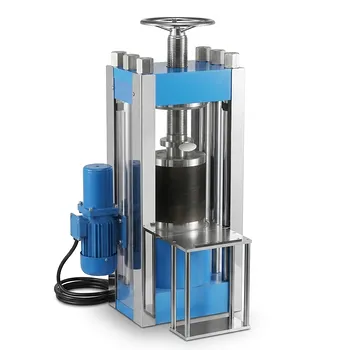
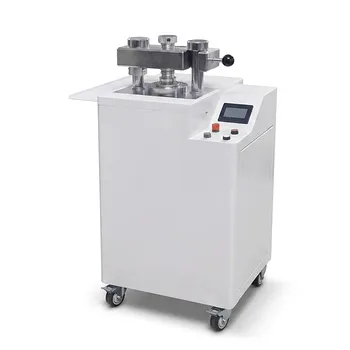
The primary application of a KBr press is the preparation of potassium bromide (KBr) pellets used for Infrared (IR) Spectroscopy. By compressing solid samples into transparent discs, this tool facilitates the detailed analysis of molecular structures, making it a cornerstone instrument in both industrial Quality Control and academic Research and Development.
The KBr press solves the challenge of analyzing solid materials by suspending them in an optically transparent medium. This ensures that the resulting spectral data reflects only the sample, not the matrix holding it, allowing for precise identification of chemical compounds.
Core Applications in Spectroscopy
Infrared Spectroscopy and Molecular Analysis
The most fundamental use of a KBr press is creating a medium for Infrared Spectroscopy. Solid samples often cannot be analyzed directly because they scatter light or are too dense for transmission.
By mixing the sample with KBr powder and compressing it, the press creates a pellet that is transparent to infrared light. This allows the spectrometer to "see" through the matrix and analyze the specific molecular vibrations of the sample without interference.
Quality Control (QC) Protocols
In industrial settings, the KBr press is a critical tool for maintaining material consistency and purity. Laboratories use these presses to routinely test batches of raw materials or finished products.
Because the pressing process is highly reproducible, QC teams can rely on the resulting pellets to provide consistent spectral data. This ensures that every batch meets strict manufacturing standards before leaving the facility.
Research and Development (R&D)
In R&D environments, the press is employed to characterize the properties of new materials and compounds. Researchers rely on the inert nature of KBr to study sensitive or novel substances without triggering unwanted chemical reactions.
This application is vital for determining the molecular makeup of synthesized chemicals, pharmaceuticals, or advanced materials where understanding the exact chemical structure is paramount.
The Mechanism Behind the Application
The Role of Transparency
The utility of the press relies entirely on the optical properties of potassium bromide. Because KBr is transparent to IR radiation, it acts as an invisible window for the spectrometer.
Achieving Uniform Dispersion
The press consists of a die set and a hydraulic system capable of applying 8 to 10 tons of pressure. This immense force ensures the sample is evenly dispersed throughout the pellet.
Uniform dispersion prevents "hot spots" in the analysis. It guarantees that the IR light interacts with the sample molecules evenly, providing a true representation of the material's bulk properties.
Understanding the Trade-offs
Sensitivity to Moisture
While KBr is an excellent optical medium, it is highly hygroscopic, meaning it absorbs moisture from the air. If the powder or the die set is not completely dry, the resulting pellet will be cloudy.
Moisture introduces water bands into the spectrum, which can obscure the data you are trying to analyze. Users must store KBr in desiccators and often heat the anvils to ensure dryness.
Requirement for Precision
The process is not automatic; it requires careful technique. The press must apply stable pressure via the base plate to ensure the pellet does not fracture.
Poor preparation leads to opaque or brittle pellets. This requires the user to restart the process, consuming more sample material and time.
How to Apply This to Your Project
If your primary focus is Routine Quality Control:
- Prioritize standardizing your pressing pressure (e.g., consistent tonnage) to ensure that every pellet yields reproducible data for batch-to-batch comparison.
If your primary focus is Research and Characterization:
- Concentrate on the preparation environment, ensuring the KBr is exceptionally dry to prevent moisture bands from masking the subtle spectral features of new compounds.
The KBr press transforms a physical sample into data, bridging the gap between raw material and molecular insight.
Summary Table:
| Application Category | Primary Purpose | Key Benefit |
|---|---|---|
| IR Spectroscopy | Creating transparent sample discs | High-resolution spectral data without matrix interference |
| Quality Control | Material consistency & purity testing | Reproducible results for batch-to-batch manufacturing standards |
| R&D | Characterizing new compounds | Inert medium allows safe study of novel chemical structures |
| Material Science | Uniform sample dispersion | Prevents light scattering and data 'hot spots' through high-pressure compression |
Elevate Your Spectroscopic Precision with KBr Solutions
Achieve flawless infrared transparency and reproducible results with KINTEK’s advanced pressing technology. Whether you are conducting sensitive battery research or routine industrial QC, our comprehensive laboratory pressing solutions—including manual, automatic, and heated models—are designed to meet the strictest research standards.
Our value to your laboratory:
- Precision Engineering: Ensure uniform dispersion and high-clarity pellets with our high-tonnage die sets.
- Versatile Systems: Choose from cold/warm isostatic presses or glovebox-compatible models for specialized environments.
- Expert Support: Benefit from KINTEK’s deep expertise in sample preparation for pharmaceutical and material science applications.
Ready to optimize your sample preparation workflow? Contact KINTEK today for a customized solution!
Related Products
- Laboratory Hydraulic Press 2T Lab Pellet Press for KBR FTIR
- Laboratory Hydraulic Pellet Press for XRF KBR FTIR Lab Press
- Automatic Laboratory Hydraulic Press for XRF and KBR Pellet Pressing
- Lab Infrared Press Mold for No Demolding
- Button Battery Sealing Press Machine for Lab
People Also Ask
- What is the role of a laboratory pressure machine and KBr in FTIR? Master Sample Preparation for Flame Retardants
- What is the role of a laboratory hydraulic press in high-loading NCM811 cathode prep for solid-state batteries?
- What role does a laboratory hydraulic press play in reaction pellets? Optimizing Lunar Soil and Metal Fuel Density
- Why is a laboratory hydraulic press necessary for sample preparation? Precise Pelleting for Spiro Heterocyclic Analysis
- What are the general applications of a laboratory hydraulic press? Maximize Precision in Material Research