
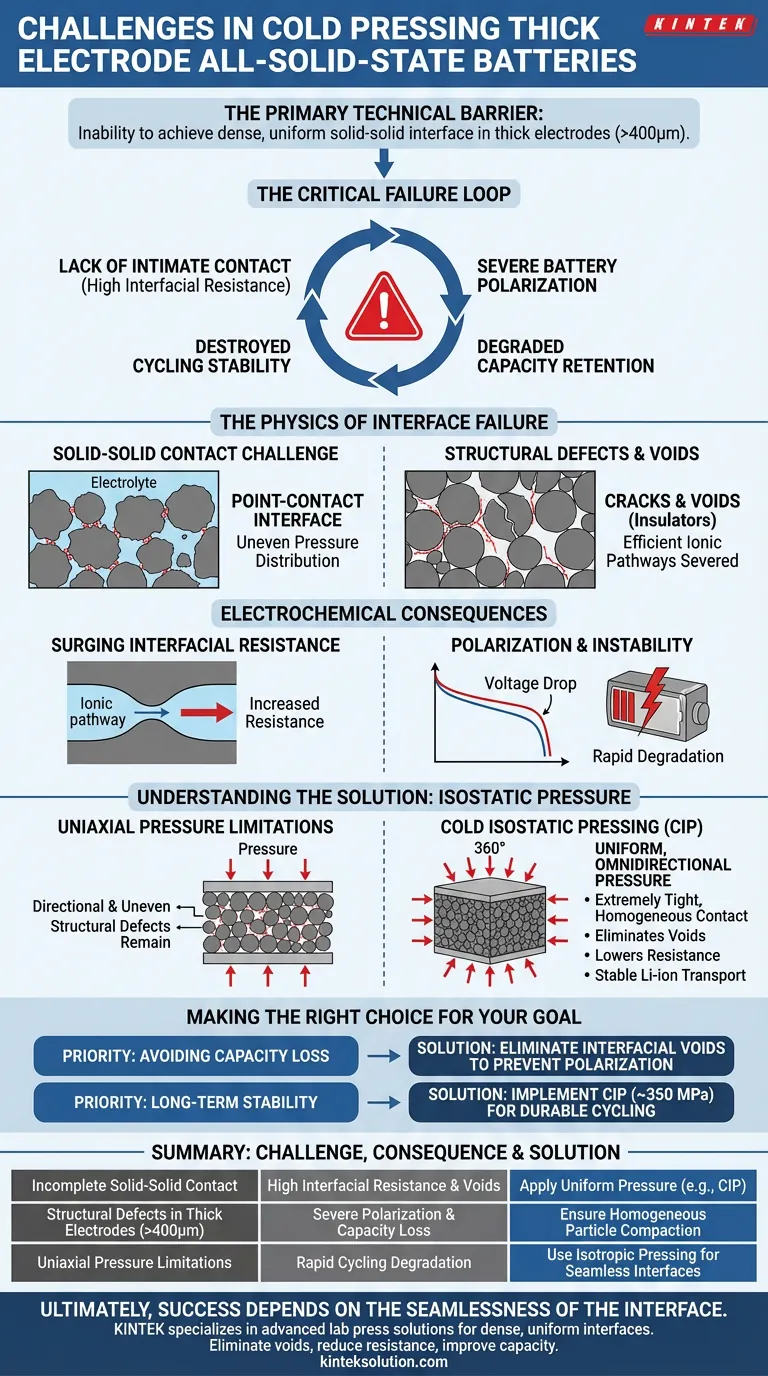
The primary technical barrier when using cold pressing for all-solid-state batteries with thick electrodes (exceeding 400µm) is the inability to achieve a dense, uniform solid-solid interface. Relying strictly on simple mechanical pressure fails to merge electrode and electrolyte particles seamlessly, creating microscopic voids and cracks that sever ionic pathways.
The Critical Failure Loop: The lack of intimate contact in cold-pressed thick electrodes creates high interfacial resistance. This resistance triggers severe battery polarization, which ultimately degrades capacity retention and destroys cycling stability.
The Physics of Interface Failure
The Challenge of Solid-Solid Contact
Unlike liquid electrolytes that naturally wet surfaces and fill pores, solid-state batteries rely entirely on physical pressure to create ionic pathways.
When you cold press thick electrodes, the force often fails to distribute evenly through the deep 400µm+ structure.
This results in a "point-contact" interface rather than a continuous boundary.
Structural Defects and Voids
The immediate physical consequence of insufficient bonding is the formation of cracks and voids.
These defects occur precisely where the electrode particles meet the electrolyte.
In thick electrode assemblies, these voids act as insulators, preventing lithium ions from crossing the boundary efficiently.
Electrochemical Consequences
Surging Interfacial Resistance
The physical gaps left by cold pressing translate directly into increased interfacial resistance.
Because the contact area is reduced by voids, the ionic current is forced through fewer pathways.
This creates a bottleneck that significantly impedes the battery's electrical performance.
Polarization and Instability
High resistance leads to severe battery polarization during operation.
Polarization causes a voltage drop that prevents the battery from utilizing its full theoretical capacity.
Furthermore, this instability stresses the material during cycling, leading to rapid degradation of the battery's lifespan.
Understanding the Solution: Isostatic Pressure
The Limitations of Uniaxial Pressure
Standard mechanical pressing (uniaxial) often causes the structural defects mentioned above because the pressure is directional and uneven.
It struggles to compact the complex composite structure of a thick cathode against a hard electrolyte pellet without leaving gaps.
The Role of Cold Isostatic Pressing (CIP)
To overcome the limitations of standard cold pressing, Cold Isostatic Pressing (CIP) is utilized as a corrective manufacturing step.
CIP applies high pressure (e.g., 350 megapascals) uniformly from all directions (isotropically).
Achieving Homogeneity
This isotropic force ensures extremely tight, homogeneous physical contact between the lithium metal anode, LLZO electrolyte, and composite cathode.
By eliminating the voids that standard cold pressing misses, CIP lowers resistance and enables stable lithium-ion transport.
Making the Right Choice for Your Goal
To maximize the performance of all-solid-state batteries with thick electrodes, you must prioritize the quality of the particle interface.
- If your primary focus is Avoiding Capacity Loss: You must move beyond simple mechanical pressure and ensure the elimination of interfacial voids to prevent polarization.
- If your primary focus is Long-Term Stability: You should implement Cold Isostatic Pressing (CIP) at approximately 350 MPa to achieve the homogeneous contact required for durable cycling.
Ultimately, the success of a thick-electrode solid-state battery depends not on the pressure applied, but on the seamlessness of the interface that pressure creates.
Summary Table:
| Challenge | Consequence | Solution |
|---|---|---|
| Incomplete solid-solid contact | High interfacial resistance & voids | Apply uniform pressure (e.g., CIP) |
| Structural defects in thick electrodes (>400µm) | Severe polarization & capacity loss | Ensure homogeneous particle compaction |
| Uniaxial pressure limitations | Rapid cycling degradation | Use isotropic pressing for seamless interfaces |
Struggling with interfacial resistance in your solid-state battery prototypes? KINTEK specializes in advanced lab press solutions, including isostatic presses and automatic lab presses, designed to achieve the dense, uniform interfaces essential for high-performance, thick-electrode batteries. Our equipment helps researchers like you eliminate voids and reduce resistance, enabling stable cycling and improved capacity retention.
Contact our experts today to find the perfect pressing solution for your laboratory's specific needs.
Visual Guide
Related Products
- Electric Lab Cold Isostatic Press CIP Machine
- Automatic Lab Cold Isostatic Pressing CIP Machine
- Electric Split Lab Cold Isostatic Pressing CIP Machine
- Manual Cold Isostatic Pressing CIP Machine Pellet Press
- Warm Isostatic Press for Solid State Battery Research Warm Isostatic Press
People Also Ask
- What are the applications of electric lab cold isostatic presses in research settings? Advance Material R&D with High-Pressure CIPs
- What role do electric lab cold isostatic presses play in industrial contexts? Bridge R&D and Manufacturing with Precision
- How does electrical Cold Isostatic Pressing (CIP) contribute to cost savings? Unlock Efficiency and Reduce Expenses
- What are some research applications of electric lab CIPs? Unlock Uniform Powder Densification for Advanced Materials
- What are the characteristics of standard off-the-shelf electric lab CIP solutions? Achieve Immediate, Cost-Effective Processing









