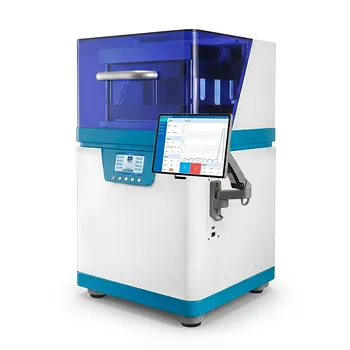
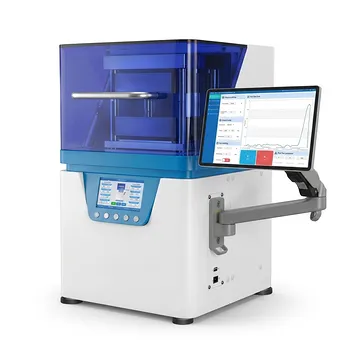
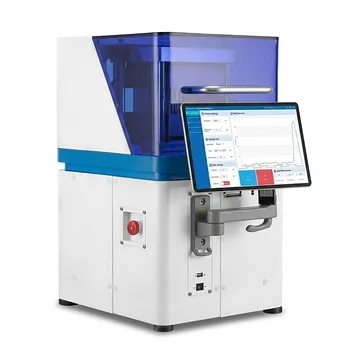
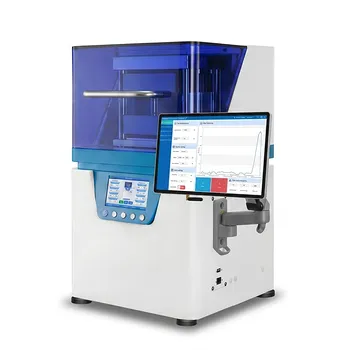
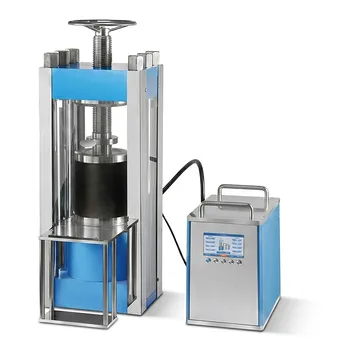
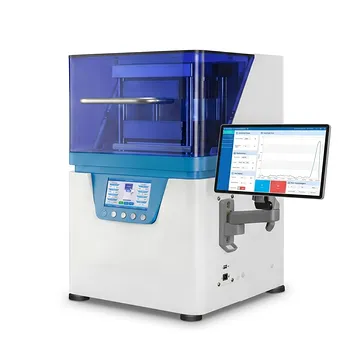
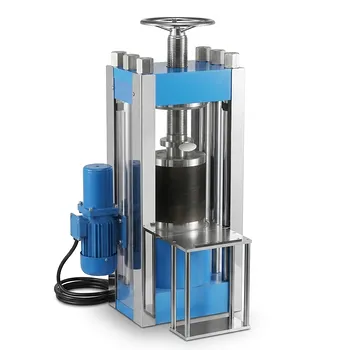
In double-layer plywood manufacturing, the laboratory hot press acts as the critical catalyst for structural integrity. It simultaneously provides High-precision thermal energy to trigger chemical cross-linking in adhesives and constant mechanical pressure to force those adhesives into the wood fibers. This dual-action process transforms loose veneers into a singular, high-strength composite by establishing both chemical bonds and mechanical anchoring.
The laboratory hot press is a precision instrument that manages the complex interplay between thermal chemical reactions and physical mechanical bonding. It ensures that the adhesive matrix cures fully while the wood structure is modified to achieve specific density and durability standards.
Facilitating Chemical and Mechanical Bonding
Triggering Resin Curing and Cross-linking
The hot press provides the specific thermal environment required to initiate curing in Nanocellulose (NCC) modified resins and other adhesives. High temperatures facilitate the chemical cross-linking reactions that turn liquid resin into a solid, durable matrix. Without this controlled heat, the adhesive would fail to reach its full load-bearing potential.
Driving Adhesive Penetration
Constant pressure, often calibrated to specific levels like 340 psi, is used to force the adhesive deep into the wood veneer fibers. This penetration is essential for establishing mechanical anchoring, which prevents delamination under stress. By eliminating air gaps, the press ensures a continuous bond across the entire interface of the two layers.
Achieving Interfacial Bonding Strength
In double-layer structures, the press can be used in stages to achieve high interfacial bonding strength. For example, one layer may be processed to a semi-cured state before the second layer is added and fully cured. This synchronized application of heat and pressure guarantees efficient conduction and structural unity between the composite layers.
Modifying Wood Physical Properties
Softening the Wood Matrix
The heating plates, typically reaching temperatures around 140°C, serve to soften the lignin and hemicellulose within the wood cell walls. This thermal conditioning makes the wood more pliable and receptive to permanent deformation. This state of "plasticization" is a fundamental requirement for any further structural enhancement.
Wood Surface Densification
By providing synchronized high temperature and pressure, the press causes the cell walls of the surface layer to collapse. This process, known as densification, significantly increases the surface density and hardness of the final plywood product. The precision of the press determines the exact depth of the densified layer, allowing for customized material properties.
Precise Thickness and Dimensional Control
The hot press ensures that the double-layer plywood meets strict standards for dimensional accuracy. By maintaining a closed-loop control system, it dictates the final thickness of each layer and the overall board. This level of control is vital for industrial applications where exact tolerances are required for assembly or further processing.
Understanding the Trade-offs
Temperature Uniformity vs. Production Speed
While higher temperatures can speed up the curing process, they risk thermal degradation of the wood fibers if not monitored closely. A laboratory press prioritizes temperature uniformity over raw speed to ensure that one area of the plywood isn't over-cured while another remains weak.
Pressure Intensity vs. Structural Damage
Higher pressure increases densification and bond strength, but excessive force can cause internal crushing of the wood cells beyond the desired surface layer. Finding the "sweet spot" involves balancing the need for adhesive penetration with the preservation of the wood's natural structural integrity.
Research Precision vs. Scalability
Laboratory hot presses are designed for high-precision R&D and small-scale samples, which allows for the exploration of complex process parameters. However, the slow, controlled cycles used in a lab setting may not always translate directly to the high-speed requirements of mass-production industrial presses.
How to Apply This to Your Project
When utilizing a laboratory hot press for plywood development, your settings should be dictated by your specific material goals.
- If your primary focus is Maximum Bonding Strength: Prioritize pressure stability (e.g., 340 psi) to ensure deep adhesive penetration and mechanical interlocking.
- If your primary focus is Surface Hardness: Focus on the precision of the heating plates to ensure uniform plasticization and controlled cell wall collapse.
- If your primary focus is Layered Functional Composites: Use a two-stage pressing approach, semi-curing the base layer before bonding the secondary layer to ensure high interfacial integrity.
Technical mastery of the hot press allows researchers to bridge the gap between raw natural materials and engineered high-performance composites.
Summary Table:
| Function | Impact on Plywood | Key Mechanism |
|---|---|---|
| Resin Curing | Structural Integrity | High-precision thermal cross-linking of adhesives |
| Mechanical Pressure | Delamination Prevention | Driving adhesive penetration into wood fibers (e.g., 340 psi) |
| Wood Softening | Improved Pliability | Plasticization of lignin and hemicellulose at ~140°C |
| Densification | Surface Hardness | Synchronized collapse of cell walls in the surface layer |
| Dimensional Control | Precision Standards | Closed-loop management of final board thickness |
| Interfacial Bonding | Material Unity | Multi-stage curing for high structural unity between layers |
Elevate Your Composite Research with KINTEK Precision
Achieving the perfect balance between adhesive curing and wood densification requires absolute control over thermal and mechanical parameters. KINTEK specializes in comprehensive laboratory pressing solutions designed to meet the rigorous demands of advanced material science.
Our extensive range includes manual, automatic, heated, multifunctional, and glovebox-compatible models, as well as advanced cold and warm isostatic presses—technology widely applied in battery research and high-performance composite manufacturing.
Why Choose KINTEK?
- Precision Engineering: Maintain exact temperatures and pressures for repeatable, high-quality R&D results.
- Versatile Applications: Equipment tailored for everything from biomass research to complex battery cell development.
- Industrial Scalability: We provide the tools you need to bridge the gap between laboratory samples and large-scale industrial production.
Ready to optimize your manufacturing process and achieve superior material performance? Contact KINTEK today to find the perfect hot press solution for your lab!
References
- Zhenbo Liu, Denis Rodrigue. Reinforcement of Lignin-Based Phenol-Formaldehyde Adhesive with Nano-Crystalline Cellulose (NCC): Curing Behavior and Bonding Property of Plywood. DOI: 10.4236/msa.2015.66060
This article is also based on technical information from Kintek Solution Knowledge Base .
Related Products
- Laboratory Split Manual Heated Hydraulic Press Machine with Hot Plates
- 24T 30T 60T Heated Hydraulic Lab Press Machine with Hot Plates for Laboratory
- Heated Hydraulic Press Machine with Heated Plates for Vacuum Box Laboratory Hot Press
- Automatic Hydraulic Hot Press with Large Plate and Precision Temperature Control for Advanced Material Sample Preparation and Industrial Research
- Laboratory Manual Heated Hydraulic Press Machine with Hot Plates
People Also Ask
- Why is a laboratory hydraulic press with heating plates required for PLA/TEC films? Achieve Precise Sample Integrity
- Why reduce load when applying composite strengthening tabs? Protect Specimen Integrity and Data Accuracy
- What role does a laboratory heated hydraulic press play in LTCC? Essential for High-Density Ceramic Lamination
- Why is a laboratory heated hydraulic press required? Ensure Precise Vulcanization for NBR/EPDM Nanocomposites
- What is the critical role of a laboratory heated hydraulic press? Mastering PVC Sample Prep for Testing