Compression molding is a high-precision manufacturing technique that enables the exact placement of Frequency Selective Surfaces (FSS) within magnetic composite layers. By utilizing fixed mold cavities and controlled pressure, it ensures that functional layers are positioned at specific depths—such as the critical two-thirds thickness mark—necessary for electromagnetic resonance. This physical precision is the primary driver for achieving broad absorption bandwidths in multilayer radar-absorbing materials (RAM).
The core technical advantage of compression molding lies in its ability to enforce strict vertical tolerances during the embedding of conductive layers. This mechanical control is essential for "tuning" the absorber, as even minor deviations in layer depth can significantly degrade the material's ability to dissipate radio frequency energy.
Precise Vertical Control and FSS Integration
Achieving Exact Layer Depth
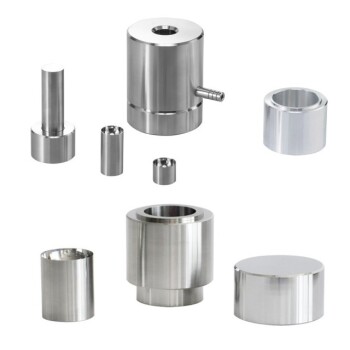
Compression molding utilizes a rigid mold cavity that defines the final dimensions of the composite structure. This allows engineers to place prefabricated Frequency Selective Surfaces (FSS) at precise vertical coordinates before the pressing cycle begins.
Because the material is compressed to a fixed volume, the internal layers remain trapped at their designated depths. This level of control is often superior to manual layup or spray-on techniques, where layer thickness can vary across the surface.
Facilitating Electromagnetic Resonance
The performance of a multilayer absorber depends on the resonant interaction between the FSS and the magnetic composite layers. The primary reference indicates that positioning the FSS at specific depths, like two-thirds of the total thickness, is necessary to broaden the absorption bandwidth.
If the FSS shifts during fabrication, the phase of the reflected wave changes, potentially ruining the interference-canceling effect. Compression molding provides the mechanical stability required to ensure this "tuning" remains consistent across the entire part.
Manufacturing Scalability and Versatility
Handling Large-Scale Components
This process is highly effective for producing large and relatively complex components, such as flat or slightly curved panels used in aerospace and defense. The use of high-pressure presses allows for the creation of expansive absorber sheets that maintain uniform density throughout.
Material Compatibility and Thermal Control
The process is compatible with a wide range of materials, including metals, fiberglass, and plastics. Depending on the specific magnetic composite used, the mold can be preheated or the platens can apply heat during the cycle to optimize the curing of the resin matrix.
This thermal control ensures that the magnetic particles within the composite are distributed evenly. Uniform distribution prevents "hot spots" or "dead zones" in the radio absorption profile.
Understanding the Trade-offs
Geometry and Design Limitations
While compression molding is excellent for flat or slightly curved surfaces, it struggles with highly complex 3D geometries or deep undercuts. Parts with intricate internal features may not receive even pressure distribution, leading to structural or electromagnetic inconsistencies.
Upfront Tooling Costs
The primary disadvantage is the requirement for custom-machined mold cavities. For low-volume prototyping, the cost of designing and fabricating these molds can be significant compared to additive manufacturing or simpler casting methods.
Cycle Time and Pressure Management
The process requires a specific "dwell time" under pressure to ensure the material fills the cavity and cures correctly. If the pressure is applied too rapidly, it can distort the FSS grid, leading to a shift in the frequency response of the final absorber.
Making the Right Choice for Your Goal
To determine if compression molding is the appropriate choice for your specific fabrication needs, consider the following strategic alignments:
- If your primary focus is broadband performance: Utilize compression molding to ensure the FSS layers are placed at the exact mathematical depths required for resonant phase cancellation.
- If your primary focus is industrial scalability: Use this method to produce large, repeatable panels where unit cost must be kept low through high-volume press cycles.
- If your primary focus is structural integrity: Leverage the high-pressure nature of the process to create dense, void-free magnetic composites that can withstand environmental stress.
Ultimately, compression molding serves as the bridge between theoretical electromagnetic design and reliable, high-performance physical hardware.
Summary Table:
| Technical Advantage | Key Impact on Performance | Ideal Context |
|---|---|---|
| Precise Vertical Control | Ensures exact FSS placement for resonant tuning | High-performance radar-absorbing materials |
| Structural Uniformity | Creates dense, void-free composites with even density | Aerospace and defense panels |
| Thermal Management | Optimizes resin curing and magnetic particle distribution | Homogeneous absorption profiles |
| Manufacturing Scalability | Repeatable production of large-scale components | Industrial-scale RAM fabrication |
Achieve Unmatched Precision with KINTEK Lab Pressing Solutions
Fabricating high-performance multilayer radio absorbers requires the highest level of mechanical control and vertical tolerance. KINTEK specializes in comprehensive laboratory pressing solutions designed to meet the rigorous demands of advanced materials science and battery research.
From manual and automatic models to heated, multifunctional, and glovebox-compatible systems—including advanced cold and warm isostatic presses—we provide the stability and control you need for precise layer integration and resonant tuning.
Why partner with KINTEK?
- Comprehensive Range: Selection of manual, automatic, and isostatic presses for any application.
- Optimized for Research: Solutions ideal for battery materials and electromagnetic composite development.
- Expert Engineering: Equipment built to maintain strict tolerances for consistent, high-bandwidth results.
Ready to elevate your fabrication process? Contact us today to find the perfect press for your lab!
References
- Vladimír Babayan, Robert Moučka. Optimized Frequency Selective Surface for the Design of Magnetic Type Thin Broadband Radio Absorbers. DOI: 10.12693/aphyspola.131.1147
This article is also based on technical information from Kintek Solution Knowledge Base .
Related Products
- Lab Isostatic Pressing Molds for Isostatic Molding
- Lab Polygon Press Mold
- Lab XRF Boric Acid Powder Pellet Pressing Mold for Laboratory Use
- Lab Anti-Cracking Press Mold
- Lab Round Bidirectional Press Mold
People Also Ask
- What is the purpose of incorporating cartridge heaters into a lab press mold for MLCC block compression? Optimize Results
- How do laboratory press machines resolve increased impedance in solid-state batteries? Achieve Low-Resistance Interfaces
- What is the function of an isostatic lab press in energy storage research? Achieve Superior Material Standardization
- How does controlling the parameters of a laboratory isostatic press contribute to reducing deformation in LTCC channels?
- Why is precise pressure holding and release control in laboratory isostatic presses critical? Maximize Food Integrity