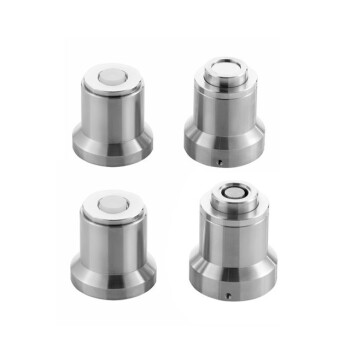
Specialized PTFE molds and threaded aluminum rods create a highly effective system for non-standard battery assembly by combining chemical stability with precise mechanical control. This configuration enables researchers to apply exact pressure loads—such as 200 KPa—to a battery stack while maintaining the flexibility needed to integrate sensor leads and monitor strain evolution.
The core value of this assembly method lies in its ability to decouple mechanical constraints from chemical interactions. By pairing the anti-adhesive nature of PTFE with the adjustable tension of aluminum rods, you gain a tunable physical model ideal for studying complex pressure gradients and internal battery mechanics.
Material Synergy and Chemical Compatibility
Leveraging PTFE Chemical Inertness
Polytetrafluoroethylene (PTFE) is selected primarily for its exceptional resistance to chemical reactivity. In a battery environment, it remains stable even when in contact with aggressive electrolytes, ensuring that the mold does not contaminate the electrochemical reaction.
Utilizing Anti-Adhesion Properties
The non-stick surface of PTFE is critical for non-standard assemblies where components might otherwise bond during cycling. This property ensures that the battery stack can be disassembled for post-mortem analysis without damaging the active materials or the mold itself.
Precision Mechanical Control
Achieving Precise Pressure Application
The integration of threaded aluminum rods provides a mechanism for fine-tuning the mechanical load on the battery stack. Unlike fixed clamps, the threading allows for incremental adjustments to reach specific pressure targets.
Maintaining Controlled Pressure Gradients
This setup is capable of sustaining defined pressures, such as 200 KPa, over the duration of an experiment. This stability is essential for studying how pressure affects the electrochemical performance and structural integrity of the cell.
Experimental Flexibility
Accommodating Sensor Integration
One of the distinct advantages of this non-standard assembly is the allowance for "flexible mechanical constraints." The mold design can be adapted to permit the insertion of sensor leads directly into the stack without compromising the seal or pressure uniformity.
Studying Strain Evolution
Because the mechanical constraints are adjustable, researchers can configure the physical model to isolate specific variables. This is particularly useful for observing strain evolution—how the battery materials expand and contract—under strictly controlled pressure conditions.
Understanding the Trade-offs
Thermal Expansion Mismatch
While PTFE is chemically superior, it has a significantly higher coefficient of thermal expansion than aluminum. In experiments involving temperature cycling, this mismatch could alter the effective pressure on the stack, requiring careful calibration.
Stiffness Limitations
PTFE is a relatively soft polymer compared to metals. When applying high pressures via aluminum rods, there is a potential for the mold to creep or deform over time, which could lead to a loss of pressure precision in long-term experiments.
Making the Right Choice for Your Goal
This assembly method is not a universal solution, but rather a specialized tool for detailed mechanical and electrochemical investigation.
- If your primary focus is mechanical characterization: This setup is ideal for isolating the effects of external pressure (e.g., 200 KPa) on internal strain and cell performance.
- If your primary focus is in-situ monitoring: Use this configuration to safely route sensor leads into the cell while maintaining a chemically inert environment.
By balancing the rigidity of aluminum with the inert flexibility of PTFE, you create a controlled environment capable of revealing the subtle mechanical dynamics of battery operation.
Summary Table:
| Component | Primary Function | Technical Advantage |
|---|---|---|
| PTFE Mold | Chemical Containment | Inert to electrolytes; non-stick surface for post-mortem analysis |
| Aluminum Rods | Mechanical Load | Threaded design allows for fine-tuned, incremental pressure (e.g., 200 KPa) |
| Sensor Ports | In-situ Monitoring | Flexible constraints permit lead integration for strain evolution study |
| Material Synergy | Dynamic Modeling | Decouples mechanical constraints from chemical interactions |
Elevate Your Battery Research with KINTEK Precision
Maximize your experimental accuracy with KINTEK’s industry-leading laboratory pressing solutions. Whether you are studying strain evolution or pressure gradients, our range of manual, automatic, heated, and glovebox-compatible presses, alongside our specialized cold and warm isostatic presses, provide the exact mechanical control your non-standard assemblies require.
Why choose KINTEK?
- Versatility: Solutions tailored for comprehensive battery research and material science.
- Precision: Maintain stable pressure environments for sensitive electrochemical testing.
- Expertise: Specialized equipment designed to work seamlessly with chemically inert molds.
Ready to optimize your lab’s workflow? Contact KINTEK today to find your perfect pressing solution!
References
- Hongye Zhang, Fenghui Wang. Unraveling plating/stripping-induced strain evolution <i>via</i> embedded sensors for predictive failure mitigation in solid-state Li metal batteries. DOI: 10.1039/d5sc03046c
This article is also based on technical information from Kintek Solution Knowledge Base .
Related Products
- Lab Button Battery Disassembly and Sealing Mold
- Lab Button Battery Tablet Press Sealing Mold
- Lab Cylindrical Press Mold for Laboratory Use
- Carbide Lab Press Mold for Laboratory Sample Preparation
- Lab Infrared Press Mold for Laboratory Applications
People Also Ask
- How does a sealed battery mold facilitate the assembly and testing of asymmetric supercapacitors using VO2?
- What is the function of specialized battery molds and sealing consumables? Optimize Your In-situ XRD Testing Today
- How does the geometry of laboratory molds influence mycelium-based composites? Optimize Density and Strength
- Why are specialized battery test molds used? Ensure Peak Performance for All-Solid-State Sodium Batteries (ASSIBs)
- What role do battery testing molds play in electrolyte performance? Exploring Pressure vs. Viscoelasticity