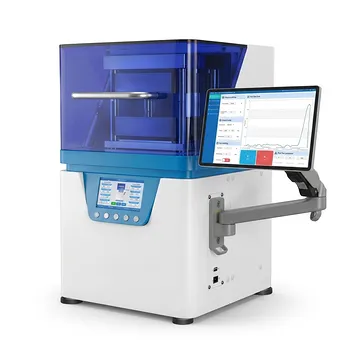
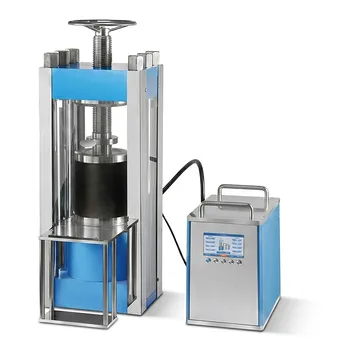
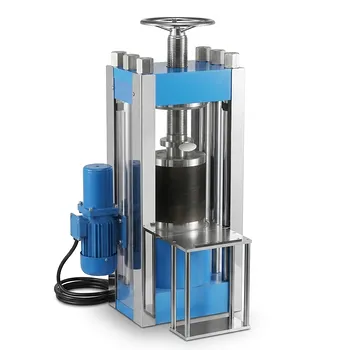
Precise temperature control is the primary determinant of success in holographic hot embossing. To achieve high-fidelity replication, a laboratory press must be stabilized at exactly 5°C to 10°C above the glass transition temperature (Tg) of the substrate material.
High-contrast holographic effects depend on maintaining a specific viscoelastic state. By precisely controlling the heat relative to the material's Tg, the polymer can flow into micron-level diffraction gratings under minimal pressure.
The Critical Link Between Temperature and Glass Transition ($T_g$)
Defining the Thermal Sweet Spot
The glass transition temperature ($T_g$) is the point where a polymer shifts from a hard, glassy state to a soft, rubbery state.
Setting the press 5°C to 10°C above this threshold ensures the material is pliable enough to be molded but stable enough to retain its structural integrity.
Achieving the Viscoelastic State
At this specific temperature range, the material enters a viscoelastic state, which is essential for anti-counterfeiting applications.
In this state, the polymer gains the fluid-like properties necessary to accurately fill the micron-level patterns on the metal mold without the need for excessive force.
Mastering Micro-Scale Replication
Filling Micron-Level Diffraction Gratings
Holographic labels rely on diffraction gratings—microscopic ridges that manipulate light to create visual depth and color shifts.
Precise heat ensures these tiny cavities are filled completely, which is the only way to achieve the high-contrast optical effects required for security labels.
The Role of Low-Pressure Molding
Because the temperature is optimized for flow, the laboratory press can operate at lower pressures.
This reduces wear on the expensive metal master molds and prevents the deformation of the underlying substrate during the embossing cycle.
Technical Capabilities of Laboratory Presses
Broad Operational Range
Modern laboratory presses are designed to handle a wide variety of polymers, typically offering a control range from 100°F to 600°F.
This versatility allows researchers to work with everything from low-temp specialized films to high-performance industrial plastics.
Precision and Stability Requirements
The hardware must not only reach the target temperature but maintain it with extreme stability across the entire surface of the platens.
Even minor fluctuations can lead to "ghosting" or uneven brightness in the holographic image, compromising the label's anti-counterfeiting utility.
Understanding the Trade-offs and Pitfalls
The Risk of Insufficient Heat
If the temperature falls below the $T_g$ + 5°C threshold, the polymer will not flow sufficiently into the mold.
This results in shallow depth of replication, leading to dull, low-contrast holograms that fail to meet security standards.
The Danger of Excessive Heat
Exceeding the recommended temperature range can cause the polymer to degrade or stick to the metal mold.
Overheating often leads to "stringing" or thermal distortion, which destroys the fine diffraction patterns and can permanently damage the master tool.
Implementing Thermal Controls for Your Project
Choosing the Correct Settings
To ensure the highest quality results for your holographic labels, tailor your temperature settings to your specific material properties.
- If your primary focus is Maximum Optical Clarity: Ensure the press is calibrated to exactly 10°C above the $T_g$ to minimize flow resistance and maximize grating depth.
- If your primary focus is Mold Longevity: Aim for the lower end of the window (5°C above $T_g$) and utilize a longer dwell time to allow the material to settle without excessive heat.
- If your primary focus is High-Throughput Testing: Prioritize a press with rapid thermal recovery times to ensure consistency between successive embossing cycles.
The marriage of precise thermal management and material science is what transforms a simple plastic film into a sophisticated security device.
Summary Table:
| Parameter | Target Requirement | Impact on Quality |
|---|---|---|
| Temperature | $T_g$ + 5°C to 10°C | Ensures polymer flows into micron-level gratings |
| Pressure | Low to Moderate | Protects expensive metal molds from wear |
| Thermal Stability | High (Uniform Platens) | Prevents ghosting and uneven image brightness |
| Material State | Viscoelastic | Allows precise replication with minimal force |
Elevate Your Precision Research with KINTEK Solutions
Achieve flawless holographic replication and material consistency with KINTEK. We specialize in comprehensive laboratory pressing solutions tailored for high-stakes research. Our range includes:
- Heated & Multifunctional Presses: Engineered for the extreme thermal stability required for $T_g$ optimization.
- Manual & Automatic Models: Versatile options for various throughput needs.
- Glovebox-Compatible & Isostatic Presses (CIP/WIP): Ideal for advanced battery research and specialized material science.
Don't settle for dull results or damaged molds. Contact KINTEK today to find the perfect pressing solution for your laboratory’s unique requirements.
References
- Denis Mihaela Panaitescu, Mona Mihăilescu. Proposal of a Biobased and Biodegradable Polymer as a Hot Embossing Substrate for Holographic Security Marks Fabrication. DOI: 10.1002/pat.6626
This article is also based on technical information from Kintek Solution Knowledge Base .
Related Products
- 24T 30T 60T Heated Hydraulic Lab Press Machine with Hot Plates for Laboratory
- Automatic Large Format Laboratory Heated Hydraulic Press 400x400mm Plate Capacity
- Automatic Heated Hydraulic Lab Press Machine 200x200 Plate Size for Battery Research and Materials Science
- Automatic Heated Hydraulic Lab Press with Programmable Touch Screen Controls and Precision Temperature Regulation
- Heated Hydraulic Press Machine with Heated Plates for Vacuum Box Laboratory Hot Press
People Also Ask
- Function of a Laboratory Hydraulic Press with Heated Platens in SSE? Enhance Battery Density & Conductivity
- Why is a laboratory hydraulic press with heating plates required for PLA/TEC films? Achieve Precise Sample Integrity
- What role does a laboratory heated hydraulic press play in LTCC? Essential for High-Density Ceramic Lamination
- Why reduce load when applying composite strengthening tabs? Protect Specimen Integrity and Data Accuracy
- Why is a laboratory heated hydraulic press utilized during the lamination stage of NASICON green tapes?