
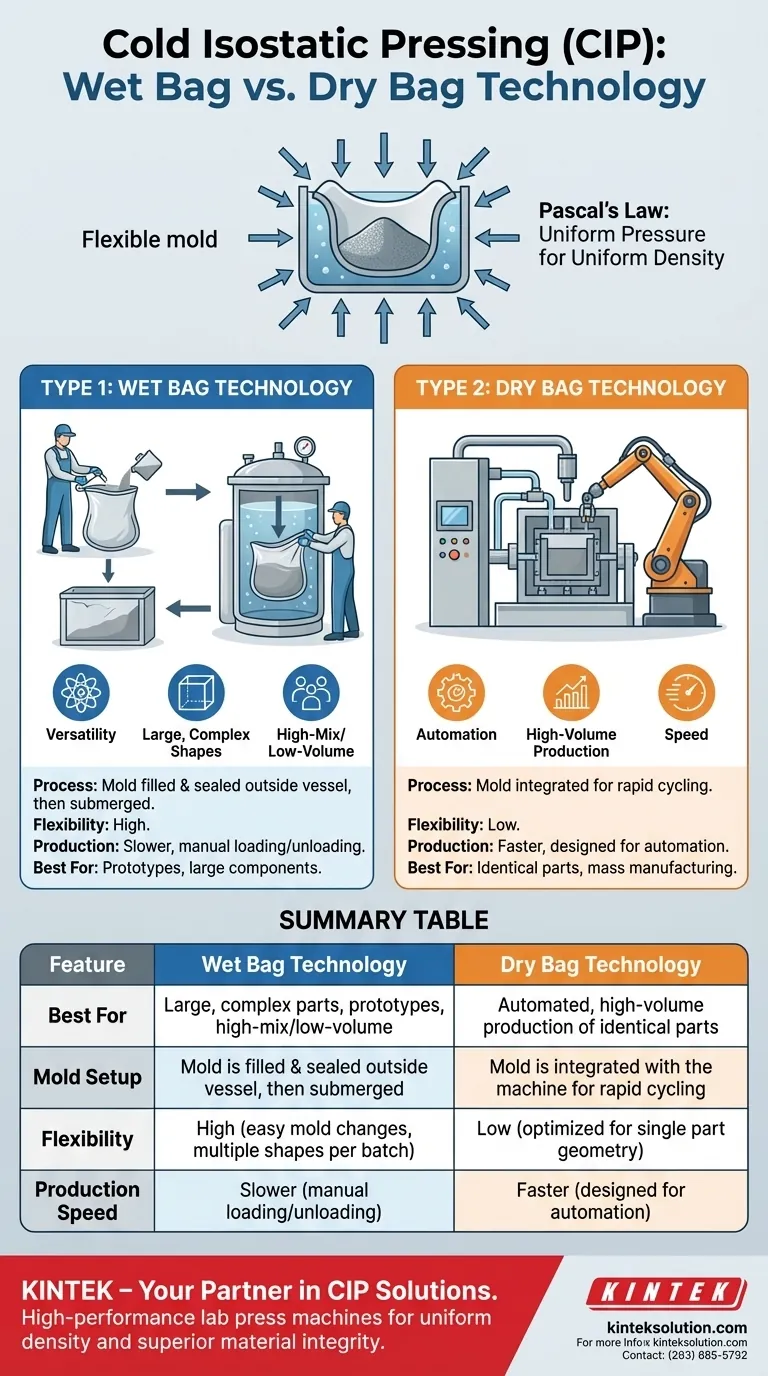
The two primary categories of Cold Isostatic Pressing (CIP) are Wet Bag Technology and Dry Bag Technology. While both methods utilize fluid dynamics to compact powder into uniform solids, they differ fundamentally in how the mold interacts with the pressure vessel. This distinction determines whether the process is best suited for highly customized, complex shapes or automated, high-volume production.
Core Insight: Cold Isostatic Pressing achieves uniform material density by applying pressure from all directions. Your choice of method depends entirely on your production scale: Wet Bag is for versatility and large, complex parts, while Dry Bag is engineered for speed and automation.
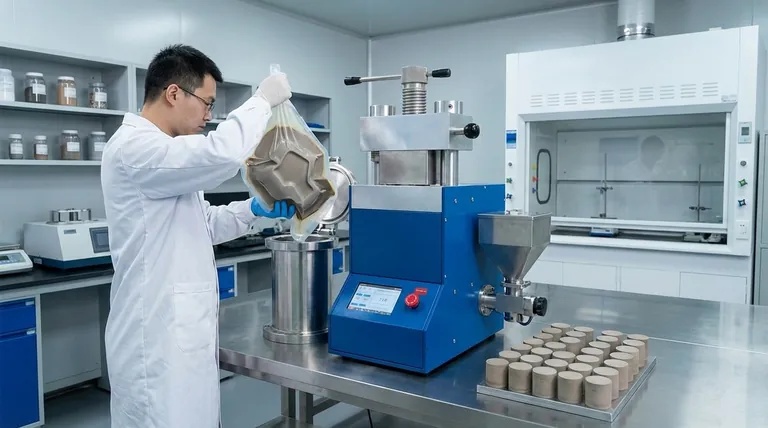
The Mechanics of Isostatic Pressing
The Underlying Principle
CIP relies on Pascal’s Law, which states that pressure applied to a confined fluid is transmitted equally in all directions. In this process, powder is placed into a flexible elastomer mold (rubber or plastic) which has low resistance to deformation.
Achieving Uniform Density
The mold is subjected to high pressure using a liquid medium, such as water, oil, or a glycol mixture. Because the pressure is applied evenly from every angle, the resulting "green" (raw) part creates a uniform density structure. This eliminates the internal stress often found in traditional uniaxial pressing.
Type 1: Wet Bag Technology
The Process
In the Wet Bag method, the powder is filled into a flexible mold which is then tightly sealed outside of the pressure vessel. This sealed mold is completely submerged directly into the pressure fluid inside the vessel.
Flexibility and Scale
This method is highly versatile. Because the mold is independent of the vessel, you can press multiple shapes and sizes simultaneously, provided they fit within the chamber. It is the ideal solution for producing large, complex shapes or experimental parts where geometry changes frequently.
Type 2: Dry Bag Technology
The Process
Dry Bag technology is designed to streamline the interaction between the mold and the pressure vessel. While the fundamental compaction physics remain the same, this setup is engineered to integrate the mold filling and pressurization steps more tightly with the machine's operation.
Focus on Automation
This method is specifically "better suited for automation and high production rates." It is designed for longer production runs of identical parts. If your goal is mass manufacturing rather than prototyping or high-mix low-volume runs, Dry Bag is the standard choice.
Understanding the Trade-offs
Cycle Time vs. Versatility
Wet Bag processing is generally slower due to the manual nature of filling, sealing, and loading individual molds. However, it offers unmatched freedom to process different components in a single batch.
Setup Costs vs. Throughput
Dry Bag processing allows for rapid cycling and automation, significantly reducing the cost per unit on large runs. The trade-off is reduced flexibility; changing the component geometry usually requires more significant downtime or tooling changes compared to the simple mold swap of the Wet Bag process.
Making the Right Choice for Your Goal
To select the correct CIP method, you must evaluate your volume requirements and geometric complexity.
- If your primary focus is High-Mix/Low-Volume Production: Choose Wet Bag Technology to accommodate varying shapes, large components, or prototype runs without expensive tooling changes.
- If your primary focus is Mass Production: Choose Dry Bag Technology to leverage automation capabilities and achieve high throughput for standardized components.
Ultimately, both methods deliver the superior material integrity and density uniformity that define Cold Isostatic Pressing, differing only in their operational efficiency.
Summary Table:
| Feature | Wet Bag Technology | Dry Bag Technology |
|---|---|---|
| Best For | Large, complex parts, prototypes, high-mix/low-volume | Automated, high-volume production of identical parts |
| Mold Setup | Mold is filled & sealed outside vessel, then submerged | Mold is integrated with the machine for rapid cycling |
| Flexibility | High (easy mold changes, multiple shapes per batch) | Low (optimized for single part geometry) |
| Production Speed | Slower (manual loading/unloading) | Faster (designed for automation) |
Need a reliable lab press for your Cold Isostatic Pressing applications? KINTEK specializes in high-performance lab press machines, including isostatic presses, designed to meet the precise demands of laboratory environments. Whether you're prototyping complex shapes with Wet Bag technology or scaling up production with Dry Bag systems, our expertise ensures you achieve uniform density and superior material integrity. Contact us today to discuss how our solutions can optimize your CIP process!
Visual Guide
Related Products
- Electric Lab Cold Isostatic Press CIP Machine
- Electric Split Lab Cold Isostatic Pressing CIP Machine
- Automatic Lab Cold Isostatic Pressing CIP Machine
- Manual Cold Isostatic Pressing CIP Machine Pellet Press
- Lab Isostatic Pressing Molds for Isostatic Molding
People Also Ask
- What are the applications of electric lab cold isostatic presses in research settings? Advance Material R&D with High-Pressure CIPs
- What role do electric lab cold isostatic presses play in industrial contexts? Bridge R&D and Manufacturing with Precision
- How does electrical Cold Isostatic Pressing (CIP) contribute to cost savings? Unlock Efficiency and Reduce Expenses
- What are some research applications of electric lab CIPs? Unlock Uniform Powder Densification for Advanced Materials
- What are the characteristics of standard off-the-shelf electric lab CIP solutions? Achieve Immediate, Cost-Effective Processing
















